
Home » Density of HDPE Sheet: Typical Values and Why They Matter
Density of HDPE Sheet: Typical Values and Why They Matter
- Author: Balance Lee
- 9+ Years of Manufacturing
When choosing an HDPE sheet, the most buyers compare thickness, size, and price first. However, density is also an important material property because it helps explain differences in sheet weight, rigidity, and suitability for different working conditions.
For solid HDPE sheets, the density range is around 0.93–0.97 g/cm³, depending on resin grade, material formulation, additives, and manufacturing conditions. A higher or lower density value does not directly mean better or worse performance. It needs to be evaluated together with the application requirements and other material properties.
Based on our experience producing HDPE sheets for cutting boards, equipment liners, ground protection mats, and custom machined components, customers frequently ask why two sheets with the same thickness can have different weights and how density should be considered during material selection.
In the following sections, we will look at how HDPE density is defined, why density values vary, and how you can use this information when reviewing material specifications.
Table of Contents
What Is the Density of HDPE Sheet?
Before comparing different density values, it is important to understand what density actually represents in an HDPE sheet. This value is not only related to the weight of the material, but also reflects differences in polymer structure and material composition.
Knowing the basic density range and how manufacturers describe this parameter can help you avoid confusion when comparing HDPE sheets from different suppliers. The following sections explain the typical density range, unit conversions, and why a specific material datasheet should be considered when evaluating HDPE grades.

Typical Density Range and Unit Conversions
For many solid HDPE sheet grades, density values are found in the approximate range of 0.93–0.97 g/cm³, depending on resin grade, formulation, and manufacturing process. In engineering applications, many standard HDPE grades are close to 0.95 g/cm³, which serves as a reference value for estimating sheet weight.
The same density can be expressed in different units:
- 0.95 g/cm³
- 950 kg/m³
These two values represent the same material property, just with different measurement systems.
For example, if an HDPE sheet has a size of 1000 × 2000 × 10 mm, its volume is:
1 m × 2 m × 0.01 m = 0.02 m³
Using a density of 950 kg/m³, the theoretical weight calculation is:
0.02 m³ × 950 kg/m³ = 19 kg
During actual production, the final weight may have a small variation because of factors such as thickness tolerance, surface texture, and manufacturing conditions.
From our production experience, customers sometimes compare suppliers only by the quoted sheet weight. However, a weight difference should always be reviewed together with thickness tolerance, material grade, and whether the sheet is made from virgin or modified material. A slightly different weight does not necessarily indicate a different quality level.
Why a Grade Datasheet Takes Priority Over a Generic Value
A general density range is useful for understanding HDPE, but it should not replace the technical data of a specific material grade.
HDPE is not one single material with identical properties. Different resin grades can have differences in molecular weight, molecular structure, additives, and processing characteristics. These differences in molecular structure, formulation, and processing conditions can influence density as well as other properties such as impact resistance, stiffness, wear behavior, and chemical resistance.
For example, two HDPE sheets may both fall within the typical density range, but they may be designed for different purposes:
- A food-grade HDPE sheet may focus on cleanliness, regulatory compliance, and stable processing.
- An industrial liner sheet may require better impact resistance and wear performance.
- A machined component may need a balance between dimensional stability and processing performance.
In our experience supplying HDPE sheets, customers often start with a general density value when comparing materials. However, we evaluate material selection based on the complete specification, including grade information, processing requirements, and the intended application.
A material datasheet provides more complete information, including density, tensile properties, impact strength, hardness, and temperature limits. This allows buyers to make decisions based on actual working conditions rather than a single number.
What Does HDPE Density Tell You About the Material?
After understanding the basic density range of HDPE sheets, the next question is how this value relates to actual material performance.
Density provides useful information about the internal structure of HDPE, but it should not be viewed as a single indicator that determines all properties. It can help explain differences in weight, stiffness, and material behavior, while other factors such as molecular structure, thickness, additives, and processing conditions also play important roles.
The following sections will look at how HDPE density is connected with key material characteristics and why density needs to be evaluated together with the requirements of the final application.
Molecular Branching, Crystallinity, and Stiffness
The density of HDPE is closely connected with its molecular structure. Two factors are especially important when explaining why different HDPE grades have different density values: molecular branching and crystallinity.
1. Molecular Branching Affects Molecular Packing
HDPE has a relatively linear molecular structure with fewer side branches compared with lower-density polyethylene materials.
With fewer branches, polymer chains can pack more closely together. This tighter arrangement contributes to higher density and helps improve structural stability.
In simple terms:
- More linear molecular chains → tighter packing
- Tighter packing → higher density
- Higher density structure → increased stiffness potential
However, density is only one part of the material structure. The final performance also depends on resin grade, molecular weight, additives, and processing conditions.
2. Crystallinity Influences Rigidity
Crystallinity describes how much of the polymer structure forms an orderly arrangement of molecular chains.
A higher crystallinity level can contribute to:
- Higher stiffness
- Better dimensional stability
- Improved hardness
In practical HDPE sheet applications, this is one reason why materials with similar density values may still show different behavior. For example, two sheets with close density values may perform differently during CNC machining, cutting, or long-term load conditions because their molecular structure and formulation are not identical.
This means density can provide a useful reference, but it does not fully describe how an HDPE grade will perform in a specific application.
3. Higher Density Is Not Always the Best Choice
During material selection, the goal is not simply to choose the HDPE sheet with the highest density.
For example:
- Equipment liners: A balance of stiffness, impact resistance, and wear performance is usually more important.
- Ground protection mats: Toughness and load distribution capability may have a greater influence on performance.
- Machined components: Dimensional stability and processing behavior need to be considered.
From our production experience, customers sometimes compare HDPE sheets only by density. In practice, we evaluate density together with thickness, material grade, and working conditions to select the most suitable solution.
Density vs Strength, Hardness, and Chemical Resistance
Density can provide useful information about HDPE, but it should not be interpreted as a direct measurement of all material properties. Strength, hardness, and chemical resistance are influenced by multiple factors, including molecular structure, material grade, thickness, and processing conditions.
Density and Strength
A higher-density HDPE structure may contribute to better stiffness because polymer chains are packed more tightly. However, load-bearing performance depends heavily on factors beyond density.
For example, a thicker HDPE sheet with a slightly lower density may provide better resistance to bending or impact than a thinner sheet with a higher density.
When evaluating strength for an application, factors such as:
- Sheet thickness
- Applied load
- Support conditions
- Impact frequency
are more important than density alone.
Density and Hardness
Hardness is related to how the material resists surface deformation. A higher crystallinity level, which is often associated with higher density, can contribute to increased hardness.
This can be beneficial for applications where the surface needs to resist wear, such as:
- Equipment liners
- Wear strips
- Sliding components
However, excessive hardness is not always the target. Some applications require a balance between surface durability and impact absorption.
Density and Chemical Resistance
HDPE already has strong resistance to many chemicals due to its non-polar molecular structure. Within the normal range of HDPE density variations, a small change in density does not automatically create a significant difference in chemical resistance.
For chemical applications, the more important factors include:
- Chemical type
- Operating temperature
- Exposure time
- Material grade
Therefore, density can help explain certain material differences, but the chemical environment should always be considered when selecting an HDPE sheet.
Why Does HDPE Sheet Density Vary?
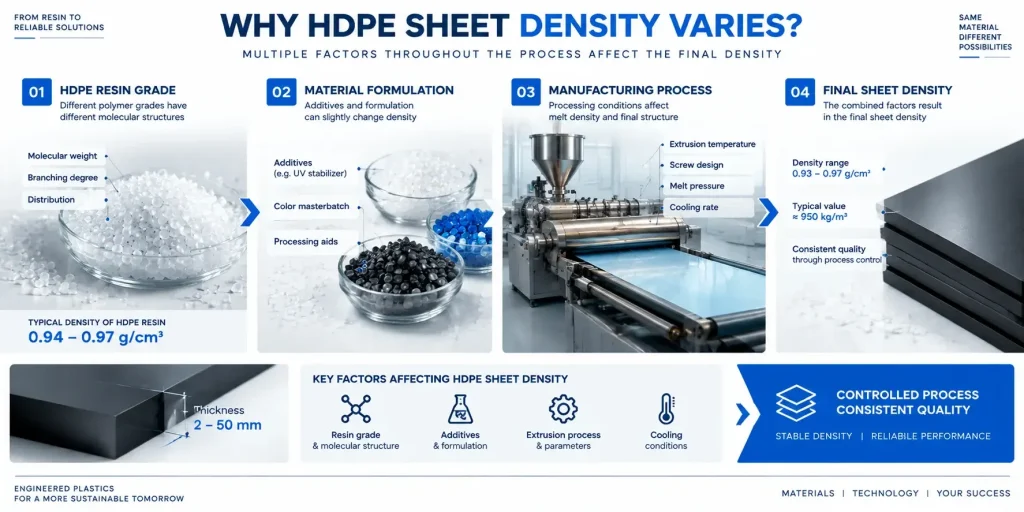
After understanding how density relates to HDPE performance, the next question buyers pay attention to is why different HDPE sheets do not always have the same density value.
Although HDPE is a specific type of polyethylene, the final sheet properties can change depending on the resin grade, molecular structure, additives, and manufacturing process. These differences are part of the reason why two HDPE sheets with similar specifications may show variations in weight, stiffness, or processing behavior.
The following sections will explain the main factors that influence HDPE sheet density and how these factors should be considered when comparing materials from different suppliers.
Resin Grade and Manufacturing Route
The density of an HDPE sheet is strongly influenced by the resin grade selected for production and the way the material is processed.
HDPE is not produced from one single resin type. Different grades can have differences in molecular weight, molecular chain structure, and processing characteristics. These differences affect how tightly polymer chains pack together, which can influence the final density of the sheet.
The manufacturing route also plays an important role. Factors such as extrusion conditions, cooling control, and process stability can affect the final structure and consistency of the material.
In practical production, two HDPE sheets with similar thickness and appearance may still have slightly different density values because they are produced with different resin specifications or process conditions.
For material selection, density differences should be reviewed together with the required performance, such as stiffness, impact resistance, wear behavior, and machining requirements, rather than comparing density values alone.
Carbon Black, Pigments, Fillers, and Recycled Content
The material formulation can also influence HDPE sheet density. In addition to the base resin, manufacturers may add color pigments, carbon black, fillers, or recycled material depending on the required application.
Carbon black and pigments are mainly used to achieve specific colors or improve properties such as UV resistance. At normal addition levels, their influence on density is limited, but different formulations can still create measurable differences.
Fillers have a more direct effect because their own density may differ from pure HDPE resin. Adding mineral fillers, for example, can increase the overall density while changing other properties such as stiffness and impact behavior.
Recycled content can also influence density because recycled materials may come from different sources and have different compositions. The final effect depends on the recycled material quality, proportion, and formulation control.
In production, we evaluate these factors together rather than looking at density alone. A higher density caused by additives does not automatically mean the material will perform better for a specific application.
Temperature, Conditioning, and Test Method
Density measurements are also affected by how the test is performed. Although HDPE density is a material property, the measured value can vary slightly depending on temperature, sample preparation, and testing conditions.
Temperature is one factor that needs attention because polymer materials can expand or contract with changes in temperature. A density test performed under different conditions may produce slightly different results.
Conditioning refers to allowing the test sample to reach a controlled environment before measurement. This helps reduce the influence of moisture, temperature differences, and internal stress from processing.
The test method itself also matters. Different standards and procedures may define different sample preparation and measurement requirements.
When comparing HDPE density data from different suppliers, it is important for you to check not only the numerical value but also:
- The test method used;
- The material grade;
- The testing conditions.
This helps ensure that the comparison is based on equivalent information.
How Is HDPE Density Measured?
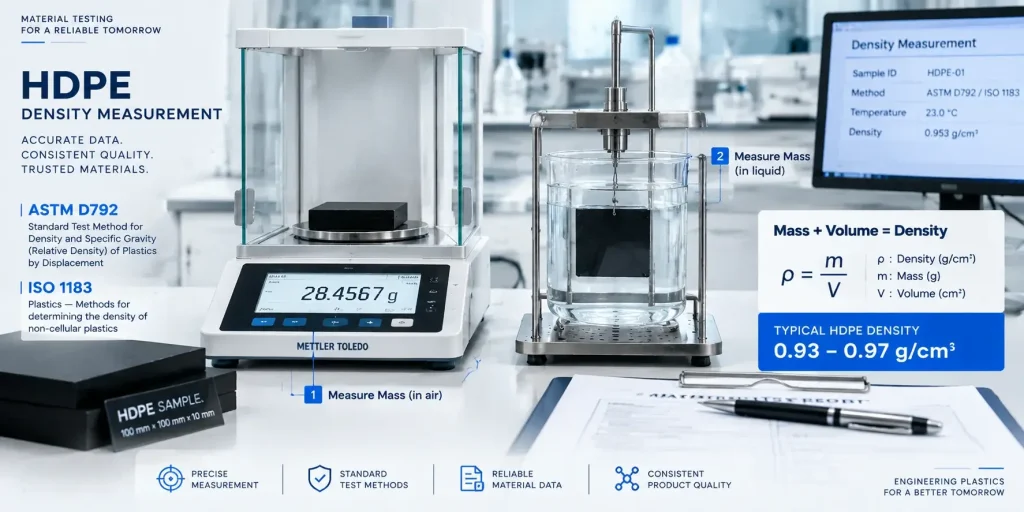
Measuring HDPE density requires more than simply checking the weight of a sheet. The value is determined through the relationship between the material’s mass and volume, using controlled testing methods to achieve a reliable result.
For buyers comparing HDPE sheets from different suppliers, understanding the basic measurement principle helps explain why reported density values may have small differences and what information should be checked when reviewing technical data.
ASTM D792 and ISO 1183 Basics
The density of HDPE can be measured according to recognized testing standards, with ASTM D792 and ISO 1183-1 being two referenced methods for plastics density measurement.
Both methods are based on the same basic principle: determining the relationship between the mass of a sample and its volume. ASTM D792 is based on a displacement method for determining density, while ISO 1183-1 provides procedures for measuring the density of plastics using methods such as immersion, liquid pycnometer, or titration depending on the test approach. In practice, the sample weight is measured first, and the volume is determined through a controlled testing procedure to calculate the material density.
Although the testing principles are similar, the detailed procedures, equipment requirements, and reporting conditions may vary depending on the standard followed.
When reviewing HDPE material data, you should pay attention not only to the density value itself but also to:
- The testing standard used
- The material grade tested
- The testing conditions and sample preparation
A density value without test information may not provide enough context for comparing different HDPE materials. Density and relative density are related concepts but are not identical. Density is expressed with units such as g/cm³ or kg/m³, while relative density is a ratio compared with a reference material and does not have a unit.
In engineering plastic applications, density data is frequently used as one reference point together with other properties such as tensile strength, impact resistance, hardness, and temperature performance.
Common Sampling and Reporting Errors
When comparing HDPE density data, several common mistakes can lead to inaccurate conclusions. The following points summarize the issues that you should pay attention to during material evaluation:
| Common Error | Why It Happens | How to Avoid |
|---|---|---|
| Comparing density values from different HDPE grades | Different grades may have different molecular structures, formulations, and performance targets. | Check the material grade and application requirements before comparing density data. |
| Ignoring sample preparation conditions | Temperature changes and internal stress from processing may influence measurement results. | Confirm that samples are tested under comparable conditions. |
| Comparing density numbers without checking the test method | Different standards or testing procedures may produce data under different conditions. | Review the testing standard and report details together with the density value. |
| Judging material quality only by density | Density does not fully represent strength, impact resistance, wear performance, or processing behavior. | Evaluate density together with other technical properties and actual working conditions. |
How Do You Calculate HDPE Sheet Weight From Density?
Once the density value of an HDPE material is known, it can be applied to practical calculations, especially when estimating sheet weight for purchasing, transportation, and project planning.
The relationship between density, volume, and weight allows you to calculate the approximate weight of an HDPE sheet before production. This provides a useful reference when comparing material options, checking shipping requirements, or determining handling methods.
However, the calculated value represents a theoretical weight. Actual sheet weight may vary slightly due to factors such as thickness tolerance, surface texture, and manufacturing conditions.
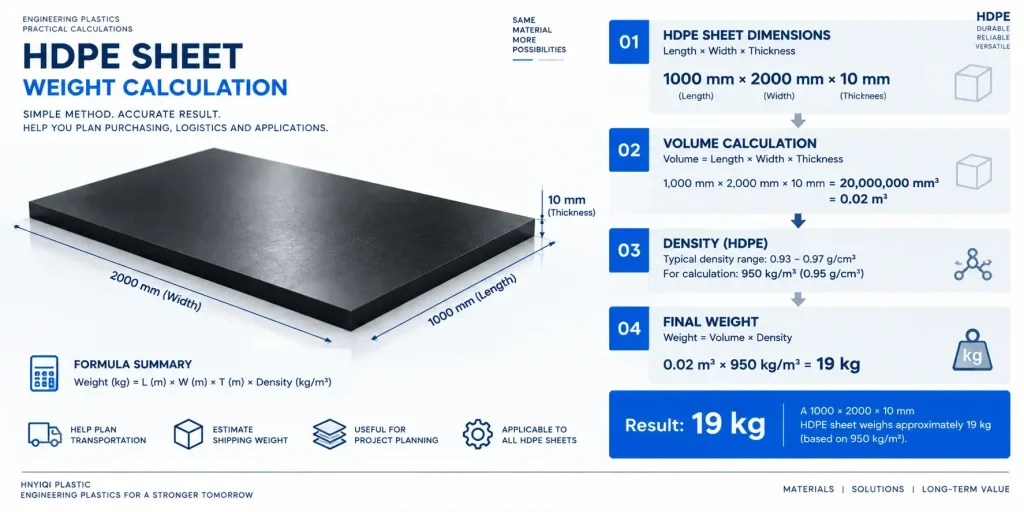
Weight Formula for Length, Width, and Thickness
The weight of an HDPE sheet can be estimated by using the relationship between volume and density.
The basic formula is:
Weight = Volume × Density
Since the volume of a sheet is calculated from its length, width, and thickness:
Volume = Length × Width × Thickness
For metric calculations, the dimensions need to be converted into meters before calculation.
For example:
- Length: 2000 mm = 2 m
- Width: 1000 mm = 1 m
- Thickness: 10 mm = 0.01 m
Volume:
2 × 1 × 0.01 = 0.02 m³
If the HDPE density is:
950 kg/m³
The estimated weight is:
0.02 × 950 = 19 kg
This calculation provides an estimated value before production. The actual weight should be checked against the final manufactured sheet.
Worked Metric and Imperial Examples
The calculation method is the same whether dimensions are provided in metric or imperial units. The key is keeping the units consistent throughout the calculation.
Metric Example
HDPE sheet:
- Size: 1000 × 2000 × 10 mm
- Density: 950 kg/m³
Estimated weight:
1 × 2 × 0.01 × 950 = 19 kg
Imperial Example
HDPE sheet:
- Size: 4 ft × 8 ft × 0.5 in
- Density: approximately 59.3 lb/ft³ (equivalent to about 0.95 g/cm³)
Estimated weight:
4 × 8 × (0.5 ÷ 12) × 59.3 ≈ 79 lb
The examples above show the theoretical calculation method. In commercial projects, this estimation is useful for you to check approximate shipment weight, container loading, and handling requirements.
Why Actual Weight May Differ From the Estimate
The formula provides a useful estimate, but the final manufactured weight may not be exactly the same as the calculated value.
Several factors can create small differences:
1. Thickness Tolerance Changes the Material Volume
The weight calculation is based on the nominal thickness, such as 10 mm or 20 mm.
However, HDPE sheets are produced within a thickness tolerance range. If the actual thickness is slightly higher than the nominal value, the sheet contains more material and the final weight increases accordingly.
For example:
A 1000 × 2000 × 10 mm HDPE sheet with a density of 950 kg/m³ has a theoretical weight of approximately 19 kg.
If the actual thickness is 10.2 mm, the same calculation method would result in an estimated weight of approximately 19.38 kg instead of 19 kg, assuming the same density and sheet dimensions.
2. Surface Texture Changes the Actual Material Volume
The calculation formula assumes a flat and smooth sheet surface.
However, HDPE sheets may have different surface designs, such as:
- Embossed texture
- Grid pattern
- Anti-slip surface
These surface structures slightly change the actual material volume compared with a completely flat sheet.
For applications where weight calculation is important, the surface design should be considered.
3. Different Material Grades Have Different Density Values
The calculation uses a selected density value, such as 0.95 g/cm³, as a reference.
However, actual HDPE grades may have different density values depending on:
- Virgin resin grade
- Material formulation
- Additives
- Recycled content
Even a small density difference can affect the final weight when the sheet size is large.
4. Production conditions
During production, factors such as cooling conditions, dimensional control, and measurement methods can influence the final reported size and weight.
For example, a sheet measured immediately after production may have slightly different dimensions compared with a sheet measured after reaching a stable condition.
HDPE vs LDPE, LLDPE, UHMWPE, PP, and PVC Density
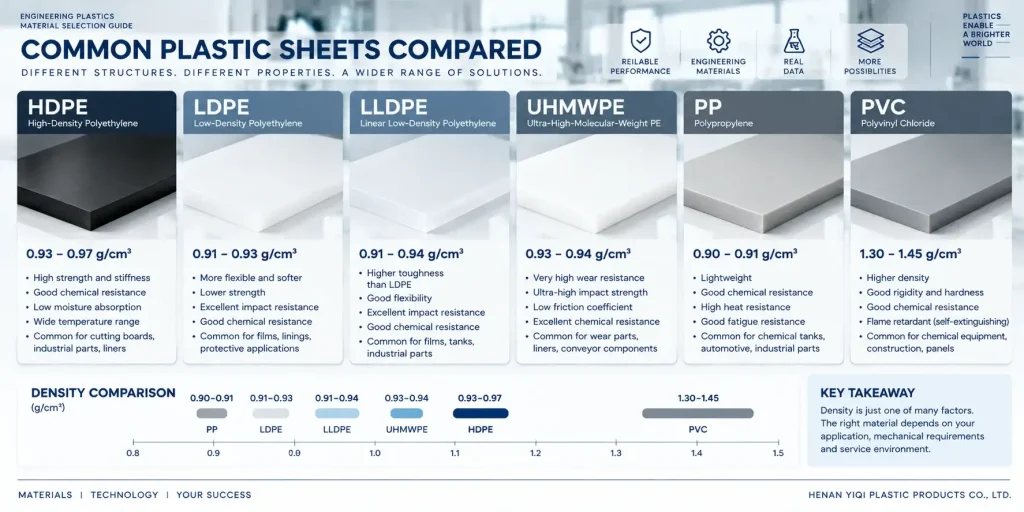
Density becomes more meaningful when HDPE is compared with other engineering plastics. Although several plastic materials may look similar in sheet form, differences in molecular structure lead to variations in density, stiffness, flexibility, and application performance.
For material selection, density can help buyers understand the general characteristics of different plastics, but it should not be used as the only factor for choosing a material. The final decision depends on the required mechanical properties, working environment, and processing requirements.
The following comparison provides a reference for understanding where HDPE stands among widely selected plastic sheet materials and why different applications require different material choices.
When Density Helps With Material Identification
Density can be a useful first reference when identifying an unknown plastic material, especially when comparing materials with clearly different density ranges.
For example:
- LDPE and LLDPE have lower density values and more flexible characteristics compared with HDPE.
- HDPE and UHMWPE have similar density ranges, which means density alone cannot easily separate these two materials.
- PVC and PP have different density characteristics due to their different molecular structures and compositions.
In practical material evaluation, density can help narrow down possible material types before further testing.
For example, if a sample has a density close to the typical HDPE range, it may indicate that the material belongs to a polyethylene family. However, additional information such as hardness, mechanical properties, chemical resistance, or supplier documentation is still needed for confirmation.
Density works best as a screening tool, helping engineers reduce possibilities before making a final material decision.
Why Density Alone Cannot Confirm a Grade
Although density provides useful information, it cannot fully identify a specific HDPE grade.
Different HDPE grades can have similar density values while being designed for different performance requirements. The differences may come from factors such as molecular weight, molecular structure, additives, and manufacturing process.
For example, two HDPE sheets may both have a density close to 0.95 g/cm³, but one may be optimized for:
- Wear resistance in industrial liners
- Food-contact applications
- Machining stability for precision components
Their density values may look similar, but their performance characteristics and recommended uses can be different.
This is why professional material selection relies on more than one parameter. A complete evaluation may include:
- Material datasheet
- Mechanical properties
- Application requirements
- Processing method
In production and material supply, density is an important reference value, but the material grade is determined by the complete specification behind that number.
How Should Buyers Use Density in a Specification?
Density can be a useful specification parameter, but it needs to be defined correctly to avoid misunderstandings during purchasing.
A single density value is not enough to describe an HDPE sheet. For a complete material requirement, buyers should consider how density relates to the required application, material grade, and quality control process.
When preparing a technical specification, density can be used as a reference range, a verification parameter, or part of the acceptance criteria. The following section explains how buyers can apply density information in a practical purchasing process.
Datasheet Limits, Batch Verification, and Acceptance Criteria
When density is included in an HDPE sheet specification, it should be connected with a clear verification method rather than used as an isolated number.
A practical specification process usually includes three levels:
1. Datasheet Range: Define the Expected Material Characteristics
The supplier’s technical datasheet should provide the density value or range associated with the specific HDPE grade.
For example, a datasheet for an HDPE sheet grade may include information such as:
- Material: HDPE sheet
- Density range: 0.93–0.97 g/cm³
- Testing method: specified standard
This information helps you understand the expected material characteristics before placing an order.
However, the datasheet value represents the material grade specification. It should not be interpreted as the exact density of every individual sheet.
2. Batch Verification: Confirm Production Consistency
For repeated purchases or large-volume projects, buyers may verify density data by checking production batches.
Batch verification helps confirm whether the supplied material remains consistent with the agreed specification.
Depending on the project requirements, verification may include:
- Supplier quality documents;
- Test reports;
- Third-party inspection;
- Sample testing.
The required verification level should match the importance and risk of the application.
3. Acceptance Criteria: Define What Is Acceptable
A clear acceptance criterion should specify:
- The required material grade;
- The applicable test method;
- The acceptable density range;
- Other important properties related to the application.
For example, a crane outrigger pad, industrial liner, and food-contact cutting board may all use HDPE, but their acceptance requirements should focus on different performance factors.
In practical purchasing, density works best as part of a complete material specification rather than a standalone requirement.
FAQs
Does black HDPE sheet have a different density?
Black HDPE sheets do not automatically have a different density simply because of their color.
In actual production and customer communication, we can see buyers compare black and colored HDPE sheets by appearance and assume that the color difference represents a material difference. In most cases, density variation is mainly related to the material formulation, including resin grade and additives.
Carbon black itself does not determine density. The final value depends on the complete formulation, including resin and additive content.
For material selection, the HDPE grade and required performance are more important than the color itself.
Does recycled HDPE have a consistent density?
The density of recycled HDPE depends on the source material, sorting quality, and production control.
During material evaluation, we have found that recycled HDPE can show different performance depending on the recycled material source and processing management. Stable raw material selection and consistent production control help improve material uniformity.
For projects requiring strict consistency, buyers should confirm the recycled content, testing data, and quality requirements before purchasing.
Can density be used to calculate shipping weight?
Yes. Density can be combined with sheet dimensions to estimate HDPE sheet shipping weight.
In quotation and project planning, this calculation is useful for estimating:
- Shipment weight
- Container loading
- Handling requirements
However, the calculated value represents an estimate. The final weight may vary due to factors such as thickness tolerance, material grade, surface texture, and production conditions.
Does higher density always mean stronger HDPE?
No. Higher density does not always mean stronger HDPE.
During material selection, we have seen cases where buyers choose a higher-density sheet expecting better performance, but the final result depends on whether the material matches the actual working conditions.
Density may influence properties such as stiffness and hardness, but factors including thickness, molecular structure, material grade, and application environment also affect performance.
The most suitable HDPE sheet is not always the one with the highest density, but the one that provides the right balance of properties for the intended application.
Partner with a Professional Engineering Plastics Manufacturer
We provide stable and reliable engineering plastic sheets and custom processing solutions for your projects
Explore More Blogs


Hey There, I'm Balance!
I am the Supply Chain Manager of YIQI Plastic. With 9 years of experience, including 4 years in engineering plastics, I specialize in material sourcing, quality control, and supply chain management.Feel free to contact us.