
Home » HDPE vs PVC Sheets: Which Material Is Better for Your Project?
HDPE vs PVC Sheets: Which Material Is Better for Your Project?
- Author: Balance Lee
- 20+ Years of Manufacturing
When choosing plastic sheets for industrial projects, many customers compare HDPE sheets and PVC sheets because both are common engineering plastic materials and are widely used in various applications.
However, HDPE and PVC are not simply interchangeable materials in real-world projects. Although both offer good chemical resistance and processing performance, they have significant differences in impact resistance, rigidity, temperature performance, long-term service conditions, and fabrication methods.
So, which material is better for your project — HDPE sheet or PVC sheet? The answer depends on your specific application environment, performance requirements, and processing needs.
In this article, we will compare the key performance differences between HDPE and PVC sheets to help you better understand their characteristics and choose the most suitable material solution for your project.
| Comparison Item | HDPE Sheet | PVC Sheet |
|---|---|---|
| Material Type | High Density Polyethylene (HDPE), a thermoplastic polyolefin material | Polyvinyl Chloride (PVC), a commonly used engineering plastic |
| Rigidity | Lower rigidity with certain toughness; not easy to crack | Higher rigidity with better dimensional stability |
| Impact Resistance | Excellent, less likely to crack when impacted | General, impact resistance decreases in low-temperature environments |
| Chemical Resistance | Good resistance to most acids, alkalis, and chemical media | Good resistance to many chemicals, but compatibility with some media needs to be confirmed |
| Water Resistance | Extremely low water absorption, suitable for long-term humid environments | Low water absorption, suitable for general humid environments |
| Temperature Performance | Good low-temperature performance; long-term service temperature approximately -50°C to 80°C | Relatively narrower temperature range; may soften at high temperatures |
| Outdoor Use | UV stabilizers can be added to improve long-term weather resistance | Long-term outdoor use requires consideration of ageing issues |
| Surface Finish | Usually more functional, available with textured and anti-slip surface treatments | Harder surface with better appearance and printing performance |
| Processing Methods | Easy cutting, drilling, CNC machining, and welding | Easy cutting, drilling, thermoforming, and bonding |
| Typical Applications | Chemical liners, tank liners, food equipment, wear-resistant parts, outdoor protection panels | Chemical equipment, electrical panels, building materials, equipment covers |
| Better Suitable Applications | Applications requiring impact resistance, moisture resistance, and chemical corrosion resistance | Applications requiring higher rigidity, dimensional stability, and surface requirements |
Table of Contents
What Is HDPE Sheet?
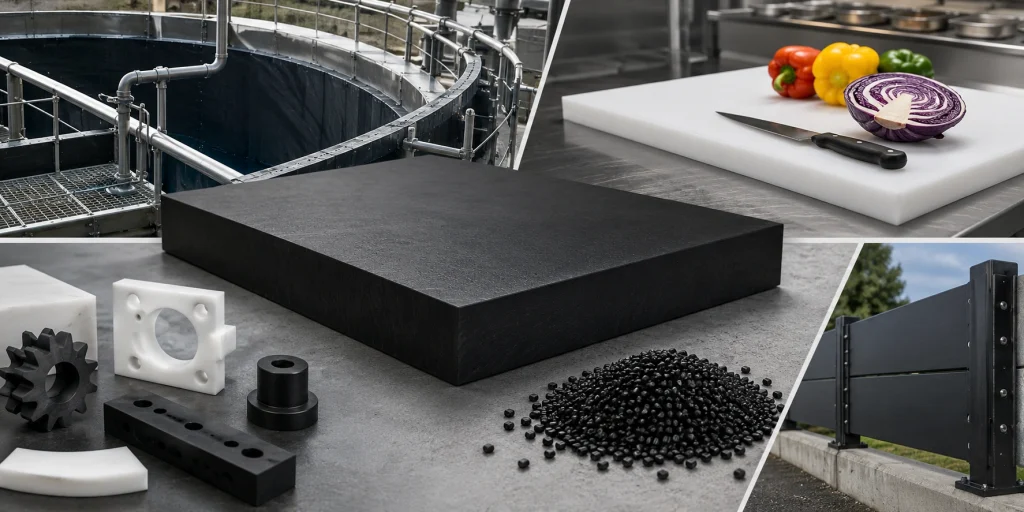
HDPE Sheet (High Density Polyethylene Sheet) is an engineering plastic sheet made from high-density polyethylene. It belongs to the thermoplastic polyolefin family.
Due to its dense molecular structure, HDPE sheet offers excellent impact resistance, chemical resistance, low water absorption, and moisture resistance. Compared with some more rigid plastic materials, HDPE has better toughness and is less likely to crack when exposed to impact or mechanical stress.
Therefore, HDPE sheets are widely used in chemical equipment liners, tank linings, food processing equipment, machine protection parts, wear-resistant components, and outdoor applications. They are especially suitable for environments that require corrosion resistance, impact resistance, and long-term exposure to water or moisture.
What Is Rigid PVC Sheet?
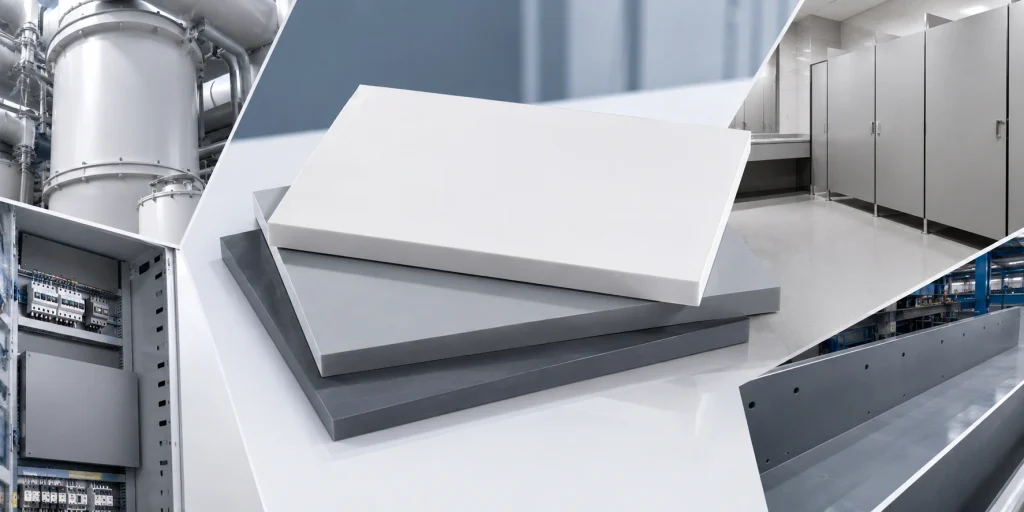
Rigid PVC Sheet is an engineering plastic sheet mainly made from Polyvinyl Chloride (PVC) without plasticizers, which gives it higher rigidity and better dimensional stability.
The main advantages of rigid PVC sheet include high rigidity, good surface performance, easy processing, and flame-retardant properties. It can maintain good shape stability and is suitable for applications that require higher hardness, better appearance, or structural support.
Therefore, rigid PVC sheets are commonly used in chemical equipment, electrical insulation parts, building panels, equipment protection covers, tank structures, and industrial processing components.
HDPE vs PVC Sheets: Mechanical Properties
Mechanical properties are an important factor when selecting engineering plastic sheets. Especially in applications such as equipment protection, liners, and mechanical components, whether a material is prone to deformation, cracking, or long-term load-bearing failure can directly affect its service life.
HDPE Sheet
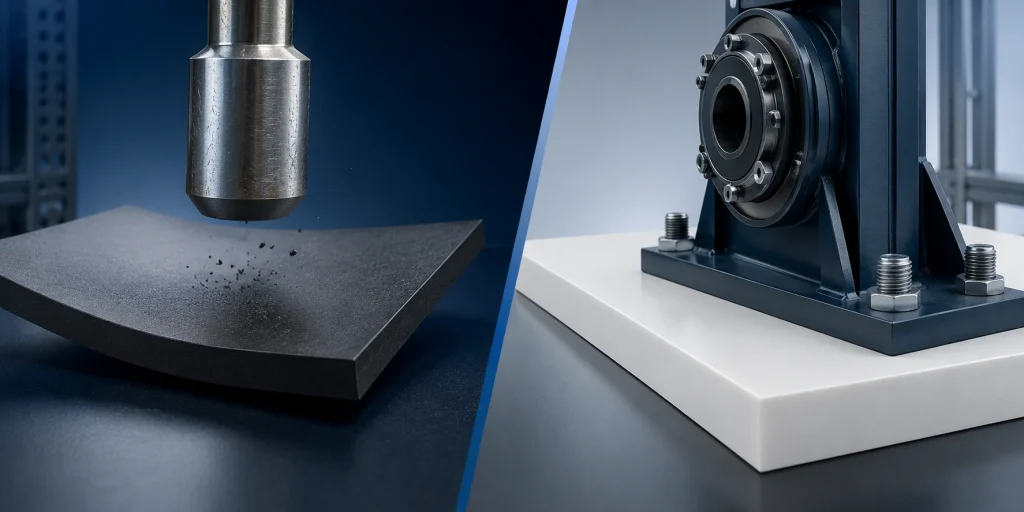
HDPE sheet has excellent toughness and impact resistance. When exposed to collision, impact, or mechanical stress, it is less likely to crack or break.
Therefore, HDPE is more suitable for applications that require good impact resistance or the ability to withstand dynamic loads, such as equipment liners, wear-resistant components, hopper liners, and transportation equipment protection panels.
However, HDPE has lower rigidity than rigid PVC. For structural applications that require high dimensional stability or stronger support capability, the actual thickness, load conditions, and installation requirements should be considered carefully.
According to our SGS test reports, the HDPE sample showed a non-break result in the Charpy unnotched impact test, an Izod notched impact strength of 15.6 kJ/m², a flexural strength of 26.9 MPa with a flexural modulus of 1250 MPa, and a tensile strength of 23.0 MPa with 830% elongation at break. You can download the corresponding test reports below for detailed test methods, conditions, and results.

Rigid PVC Sheet
Rigid PVC sheet offers higher rigidity and better dimensional stability, allowing it to maintain its shape under load. It is suitable for applications that require higher hardness and structural support.
However, compared with HDPE, PVC has lower toughness. Especially in low-temperature environments or under strong impact, rigid PVC has a relatively higher risk of cracking.
HDPE vs PVC Sheets: Chemical Resistance
Chemical resistance is an important factor when selecting engineering plastic sheets, especially for applications such as chemical equipment, storage tanks, and corrosion-resistant liners. Whether a material can withstand long-term exposure to chemical media directly affects the safety and service life of the equipment.
HDPE Sheet
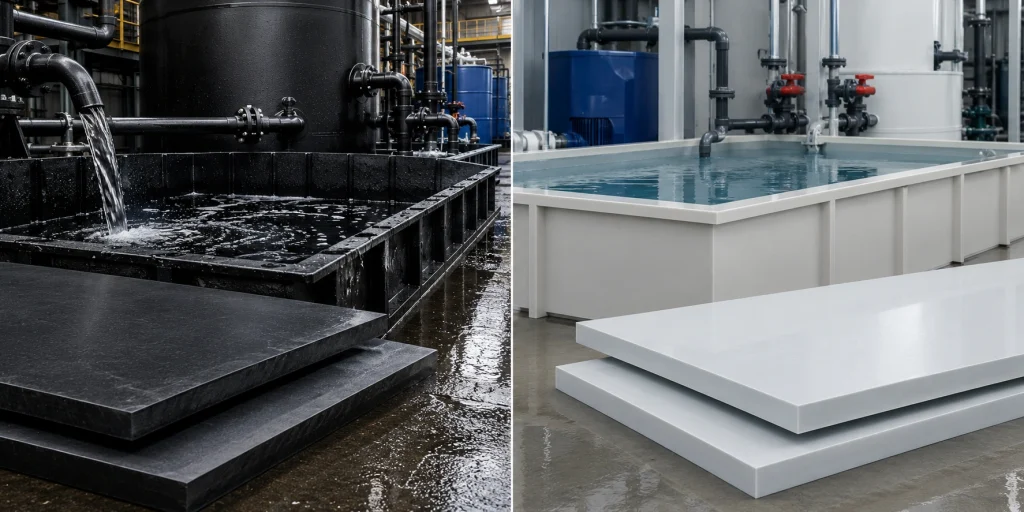
HDPE sheet has excellent chemical resistance and can withstand many acids, alkalis, salt solutions, and common industrial chemical media.
At the same time, HDPE sheet has extremely low water absorption and does not easily absorb moisture. Therefore, it can maintain stable performance in long-term humid environments or applications involving continuous liquid exposure.
Due to its excellent corrosion resistance and impact resistance, HDPE sheet is commonly used in:
- Chemical storage tank liners;
- Water treatment equipment;
- Corrosion-resistant liners;
- Chemical storage and transportation equipment.
According to our SGS test report, the HDPE sample showed no color change after being immersed in 5% HCl at 23°C for 24 hours under ISO 175:2010. You can download the test report below for detailed test conditions and results.
Rigid PVC Sheet
Rigid PVC sheet also has good chemical resistance and provides good resistance to many acids, alkalis, salts, and industrial chemicals. Therefore, it is also widely used in chemical equipment and corrosion-resistant structures.
Compared with HDPE, PVC sheet offers higher rigidity and better dimensional stability, making it advantageous in chemical equipment or protective components where maintaining structural shape is important.
However, in some special chemical environments, such as high-temperature conditions, strong oxidizing media, or long-term exposure to specific chemicals, material compatibility should still be confirmed based on the actual application.
HDPE vs PVC Sheets: Moisture and Water Resistance
In applications involving long-term exposure to water, humid environments, or liquid media, the water absorption rate and moisture resistance of a material directly affect its stability and service life.
Although both HDPE and PVC sheets offer good water resistance, their performance characteristics are different.
HDPE Sheet
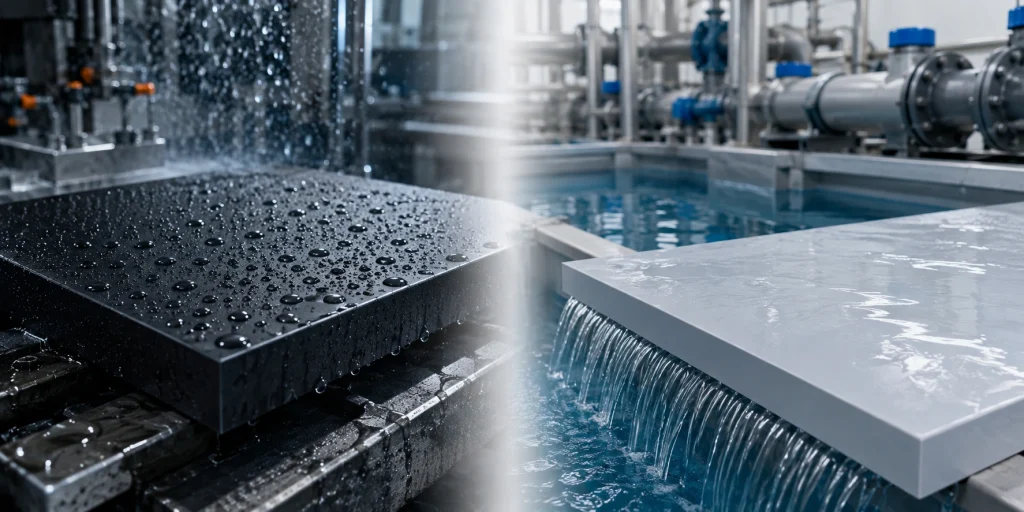
HDPE sheet has an extremely low water absorption rate and absorbs almost no moisture. Therefore, it can maintain stable performance in humid environments, long-term water contact, or outdoor applications.
Due to its stable molecular structure, HDPE is less likely to experience significant performance changes caused by moisture absorption. Therefore, it is commonly used in applications such as:
- Water treatment equipment;
- Tank liners;
- Chemical-resistant liners;
- Marine components;
- Outdoor protection panels and other applications involving long-term water exposure.
Rigid PVC Sheet
Rigid PVC sheet also has low water absorption and good water resistance, making it suitable for general humid environments and industrial applications that require waterproof performance.
However, compared with HDPE, PVC requires more attention to long-term service conditions. Especially under high temperatures, prolonged outdoor exposure, or certain chemical environments, its performance may be affected.
Therefore, in simple terms:
- If the application involves long-term water exposure, high humidity, or requires better impact resistance, HDPE sheet is usually more suitable.
- If your project focuses more on rigidity, dimensional stability, and general moisture resistance, rigid PVC sheet is also a common choice.
HDPE vs PVC Sheets: Temperature Performance
Temperature conditions can affect the strength, rigidity, and long-term stability of plastic sheets. Therefore, material selection requires special consideration in high-temperature or low-temperature applications.
HDPE Sheet
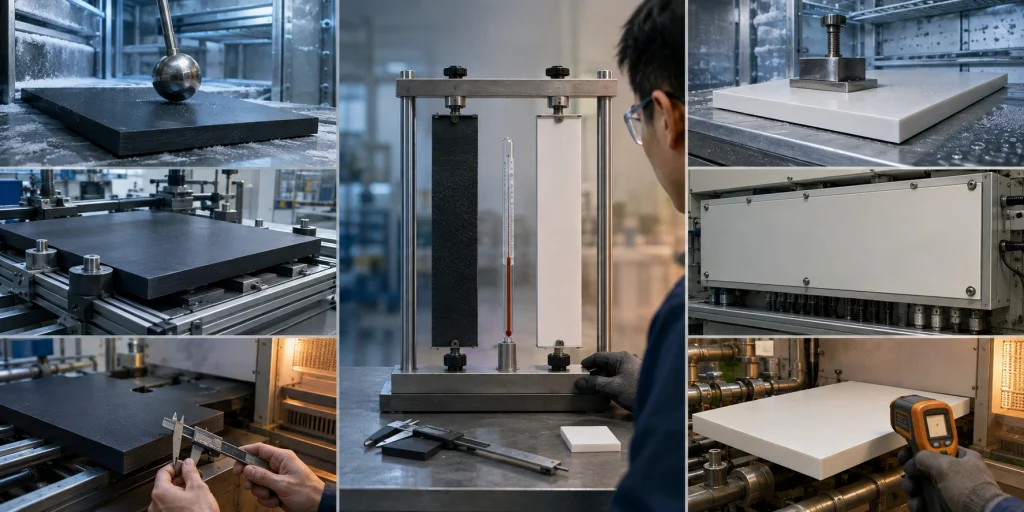
HDPE sheet has good low-temperature resistance and can maintain a certain level of toughness in cold environments. It is less likely to become brittle and crack compared with some rigid materials.
At the same time, the long-term service temperature of HDPE is generally around -50°C to 80°C, and it can withstand higher temperatures for short periods.
However, as HDPE is a thermoplastic material, it gradually softens when the temperature increases and has relatively noticeable thermal expansion characteristics. Therefore, in high-temperature applications or applications with strict dimensional requirements, installation methods and dimensional changes need to be considered.
According to our SGS test reports, the HDPE sample showed no visual change after 24 hours at -50°C and after 24 hours at 100°C under dry heat conditions. You can download the corresponding test reports below for detailed test methods, conditions, and results.
Rigid PVC Sheet
Rigid PVC sheet has good rigidity and dimensional stability, allowing it to maintain good structural performance under normal industrial temperature conditions.
However, the high-temperature resistance of PVC is generally lower than that of some engineering plastics. It may soften when the temperature increases, and careful evaluation is required for long-term high-temperature applications.
Therefore, HDPE has more advantages in low-temperature environments, outdoor applications, or situations requiring better impact resistance. For normal industrial equipment applications that require higher rigidity and dimensional stability, PVC may be more suitable. If your project involves continuous high temperatures or special temperature conditions, the material should be selected based on the actual temperature range.
HDPE vs PVC Sheets for Outdoor Use
Outdoor applications usually need to consider factors such as UV exposure, temperature changes, rain, impact, and long-term ageing. Therefore, the weather resistance of the material is very important.
HDPE Sheet
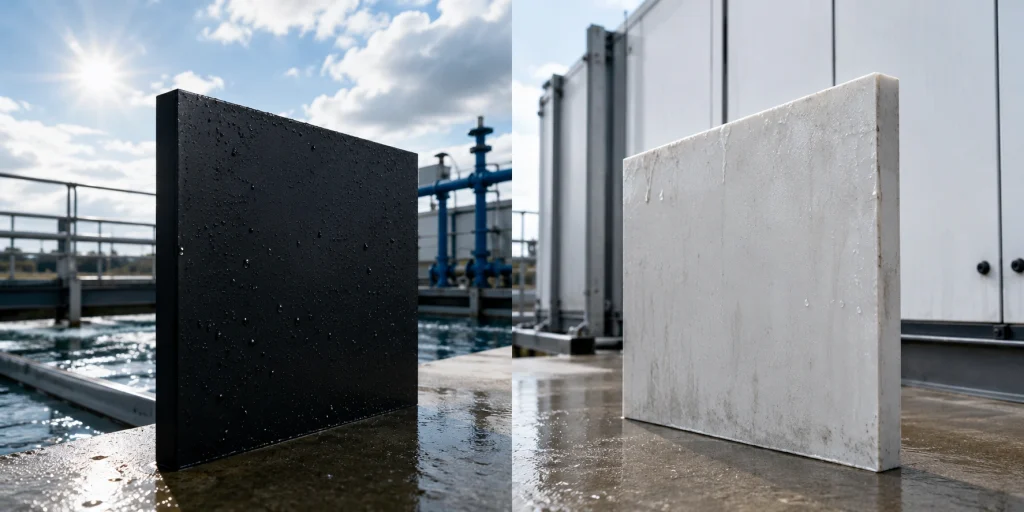
HDPE sheet has good weather resistance. With UV stabilization treatment, its resistance to ageing during long-term outdoor use can be improved.
At the same time, HDPE offers good impact resistance and water resistance. Even when exposed to outdoor conditions, impact, or long-term moisture, it can maintain relatively stable performance.
Common applications include:
- Ground protection mats;
- Outdoor equipment protection;
- Marine components;
- Temporary road protection panels;
- Agricultural and aquaculture facilities.
According to our SGS test report, the HDPE sample showed no obvious discoloration after 24 hours of UV ageing exposure under ISO 4892-3:2016 Cycle 1 using UVA-340 lamps. You can download the test report below for detailed test conditions and results.
Rigid PVC Sheet
Rigid PVC sheet can also be used for some outdoor applications, especially where higher rigidity, better surface flatness, and appearance requirements are needed.
However, when ordinary PVC sheet is exposed to sunlight and temperature changes for a long time, UV ageing needs to be considered. If necessary, formulation modification or surface protection may be required.
Therefore:
- If the outdoor environment involves rain, impact, temperature changes, or long-term exposure, HDPE is more suitable.
- If the outdoor application focuses more on rigidity, appearance, and dimensional stability, PVC can be considered.
However, the final choice still depends on the specific environment, such as whether the material will be exposed to sunlight for long periods, whether it needs to withstand impact, whether high rigidity is required, and the expected service life.
HDPE vs PVC Sheets: Fire Behavior
Flammability performance is an important factor for you to consider when selecting materials, especially in applications such as construction, electrical equipment, and other areas with higher safety requirements.
HDPE Sheet
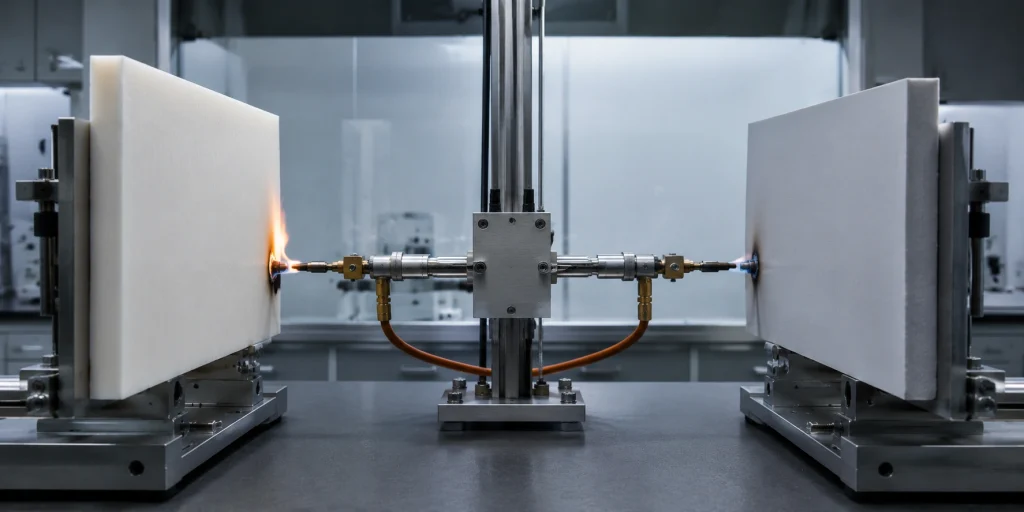
HDPE is a polyolefin material with good chemical resistance and mechanical properties, but it is naturally a combustible material.
Standard HDPE sheet will burn when exposed to a flame and may produce melting and dripping. Therefore, for projects with specific flame-retardant requirements, flame-retardant modified HDPE sheet should be selected.
Flame-retardant HDPE sheet can improve fire resistance by adding flame-retardant additives, making it suitable for industrial applications with higher safety requirements.
Rigid PVC Sheet
Due to the presence of chlorine elements in its molecular structure, rigid PVC sheet has better natural flame-retardant performance compared with HDPE.
PVC sheet has good self-extinguishing properties. After the flame source is removed, the burning speed will decrease, making it commonly used in applications with certain fire safety requirements, such as electrical equipment, protective covers, and building-related components.
However, PVC may release corrosive gases during combustion, so its suitability should still be evaluated based on the specific application environment.
Therefore:
- If your project focuses more on flame retardancy and fire safety requirements, rigid PVC has more advantages.
- If your project focuses more on impact resistance, chemical resistance, and durability, HDPE is more suitable.
- If HDPE is required for applications with special fire safety requirements, you can choose flame-retardant modified HDPE sheet.
HDPE vs PVC Sheets: Electrical Properties
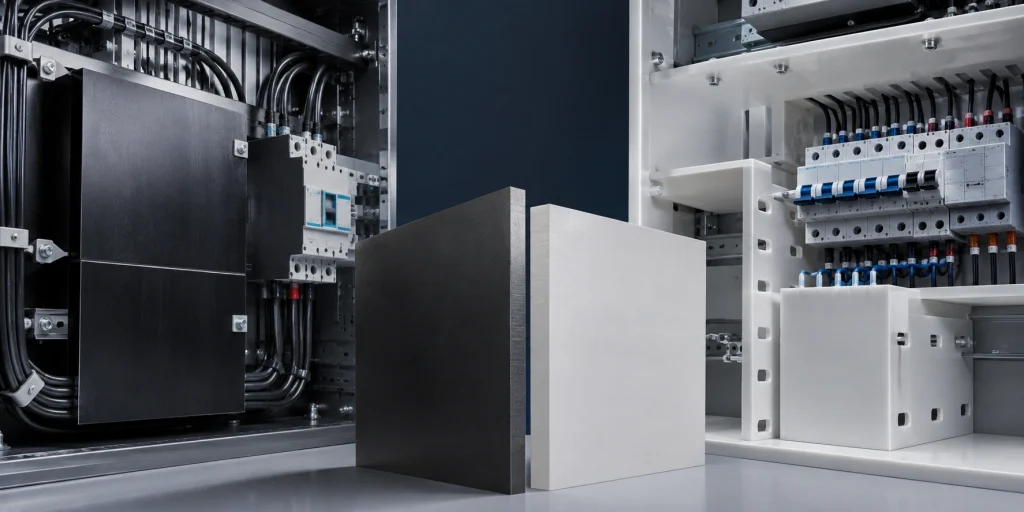
HDPE and PVC are both engineering plastics with electrical insulating properties, so they can both be used in certain electrical applications. However, their electrical characteristics are different.
HDPE Sheet
Standard HDPE sheet has good electrical insulation properties and can be used as a non-conductive material.
At the same time, HDPE can be modified by adding special materials, such as: anti-static HDPE and conductive HDPE.
Therefore, HDPE has advantages in applications that require a combination of chemical resistance, moisture resistance, and electrical insulation performance.
Rigid PVC Sheet
Rigid PVC sheet has stable electrical insulation properties and good dimensional stability, making it commonly used for:
- Electrical equipment partitions;
- Insulation protection components;
- Internal structural parts of control cabinets.
In addition, PVC itself has good flame-retardant properties, giving it advantages in certain electrical applications.
In summary:
- If the application requires a combination of chemical resistance, moisture resistance, and electrical insulation performance, HDPE is a better choice.
- If the application focuses more on rigidity, flame retardancy, and dimensional stability, PVC is more suitable.
HDPE vs PVC Sheets: Surface Finish, Printing and Appearance
Besides mechanical properties and chemical resistance, surface appearance and post-processing performance are also important factors that many customers consider when selecting materials, especially for applications such as advertising, equipment covers, and display products.
HDPE Sheet
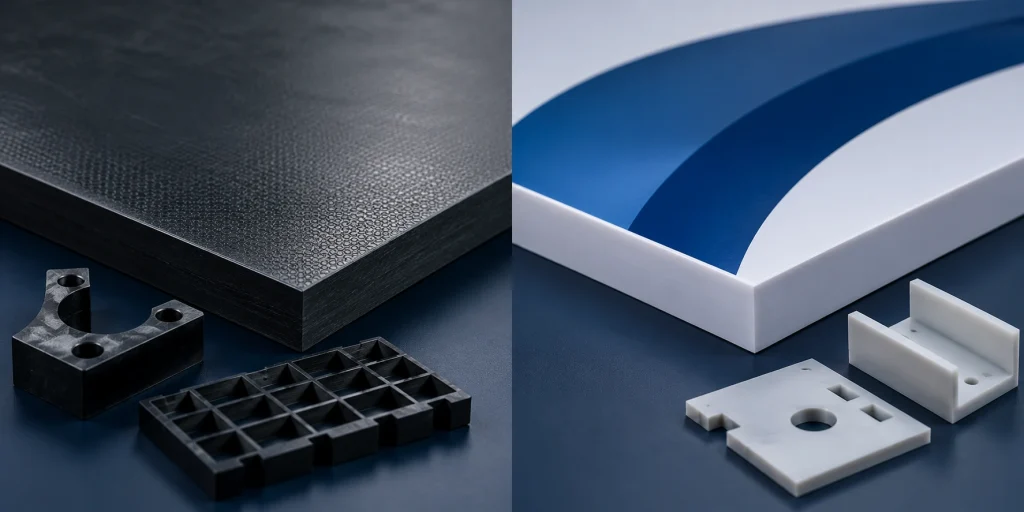
HDPE sheet has a practical industrial appearance and can be supplied with different surface finishes, including smooth surface, textured surface and anti-slip surface.
Due to the relatively low surface energy of HDPE, the adhesion of standard inks and adhesives is limited. Therefore, surface treatment is required if printing or bonding is needed.
HDPE is more suitable for applications that focus on functionality and durability, such as liners, protection panels and mechanical components.
Rigid PVC Sheet
Rigid PVC sheet offers better surface flatness and processing performance, making it easier to perform:
- Printing;
- Spray coating;
- Bonding;
- Surface decoration treatments.
Therefore, PVC is more commonly used in applications where appearance, identification, and surface finish are important.
In simple terms:
- If your project focuses on durability, protection performance, and long-term service stability, HDPE is more suitable.
- If your project focuses on appearance, printing performance, and surface treatment capability, PVC has more advantages.
HDPE vs PVC Sheets: Weight and Density
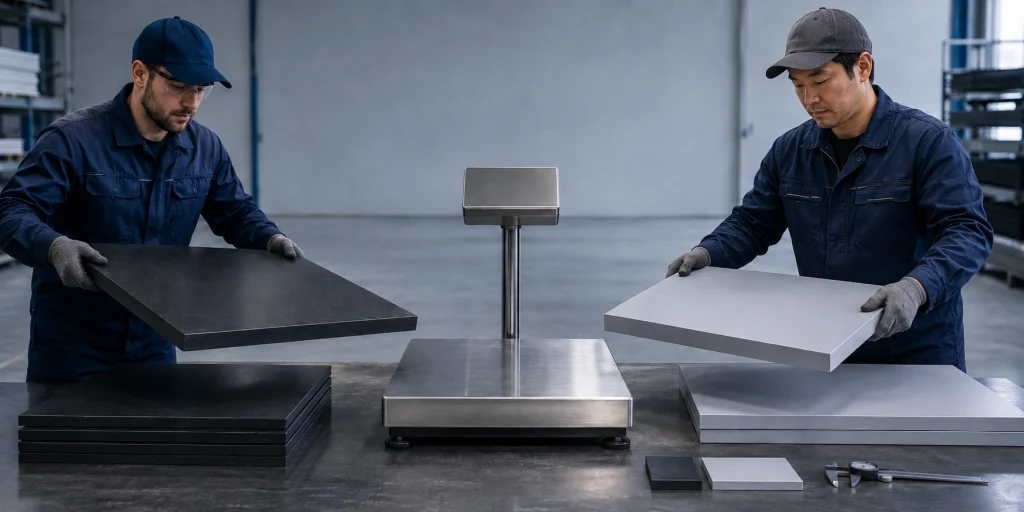
Material density directly affects sheet weight, transportation costs, and installation methods.
HDPE Sheet
The density of HDPE is typically around 0.94–0.96 g/cm³, making it a relatively lightweight engineering plastic.
Compared with materials with higher density, HDPE sheet has the advantage of being lightweight. It is more convenient for large-size sheet applications, outdoor equipment, and projects that require manual handling.
Rigid PVC Sheet
The density of rigid PVC is typically around 1.35–1.45 g/cm³, which is significantly higher than HDPE.
Therefore, under the same size and thickness, PVC sheet is heavier, but it also provides higher rigidity and better dimensional stability.
In simple terms, HDPE is a lighter and tougher option, while PVC is a heavier and more rigid option. When selecting the right material, the load requirements, installation method, and working environment should all be considered.
HDPE vs PVC Sheets by Application
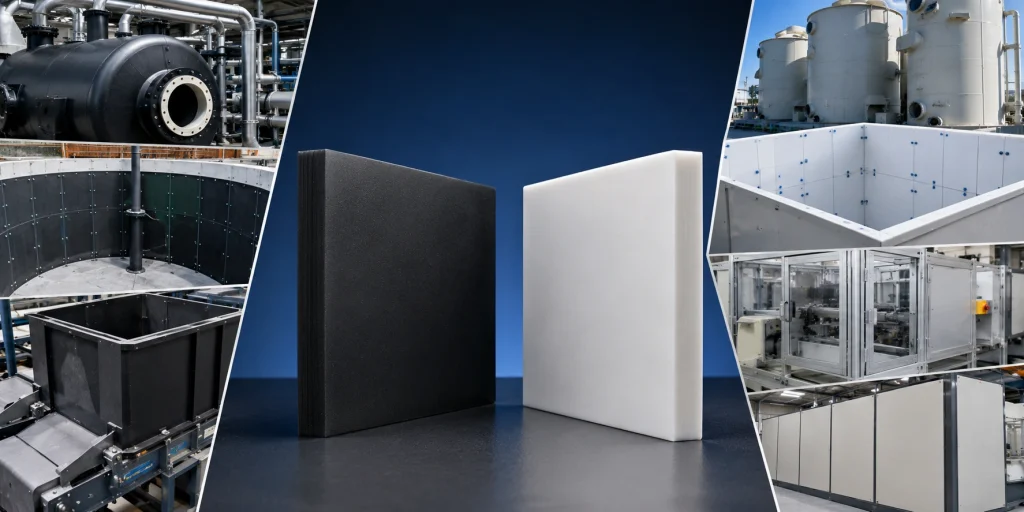
HDPE and rigid PVC are both common types of engineering plastic sheets, but due to their different performance characteristics, they are not entirely suitable for the same applications. When selecting materials, it is necessary for you to evaluate the project’s requirements for impact resistance, rigidity, chemical resistance, temperature tolerance, outdoor durability, and processing methods.
| Application Scenario | Recommended Material | Reason |
|---|---|---|
| Chemical storage tanks, chemical equipment liners | HDPE / PVC (Select according to the medium) | Both have chemical resistance, but HDPE has better impact resistance and moisture resistance, while PVC has higher rigidity |
| Water treatment equipment, water tanks, humid environment applications | HDPE | Low water absorption and more stable performance during long-term water exposure |
| Mechanical protection, wear-resistant liners | HDPE | Good toughness, impact resistance, and less likely to crack due to collision |
| Electrical equipment, control cabinets, insulation components | PVC | Higher rigidity, better dimensional stability, and good flame-retardant performance |
| Building sheets, structural protection | PVC | More suitable when higher rigidity and better surface flatness are required |
| Outdoor equipment, temporary protection panels | HDPE | Impact resistant, water resistant, and UV modification can improve weather resistance |
| Applications requiring printing, spraying, or appearance requirements | PVC | Surface treatment and printing performance are usually better |
When Should You Choose HDPE Sheet?
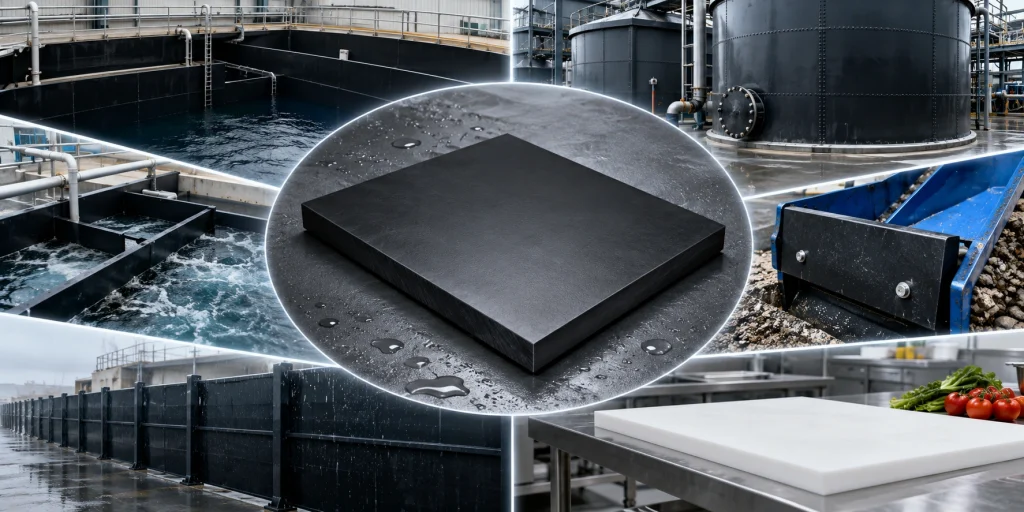
HDPE Sheet is more suitable for the following applications:
Applications requiring high impact resistance
If the sheet will be exposed to collision, impact, or mechanical stress, such as equipment liners, hopper liners, and transportation equipment protection panels, the toughness of HDPE can help reduce the risk of cracking.
Long-term exposure to water or humid environments
HDPE has extremely low water absorption. It can maintain stable performance when exposed to water, humid air, or liquid media for a long time.
Typical applications include:
- Water treatment equipment;
- Tank liners;
- Water tanks;
- Marine components;
- Outdoor protection structures.
Applications involving chemical media
For applications that require resistance to acids, alkalis, salt solutions, and certain industrial chemicals, HDPE is a common choice.
Applications requiring on-site fabrication
HDPE is easy to process through:
- Cutting;
- Drilling;
- CNC machining;
- Welding
Therefore, it is suitable for customized structural parts and non-standard size components.
When Should You Choose Rigid PVC Sheet?
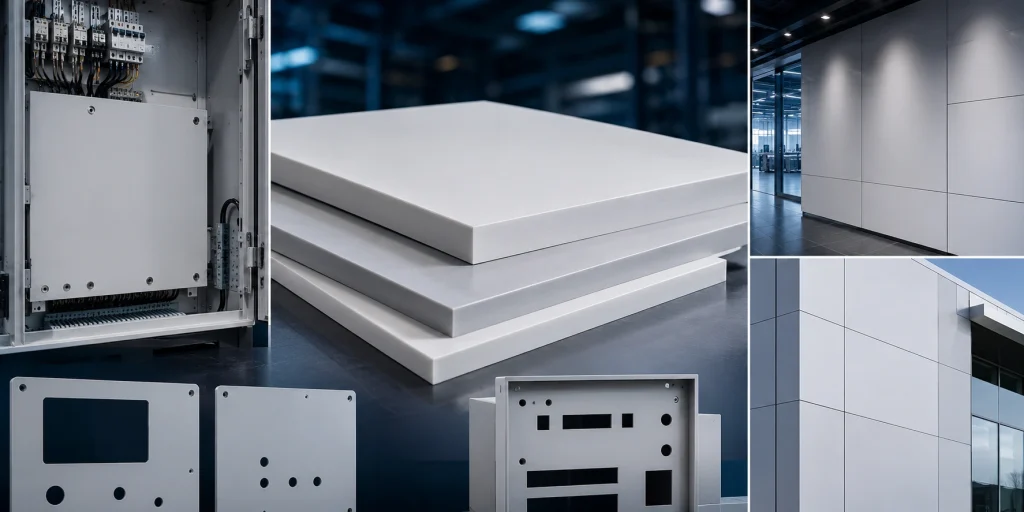
Rigid PVC Sheet is generally more suitable for the following applications:
Applications requiring higher rigidity and dimensional stability
If your project requires the sheet to maintain good shape stability, such as equipment covers, structural partitions, and building components, PVC has a clear advantage due to its higher rigidity.
Applications requiring better flame-retardant performance
Due to its material structure, PVC has better natural flame-retardant properties than standard HDPE. Therefore, it is commonly used in:
- Electrical equipment;
- Control cabinets;
- Industrial protective covers.
Applications requiring better surface appearance
If your project focuses on:
- Surface flatness;
- Printing performance;
- Spray coating performance;
- Appearance requirements;
Rigid PVC is usually easier to process and can better meet these requirements.
General industrial applications
For applications where temperature resistance, impact resistance, and weather resistance requirements are not particularly high, but stable structural performance is needed, PVC is an economical and practical choice for you.
Common Mistakes When Comparing HDPE and PVC Sheets
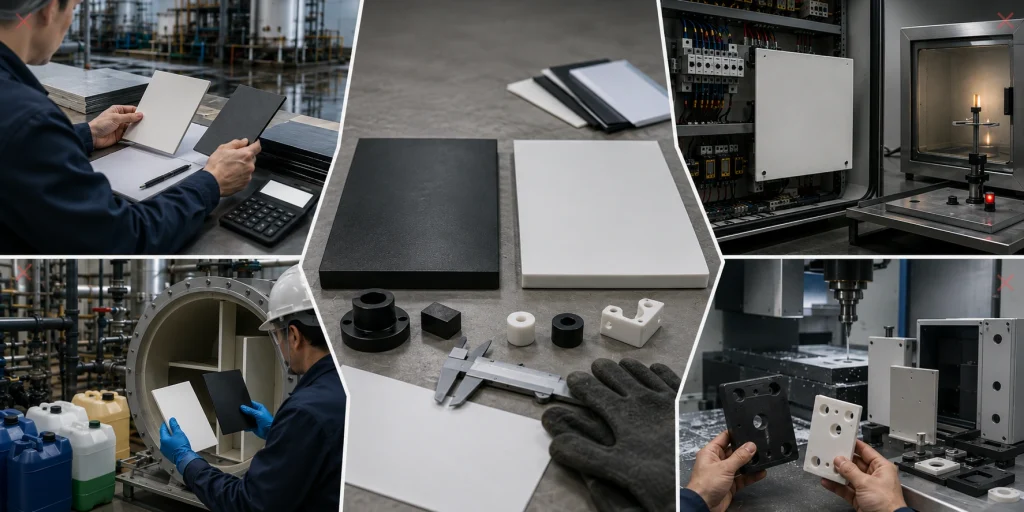
When selecting between HDPE sheet and PVC sheet, many customers tend to focus only on a single performance factor or the initial price while overlooking the actual working environment and project requirements.
The following are some common material selection mistakes:
Assuming the Lower-Priced Material Is Always More Cost-Effective
Material cost is only one part of the total project cost. If the sheet cannot meet the actual application requirements, additional costs from replacement, maintenance, and downtime may occur.
For example, in applications requiring impact resistance and long-term durability, HDPE may be a more suitable choice than standard plastic sheets. Even if the initial purchase cost is different, it may provide a longer service life.
Comparing Only Rigidity Without Considering Actual Working Conditions
PVC sheet usually has higher rigidity, but higher rigidity does not mean it is suitable for every application.
If the application involves frequent collision, impact, or mechanical wear, the toughness and impact resistance of HDPE may provide better performance.
Assuming the Two Materials Can Completely Replace Each Other
Although both HDPE and PVC are engineering plastic sheets, they have different performance characteristics.
HDPE is more suitable for:
- Applications requiring high impact resistance;
- Long-term exposure to water or humid environments;
- Applications requiring chemical resistance and wear resistance.
PVC is more suitable for:
- Applications requiring higher rigidity;
- Applications focusing on dimensional stability;
- Applications requiring better surface finishing and flame-retardant performance.
Ignoring Processing Methods and Installation Requirements
Different projects have different requirements for cutting, drilling, welding, bonding, and other processing methods.
HDPE is generally more suitable for welding and CNC machining, while PVC has certain advantages in bonding, surface treatment, and structural processing. Therefore, processing methods should be considered before selecting the material.
Therefore, there is no absolute answer as to whether HDPE or PVC is “better”. The right choice is about finding the material that is more suitable for your application.
The correct material selection should be based on a comprehensive evaluation of the working environment, performance requirements, processing methods, and long-term costs, rather than comparing only a single parameter.
Real-World Case Study: HDPE vs PVC Sheet Selection
In real industrial projects, there is no absolute answer as to whether HDPE or PVC is better. The correct material choice depends on the customer’s working environment, performance requirements, and processing needs.
The following two cases demonstrate the material selection logic for different application scenarios.
Case 1: HDPE Sheet for Outdoor Temporary Fence Application
The following case study shows how a customized UV-resistant HDPE Sheet with dimensions of 1640 × 2580 × 3 mm was developed to meet an Australian customer’s outdoor temporary fence application requirements.
Case Study: Customized HDPE Sheet for Outdoor Temporary Fence Application
Case Study: Customiz
Project Background
A customer from Australia needed white HDPE sheets for manufacturing temporary fencing.
Customer Requirements
- Sheet size: 1640 × 2580 mm
- Thickness: 3 mm
- Color: White
- Application environment: Outdoor temporary fencing
- Key requirements: Lightweight, weather resistant, and easy installation
Since the customer required a relatively large sheet size, standard HDPE sheet dimensions could not directly meet the project requirements. Therefore, we customized the production according to the customer’s specifications.
Solution
Considering the outdoor application environment, we recommended HDPE sheets with UV stabilization to improve long-term weather resistance under sunlight exposure.
At the same time, we adjusted the production specifications according to the customer’s required dimensions to ensure the sheets could meet the actual installation requirements.
Project Advantages
The advantages of HDPE sheet in this project include:
- Good impact resistance, reducing the risk of cracking caused by collision;
- Low water absorption, suitable for outdoor and humid environments;
- Lightweight design, making transportation and installation easier;
- UV modification available according to requirements to improve outdoor service life.
Finally, the product successfully met the customer’s requirements for size, color, and outdoor performance.
Case 2: PVC Sheet for Large-Size Industrial Application
The following case study shows how customized PVC Solid Boards with a large size of 1350 × 4000 × 38 mm were developed with precise dimensional control to meet specific overseas project requirements.
Case Study: Large Size PVC Solid Boards with Customized Dimensional Control for an Overseas Customer
Case Study: Large Si
Project Background
A customer from Mexico needed rigid PVC sheets for an industrial project.
Customer Requirements
- Material: Rigid PVC Sheet
- Size: 1350 × 4000 mm
- Thickness: 38 mm
- Key requirement: Extra-wide and extra-thick sheet specification
Solution
To meet the customer’s large-size requirements, we adjusted the production parameters and focused on controlling:
- Sheet flatness;
- Thickness uniformity;
- Edge quality;
- Extrusion speed.
Meanwhile, based on the customer’s budget requirements, we optimized the material solution to provide the most suitable configuration while maintaining the required product performance.
Project Advantages
The advantages of PVC sheet in this project include:
- Higher rigidity, suitable for large-size structural applications;
- Good dimensional stability;
- Smooth surface, suitable for industrial processing;
- Thick sheet structure capable of meeting support requirements.
Finally, the product successfully met the customer’s requirements for large dimensions and performance, and was delivered successfully.
What Can We Learn From These Cases?
From these two cases, we can see:
- HDPE sheet is more suitable for applications requiring impact resistance, water resistance, and weather resistance, such as outdoor protection panels, liners, and wear-resistant components.
- PVC sheet is more suitable for applications requiring high rigidity, dimensional stability, and structural support, such as industrial equipment and large-size sheet structures.
Choosing the right plastic sheet is not about deciding which material is simply “better”, but about finding the solution that best matches your project requirements.
Request HDPE or PVC Sheets for Your Project
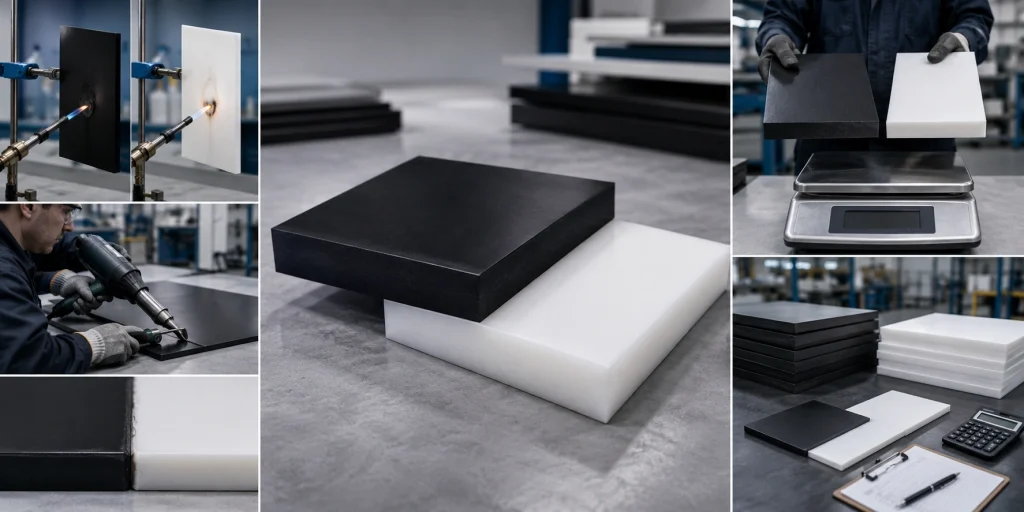
Choosing the right engineering plastic sheet is not simply about deciding whether HDPE or PVC is the better material. The correct choice depends on your project’s actual application environment, performance requirements, and processing needs.
If your project requires better impact resistance, water resistance, and chemical stability, HDPE sheet may be a more suitable choice. If your project focuses on rigidity, flame-retardant performance, surface appearance, or dimensional stability, rigid PVC sheet may better meet your requirements. We can help you evaluate the most suitable material solution based on your application scenario, sheet size, thickness, working environment, and processing requirements.
FAQs
Is PVC more fire-resistant than HDPE?
In most cases, PVC has better flame-retardant performance than standard HDPE due to its chlorine-containing molecular structure and self-extinguishing properties. It is commonly used in applications with fire safety requirements, such as electrical equipment and protective covers.
HDPE is a combustible polyolefin material and may melt and drip during burning. For applications requiring higher flame resistance, flame-retardant modified HDPE sheet can be selected.
Can HDPE and PVC sheets be welded?
Both HDPE and PVC sheets can be welded, but their joining methods are different.
HDPE Sheet:
HDPE can be joined through hot air welding, extrusion welding, and heat fusion welding. It provides reliable connections and is commonly used in applications requiring sealing performance, such as tanks, chemical equipment, and water treatment facilities.
PVC Sheet:
Rigid PVC can also be welded using hot air welding or plastic welding rods. It is commonly used in chemical equipment, corrosion-resistant structures, and piping systems.
Can HDPE be welded to PVC?
Directly welding HDPE and PVC together is not recommended.
HDPE (polyethylene) and PVC (polyvinyl chloride) have different molecular structures, melting temperatures, and welding characteristics, making it difficult to achieve a reliable fusion bond.
For connecting HDPE and PVC components, it is recommended to use:
- Mechanical connections;
- Flange connections;
- Special connection structures.
Which is lighter, HDPE or PVC?
HDPE is lighter than PVC.
Common density ranges:
- HDPE: approximately 0.94–0.96 g/cm³
- Rigid PVC: approximately 1.35–1.45 g/cm³
Under the same size and thickness, HDPE sheet weighs less than PVC sheet. Therefore, HDPE has advantages in applications that require manual handling, transportation cost control, or large-size sheet applications.
However, the higher density of PVC also provides higher rigidity and better dimensional stability.
Is HDPE cheaper than PVC?
The price of HDPE and PVC cannot be compared simply, as it depends on factors such as raw material cost, sheet size, thickness, performance grade, and processing requirements.
Generally, standard HDPE and PVC sheets may have similar price ranges, but the best choice depends on the application.
For projects requiring impact resistance, chemical resistance, and long-term durability, HDPE may provide better overall value.
For projects requiring high rigidity, flame-retardant performance, or better surface finishing, PVC may be more suitable.
When selecting materials, consider the total service life cost rather than only the initial purchase price.
Partner with a Professional Engineering Plastics Manufacturer
We provide stable and reliable engineering plastic sheets and custom processing solutions for your projects
Explore More Blogs


Hey There, I'm Balance!
I am the Supply Chain Manager of YIQI Plastic. With 9 years of experience, including 4 years in engineering plastics, I specialize in material sourcing, quality control, and supply chain management.Feel free to contact us.