
Case Study: Custom Extruded Grooved PE Cutting Boards for a German Kitchenware Retailer
A German kitchenware retailer specializing in kitchen knives and related food-preparation products began cooperating with us in 2023.
Because the cutting boards were sold together with the customer’s kitchen knives, the customer placed particular importance on product appearance, surface quality, dimensional consistency, durability, and delivery reliability. Any visible defect on the cutting boards could directly affect consumers’ perception of the customer’s entire kitchenware range.
Before working with us, the customer had purchased PE cutting boards from another supplier. However, the delivered products did not meet the expected quality standard. The boards showed visible surface marks, uneven thickness, inconsistent weight, and irregular finishing.
After comparing different suppliers, the customer selected us to develop a more stable and customizable grooved PE cutting board solution.


Customer Requirements and Project Expectations
The customer wanted to establish a reliable cutting board product line that could be sold together with its kitchen knives.
The boards needed to provide a clean and professional retail appearance while remaining suitable for regular food preparation. In addition to food-contact safety and durability, the customer paid particular attention to surface flatness, thickness consistency, groove quality, edge finishing, product weight, color consistency, and production lead time.
The customer also required both smooth and fine grid-textured surfaces to support different product ranges and retail positioning.
Another important requirement was size flexibility. The customer needed cutting boards in multiple dimensions rather than being limited to only a few mold-based sizes.
Client Detail Requirements
The client’s key requirements include:
- Food-grade PE/HDPE material
The boards needed to be suitable for direct food contact and repeated kitchen use. - Uniform thickness
The center and edges of each cutting board needed to maintain a consistent thickness. - Accurate product weight
The finished boards needed to meet the agreed dimensions, thickness, and weight. - Flat and consistent surfaces
The boards could not have obvious water-wave marks, press marks, scratches, or deformation. - Two surface options
Both smooth surfaces and fine grid-textured surfaces were required. - Flexible size customization
The customer needed different lengths and widths without being restricted by fixed molds. - Precision juice grooves
The grooves needed to be evenly machined around the perimeter of the board. - Smooth, burr-free edges
The groove, board edge, and rounded corners needed to be comfortable to touch and easy to clean. - Multiple color options
Red, blue, yellow, green, black, burgundy, white, and customized colors were required. - Reliable delivery planning
Production needed to be arranged according to the customer’s expected arrival date and inventory requirements.
Customer Pain Points
1. Uneven Thickness
The previous supplier used a hydraulic press-molding process.
The delivered boards showed an uneven thickness distribution, with some areas in the center appearing thinner while the surrounding areas were thicker. This affected the flatness, consistency, and overall product quality.
2. Insufficient Product Weight
Some boards supplied by the previous manufacturer were lighter than expected and did not fully meet the agreed specifications.
For a retailer selling the boards as quality kitchenware products, insufficient weight could make the products feel less substantial and reduce consumer confidence.
3. Water-Wave Marks on the Surface
The surface of the previous products showed visible ripple-like or water-wave marks.
These marks reduced the visual quality of the boards and made them less suitable for retail display alongside premium kitchen knives.
4. Limited Size Flexibility
The previous manufacturing process depended on fixed molds.
A separate mold was required for different board dimensions, which restricted the available sizes and made customized production less flexible.
5. Inconsistent Groove and Edge Finishing
The customer required a full-perimeter juice groove, but the groove and surrounding edges needed to remain smooth and free from burrs.
Rough machining marks or sharp burrs could affect appearance, cleaning, handling, and the overall user experience.
6. Unstable Delivery Time
The customer needed the products to arrive according to its sales and inventory schedule.
Uncertain production times could result in delayed product launches, insufficient stock, or interruptions to retail supply.
Our Extruded Grooved PE Cutting Board Solution
After reviewing the customer’s previous products and quality concerns, we recommended using an extrusion manufacturing process rather than relying on fixed-size hydraulic press molds.
Our process first produces large PE/HDPE sheets with controlled thickness and surface quality. The large sheets are then cut into the dimensions required by the customer.
This manufacturing method helps achieve a flatter surface, more uniform thickness, and more consistent product weight. Because the final boards are cut from large extruded sheets, the customer is not restricted by fixed mold dimensions. Different lengths and widths can be produced according to individual product requirements.
For the juice groove and edge processing, we first use CNC equipment to machine the full-perimeter groove and board profile. After machining, the groove, edges, and corners are polished and deburred to achieve a smoother finish without sharp or rough areas.
Both smooth and fine grid-textured surfaces are available. The smooth option provides a clean and classic appearance, while the grid-textured option creates a more distinctive visual and tactile finish.
The recommended product configuration is shown below.
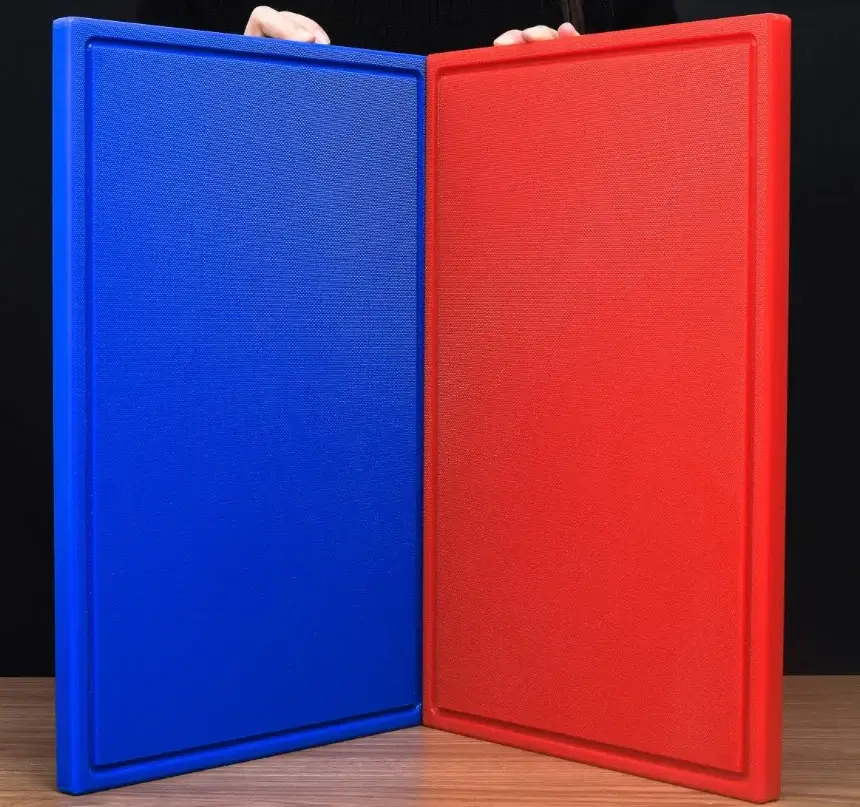
| Item | Recommended Solution |
|---|---|
| Product Type | Custom Extruded Grooved PE Cutting Board |
| Customer Type | German kitchenware and kitchen-knife retailer |
| Application | Retail kitchenware and daily food preparation |
| Material | Food-grade PE / HDPE |
| Manufacturing Process | Large-sheet extrusion followed by precision cutting |
| Thickness | Customizable from 10 to 50 mm |
| Length | Customized according to customer requirements |
| Width | Customized according to customer requirements |
| Size Flexibility | Multiple dimensions without fixed-mold restrictions |
| Surface Options | Smooth surface or fine grid-textured surface |
| Groove Type | Full-perimeter juice groove |
| Groove Processing | CNC machining followed by polishing and deburring |
| Reference Groove Width | 6–12 mm |
| Reference Groove Depth | 4–10 mm |
| Edge Type | Straight or chamfered |
| Corner Type | Rounded corners |
| Color Options | Red, blue, yellow, green, black, burgundy, white, or customized |
| Flatness Control | Reference tolerance of ±0.5 mm |
| Dimensional Control | Reference tolerance of ±1.0 mm |
| Quality Inspection | Surface, thickness, dimensions, weight, groove, edges, and color |
| Packaging | PE film with carton or pallet; customized packaging available |
| Reference Production Time | Approximately 20–25 days per container |
| Main Purpose | Improve consistency, customization flexibility, retail appearance, and delivery reliability |

Why Our Grooved PE Cutting Board Was Recommended
• More Uniform Thickness
The extrusion process helps maintain more consistent thickness across the center and edges of the cutting board.
This improves flatness, product stability, and overall appearance.
• Full Specified Dimensions and Weight
The boards are produced and inspected according to the agreed dimensions, thickness, and weight requirements.
This gives the finished products a more substantial and consistent feel.
• Flatter and Cleaner Surface
Compared with the customer’s previous products, the extruded boards provide a flatter surface with fewer visible ripple marks or pressing defects.
This makes them more suitable for professional retail presentation.
• Flexible Size Customization
Large PE/HDPE sheets are produced first and then cut according to the customer’s required dimensions.
This avoids the limitations of fixed molds and allows different cutting board sizes to be manufactured more efficiently.
• Smooth and Grid-Textured Surface Options
The customer can select either a smooth surface or a fine grid-textured surface.
The two options allow the retailer to create different product ranges while maintaining consistent material quality and processing standards.
• Precision CNC Juice Groove
The full-perimeter juice groove is machined by CNC equipment to maintain consistent width, depth, and positioning.
The groove helps collect liquids released when cutting meat, poultry, seafood, fruit, and vegetables.
• Polished and Burr-Free Finish
After CNC machining, the groove, edges, and corners are polished and deburred.
This provides a smoother appearance, improves handling comfort, and makes the board easier to clean.
• Multiple Color Options
Different colors help the customer create a coordinated retail product collection.
They can also be used to distinguish cutting boards intended for different food categories.
• Reliable Production Planning
We arrange the production schedule according to the customer’s required arrival date.
Under normal conditions, one container can generally be completed and shipped within approximately 20–25 days, depending on the confirmed specifications and production schedule.
Our Customization and Manufacturing Capabilities
We can customize grooved PE cutting boards according to different retail and commercial requirements, including:
- Customized length, width, and thickness
- Multiple dimensions without fixed-mold restrictions
- Smooth or fine grid-textured surfaces
- Full-perimeter or customized juice grooves
- Customized groove width and depth
- CNC cutting and groove machining
- Polishing and deburring after CNC processing
- Straight or chamfered edges
- Rounded corner processing
- Multiple standard and customized colors
- Customized handles and hanging holes
- Logo engraving and product identification
- Customized labels, cartons, and retail packaging
- Batch inspection of dimensions, thickness, weight, flatness, surface, and color
- Production planning based on the customer’s expected arrival time