
Home » What Are Ground Protection Mats? A Practical Guide
What Are Ground Protection Mats? A Practical Guide
- Author: Balance Lee
- 9+ Years of Manufacturing
Ground protection mats provide a temporary surface for vehicles, equipment, and pedestrians to move across grass, soil, gravel, and other vulnerable ground. They help spread loads, reduce surface damage, and improve traction where direct access could be difficult or damaging.
But choosing the right mat involves more than checking its thickness or advertised load capacity. Ground conditions, vehicle weight, mat material, and installation methods all affect how the system performs on site.
This guide explains how ground protection mats work, where they are used, and what you need to consider when choosing and installing the right mats for your project.
Table of Contents
What Ground Protection Mats Are Designed to Do
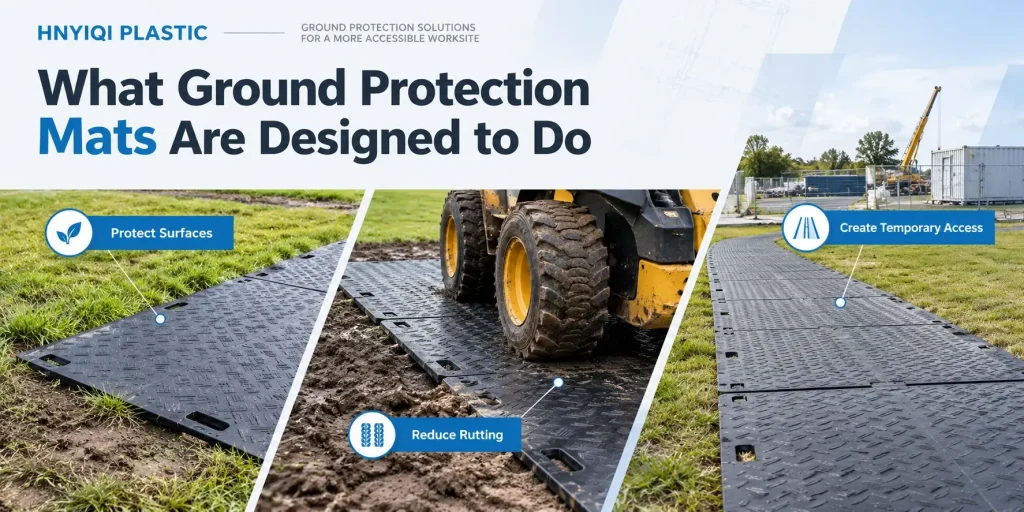
Ground protection mats are temporary, reusable panels placed over existing ground to provide a working or access surface for vehicles, equipment, and pedestrians. They are designed to reduce direct contact with vulnerable ground, limit surface damage, and help maintain access where unprotected soil or grass may become difficult to cross.
Their main purpose is not to make weak ground strong, but to reduce the damage and access problems caused by repeated movement over it.
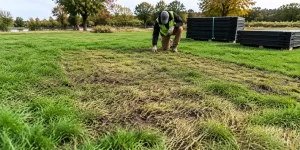
For example, when construction vehicles repeatedly travel across a grassed area, the tires can leave ruts, compact the soil, and damage the vegetation. On wet or muddy ground, the same traffic may disturb the surface further, making subsequent vehicle movements more difficult.
Placing ground protection mats along the intended access route creates a more consistent contact surface between the tires and the ground below.
Protecting the Ground While Keeping Work Moving
Ground protection mats are designed to address three practical needs:
- Surface protection: Reduce direct tire contact with grass, soil, paving, and other surfaces that may be damaged by traffic.
- Temporary access: Provide a defined route for equipment, delivery vehicles, or pedestrians without constructing a permanent road.
- Improved traction: Textured mat surfaces can help tires maintain grip, particularly where exposed ground is wet or muddy. Actual traction still depends on the tire, surface contamination, and operating conditions.
In the ground protection mat inquiries we handle, the intended use is an important starting point. A contractor protecting a finished lawn has a different concern from a project team trying to move loaded vehicles across a muddy construction entrance.
The first project may prioritize minimizing surface marks, while the second may prioritize maintaining vehicle access and reducing rut formation. Both involve ground protection, but they do not necessarily require the same mat arrangement or operating conditions.
What Ground Protection Mats Cannot Do
Ground protection mats also have practical limits.
A mat does not automatically make saturated soil, deep mud, or poorly supported ground safe for heavy vehicles. Even if the mat itself remains intact, the ground underneath can still deform, sink, or lose stability under repeated loading.
For this reason, mat performance must be considered together with ground conditions and vehicle loads, rather than judged by material thickness or a supplier’s stated load capacity alone.
This distinction leads to the next question: if a mat cannot eliminate the weakness of the ground underneath, how does it help vehicles pass over it?
The answer lies in how ground protection mats transfer loads and provide surface traction, which we will examine in the next section.
How Ground Protection Mats Distribute Loads and Create Traction
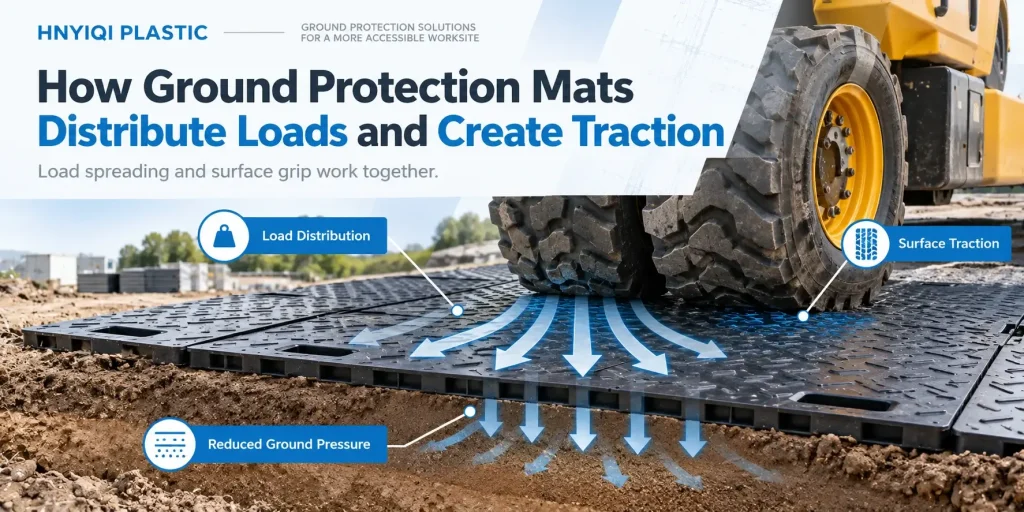
Ground protection mats work through two related mechanisms: spreading concentrated loads over a wider area and providing a textured contact surface for tires or footwear. These functions help reduce localized ground deformation and improve movement across suitable temporary access routes.
However, load distribution and traction address different problems. A mat may help prevent a tire from digging into the soil, while its surface texture helps the tire maintain grip during movement. Understanding both is important when evaluating mat performance.
How Load Distribution Reduces Ground Pressure
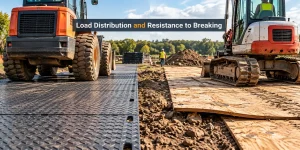
When a vehicle travels directly over soft ground, its weight is transferred through the tires or tracks into relatively small contact areas. If the applied pressure exceeds what the soil can support, the ground may deform, creating ruts or allowing the vehicle to sink.
A ground protection mat introduces an additional load-spreading layer between the tires and the soil. As the panel bends under loading, part of the force can be transferred beyond the original tire contact area, reducing the concentration of pressure beneath the wheel.
The basic relationship is:
Pressure = Applied Force ÷ Contact Area
Consider a simplified example:
- A single wheel applies a vertical load of 20 kN, equivalent to approximately 2.04 tonnes-force.
- Without a mat, assume the tire contact area is 0.08 m².
- The average contact pressure is 20 ÷ 0.08 = 250 kPa.
- If a suitable mat and supporting ground allow that load to act over an effective area of 0.40 m², the corresponding average pressure becomes 50 kPa.
This represents an 80% reduction in average pressure in the simplified calculation.
The 0.40 m² effective area is an assumed value, not a measured result or a guaranteed performance figure for a particular ground protection mat. In practice, the area receiving the load depends on panel stiffness, thickness, ground support, contact position, and the degree of bending.
A 1220 × 2440 mm mat, for example, has a plan area of approximately 2.98 m². That does not mean a wheel load will be distributed evenly across all 2.98 m². The actual load transfer may involve only part of the panel.
How Surface Texture Helps Tires Maintain Traction
Load distribution addresses vertical pressure. Traction determines how effectively tires can transfer driving, braking, and turning forces to the mat surface.
On exposed wet soil, vehicle tires may lose grip as the surface becomes disturbed. Ground protection mats provide a more consistent contact surface, while raised patterns can create additional interaction with tire tread.
The effectiveness of the texture depends on several factors:
- Pattern geometry: Raised diamond or other molded patterns create contact features that can interact with tire tread.
- Surface contamination: Mud, clay, oil, or standing water may reduce the available grip, even on a textured panel.
- Vehicle movement: Acceleration, braking, and turning introduce horizontal forces that can affect both tire traction and mat stability.
From our ground protection mat inquiries, surface texture is an important consideration when customers describe repeated vehicle movements over muddy routes.
A pronounced tread pattern may be appropriate for vehicle access, but a deeper texture should not be treated as proof of better traction under every condition. Tire type, travel direction, surface contamination, and site conditions also influence the result.
The mat itself must also remain stable. If it slides, shifts, or lifts under vehicle movement, adequate tire grip alone will not ensure safe passage.
Why Load Distribution and Traction Must Be Considered Together
Consider a temporary access route used by loaded construction vehicles during wet weather.
A mat may spread wheel loads sufficiently to reduce local rut formation, but the vehicles could still experience wheel slip if the surface becomes heavily contaminated with mud.
Conversely, a deeply textured mat may provide suitable tire contact, yet the route could still develop depressions if the soil underneath cannot support the transferred load.
For this reason, we evaluate ground support and traction as separate but connected requirements when reviewing vehicle access projects. Vehicle weight, axle loading, soil condition, route gradient, and expected turning movements all help determine whether a proposed mat system is suitable.
These mechanisms also explain why ground protection mats are manufactured from different materials and with different surface structures. The next section compares those options and examines how material selection affects flexibility, durability, and application suitability.
Common Materials and Ground Protection Mat Types
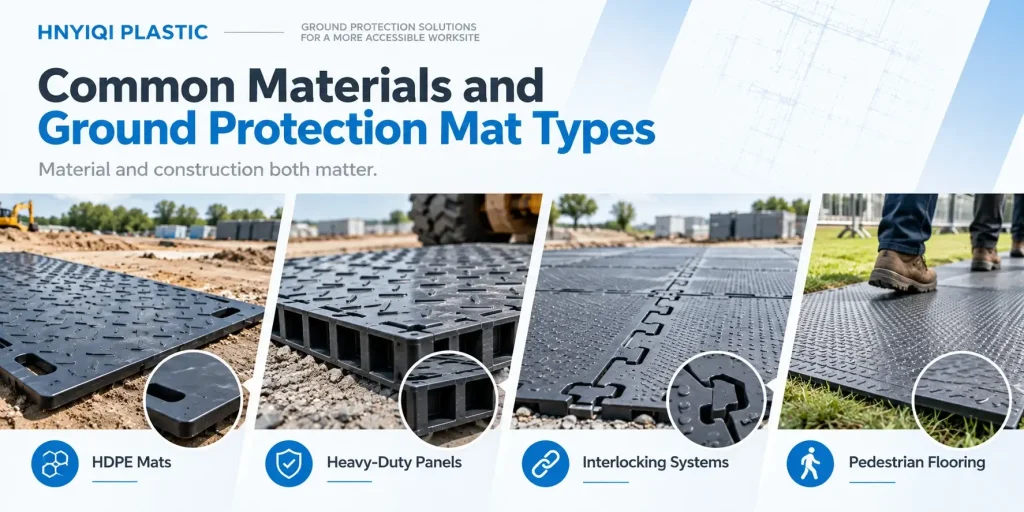
Ground protection mats are available in different materials and structural designs because temporary access projects place different demands on flexibility, impact resistance, weight, and ground support.
HDPE is a practical choice for many reusable ground protection mats, while UHMWPE, reinforced composites, and engineered heavy-duty panels serve more specific requirements. The material name alone, however, does not determine how much weight a mat can support.
Two mats made from polyethylene may perform differently if one is a flexible solid panel and the other has a thick, reinforced structure. This is why material and construction should be considered together.
HDPE Ground Protection Mats
High-density polyethylene (HDPE) is well suited to removable ground protection panels because it combines impact resistance, moisture resistance, and flexibility.
Unlike timber-based panels, HDPE does not absorb significant amounts of water or rot after exposure to wet ground. Its flexibility also allows a properly designed mat to accommodate limited surface irregularities without behaving like a completely rigid plate.
In our manufacturing and quotation work, HDPE is an important starting material when customers need reusable temporary access panels that can be transported, installed, removed, and cleaned between projects.
A frequently requested format is approximately 1220 × 2440 mm (4 × 8 ft), with 12.7 mm (½ in) nominal thickness.
For reference, a flat, solid HDPE panel measuring 1220 × 2440 × 12.7 mm has a theoretical weight of approximately 35.9 kg at an assumed density of 950 kg/m³. The calculation excludes the additional volume of raised surface patterns and material removed for handles or connection holes.
That figure helps buyers estimate transportation and handling requirements, but it is not a load rating.
HDPE mats may also be manufactured using virgin material, recycled material, or specified material blends. The choice should account for consistency, impact performance, outdoor exposure, and the requirements of the finished product rather than material price alone.
UHMWPE and Heavy-Duty Composite Mats
Ultra-high molecular weight polyethylene (UHMWPE) offers excellent abrasion resistance, impact toughness, and a low coefficient of friction. These properties make it valuable in industrial wear applications.
However, UHMWPE should not automatically be considered a better ground protection material simply because it has higher wear resistance.
Its low-friction characteristics do not replace the need for a suitable traction pattern, and its mechanical properties must be assessed against the actual loading conditions. For many temporary access projects, HDPE can offer a more appropriate balance of material cost, flexibility, and manufacturing requirements.
Heavy-duty composite mats represent another category. Some use reinforced polymer structures, while others incorporate engineered cores or layered construction to achieve specific stiffness and load-spreading characteristics.
These systems may be considered for demanding temporary roadways or equipment access, but their increased structural capability can come with greater panel weight, handling requirements, and cost.
When comparing these options, we look beyond the polymer name and ask whether the project needs a flexible surface protection panel or a more rigid load-spreading system.
Solid Panels, Interlocking Mats, and Pedestrian Flooring
Material is only one part of the product specification. Ground protection mats can also be classified by their physical structure and connection method.
| Mat Type | Main Characteristics | Key Consideration |
|---|---|---|
| Solid Textured Panels | One-piece panels with molded surface patterns, handles, or connection holes | Balance between flexibility, handling weight, and traction |
| Connected or Interlocking Mats | Individual panels joined to form a continuous route or platform | Connection strength, alignment, and movement under traffic |
| Reinforced Heavy-Duty Panels | Thicker or engineered structures designed for specific load-spreading requirements | Ground support, equipment handling, and verified performance |
| Pedestrian Access Flooring | Lower-profile surfaces designed for walking areas and temporary event spaces | Walking comfort, trip hazards, accessibility, and slip resistance |
One important distinction is that connection holes do not turn a solid mat into a structurally reinforced panel. Their purpose is to allow adjacent panels to be joined and help control relative movement.
Likewise, a double-sided traction pattern does not mean both surfaces perform identically. Pattern height, contact geometry, and the intended traffic must be considered.
For pedestrian routes, a lower-profile texture may be preferable to aggressive vehicle tread patterns, provided the surface meets the project’s slip-resistance and accessibility requirements.
Why Material and Construction Must Be Evaluated Together
A useful procurement comparison begins with the complete mat design rather than a single material specification.
For example, consider two HDPE mats of the same length and width but different thicknesses. Increasing the thickness changes the panel’s bending stiffness and weight, yet it does not establish a fixed vehicle load capacity without considering the ground underneath.
Similarly, adding connectors can help keep adjacent panels aligned, but it does not eliminate settlement caused by inadequate soil support.
From our experience reviewing ground protection mat requirements, the most useful early distinction is whether the buyer needs surface protection, repeated vehicle access, or a more demanding temporary roadway system.
That distinction helps narrow the suitable materials and structures before discussing exact dimensions, thicknesses, or connection details.
With these differences established, the next step is to examine where each type of ground protection mat is used and what changes between construction sites, landscaped areas, industrial access routes, and temporary events.
Where Ground Protection Mats Are Used
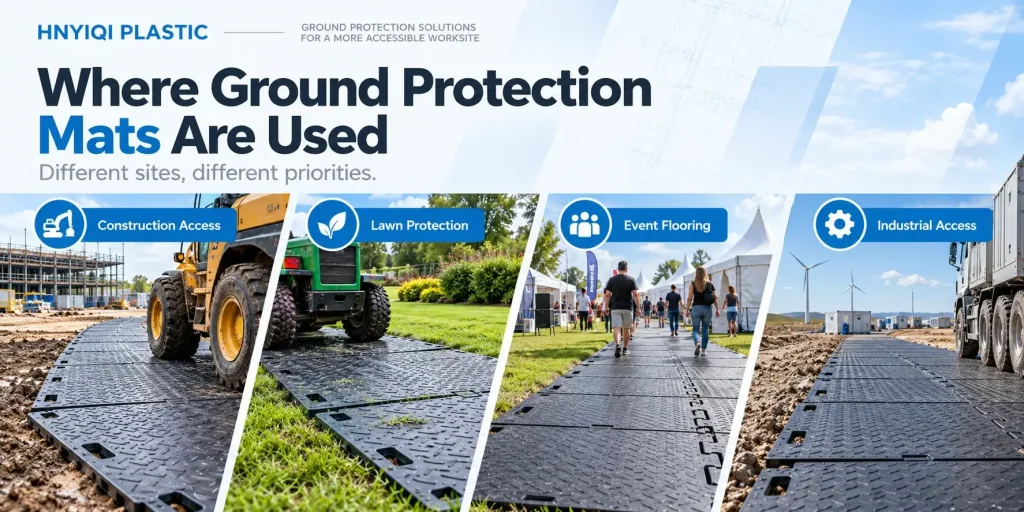
Ground protection mats are used wherever temporary access is needed without permanently changing the existing ground. Their applications range from construction entrances and landscaped properties to outdoor events and industrial access routes.
However, the reason for installing mats changes from one site to another. Some projects focus on preventing damage to finished surfaces, while others need to keep vehicles moving across wet or unstable ground. These differences affect the layout, surface texture, and type of mat required.
Construction Sites and Temporary Vehicle Access
Construction projects require vehicles to cross areas that were never designed for repeated traffic. Excavators, delivery trucks, concrete equipment, and site vehicles may need temporary access before permanent roads are available.
On exposed soil, repeated wheel movements can create ruts, particularly after rainfall. These depressions may collect water and make later vehicle movements more difficult.
Ground protection mats can be installed along designated routes to reduce direct ground disturbance and provide a more consistent driving surface. They are also useful for creating temporary crossings between work zones.
A practical detail that deserves attention is the turning area. Straight routes and turning points do not experience the same forces. When loaded trucks turn, tire movement can introduce substantial lateral forces, increasing the risk of panel movement or surface displacement.
For this reason, a construction access plan should consider not only the length and width of the route, but also where vehicles will turn, stop, and brake.
Landscaping, Lawns, and Property Maintenance
For landscaping work, the primary concern is surface damage rather than vehicle mobility.
Equipment such as compact loaders, mini excavators, and material transport vehicles may need to pass over established lawns, gardens, or landscaped areas. Even when the ground appears firm, repeated traffic can leave tire marks, compress soil, or damage grass roots.
Ground protection mats create a temporary separation between equipment and the finished landscape, helping reduce direct wear and localized damage.
One important consideration is how long the mats remain in place. Grass beneath a covered surface receives less light and ventilation, and prolonged coverage may affect its condition.
Temporary installation should therefore be planned around the expected working period, weather, soil moisture, and sensitivity of the vegetation.
Protecting a finished lawn also requires attention to installation and removal. Dragging contaminated panels across grass, or allowing sharp debris to become trapped beneath them, can cause the very damage the mats were intended to prevent.
Outdoor Events and Temporary Pedestrian Areas
Outdoor exhibitions, festivals, temporary camps, and other short-term facilities may require walkways or usable surfaces over grass, soil, or compacted sand.
Unlike vehicle access routes, these applications prioritize pedestrian comfort, surface stability, drainage, and minimizing trip hazards.
A temporary camp project, for example, may involve large areas occupied by tents, beds, chairs, and pedestrian traffic rather than heavy machinery. In this situation, designing every section around heavy construction vehicle loads could introduce unnecessary material weight and installation cost.
For an illustrative 35 × 35 m tent area, the floor coverage is 1,225 m². Using 1220 × 2440 mm panels, this represents approximately 412 panels by area alone, before accounting for cutting, layout, gaps, and edge details.
The calculation is useful for early quantity planning, but the final panel count must be based on the actual layout, particularly where the floor dimensions do not match the panel dimensions.
For pedestrian applications, surface patterns also matter. A pronounced vehicle traction pattern may be less comfortable for walking or moving lightweight equipment than a lower-profile texture.
Where accessible routes or public walkways are required, the finished surface should also be checked against applicable accessibility and slip-resistance requirements.
Industrial Sites, Mining, and Remote Access Routes
Industrial and remote projects present a different challenge: maintaining access where conventional road construction may be impractical, temporary, or difficult to maintain.
Examples include mining operations, pipeline construction, utility maintenance, and equipment access across undeveloped land.
In mining-related ground protection inquiries, we have encountered requirements involving heavy vehicle traffic, muddy seasonal conditions, steep route sections, and large coverage areas. Under these conditions, the project cannot be evaluated from vehicle weight alone.
A route that performs adequately on firm, level ground may behave differently on saturated soil or an incline. Repeated braking, acceleration, and loaded vehicle movements can affect both the mats and the underlying ground.
For long temporary routes, installation logistics become particularly important. Panel dimensions influence the number of units required, while connection methods affect installation time and the ability to maintain a continuous driving surface.
Improving access does not mean that higher vehicle speeds are automatically safe. Any proposed operating speed must be assessed against the vehicle, ground conditions, route geometry, and stability of the installed mat system.
How the Application Changes the Project Requirements
These examples show why specifying ground protection mats by application name alone is insufficient.
A lawn protection project and a mining access route may both use polyethylene panels, but their operating conditions and purchasing priorities are different.
When reviewing a project, the most useful starting information is what will travel over the mats, what surface lies underneath, and how long the system needs to remain in service.
Those answers help you identify the appropriate type of mat. The next stage is more technical: determining how vehicle loads, ground conditions, and panel dimensions influence the selection.
That is where thickness, load capacity, and mat size need to be examined together rather than as separate specifications.
Load Capacity, Ground Conditions, and Mat Size
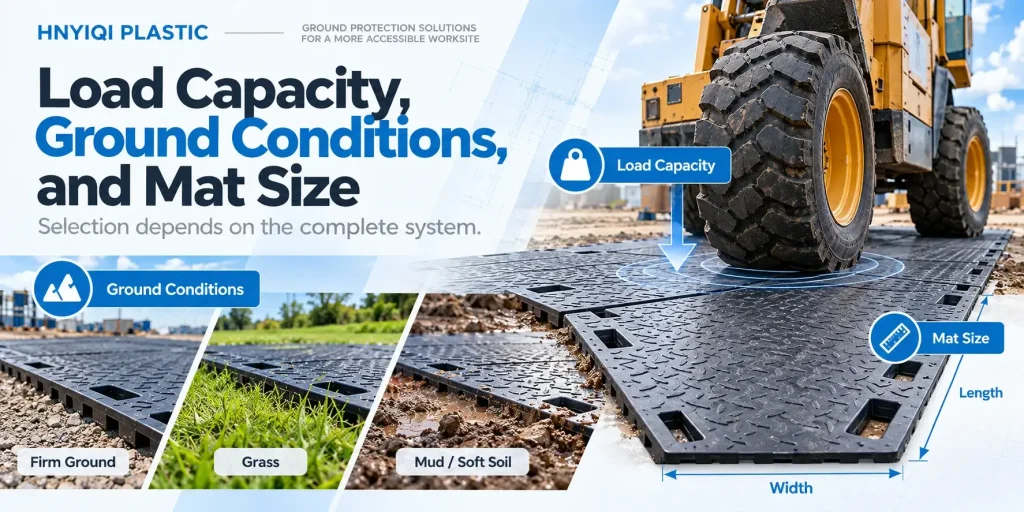
A ground protection mat’s stated load capacity is one of the first specifications buyers notice. Yet a figure such as 30 or 80 tonnes cannot fully describe how a mat will perform on a particular site.
The load a ground protection mat can safely accommodate depends on both the mat system and the ground supporting it. Vehicle configuration, wheel or track contact pressure, repeated traffic, and the condition of the underlying soil all influence the outcome.
A mat that performs well on compacted ground may experience excessive bending or settlement over saturated soil. This is why load capacity, ground conditions, and mat dimensions need to be evaluated together rather than treated as independent specifications.
What Does Ground Protection Mat Load Capacity Really Mean?
Manufacturers may describe load capacity using a maximum vehicle weight, a load-bearing range, or a tested pressure value. These figures are not necessarily based on the same test methods or ground conditions.
For example, a mat advertised for vehicles weighing up to 30 tonnes should not automatically be considered suitable for every 30-tonne vehicle.
Gross vehicle weight is not the same as the load applied at an individual wheel or track.
Consider a truck with a gross weight of 30 tonnes. Its weight is distributed across its axles, but that distribution may be uneven. The load reaching each contact point depends on axle configuration, cargo distribution, tire pressure, and vehicle movement.
A 30-tonne wheeled truck also applies loads differently from a tracked machine of the same total weight.
When checking a manufacturer’s load rating, you should establish:
- Rating basis: Was the figure obtained through testing, engineering calculation, or an indicative application assessment?
- Supporting surface: Was the mat tested on concrete, compacted soil, or another specified ground condition?
- Loading arrangement: Does the rating refer to total vehicle weight, wheel load, track load, or concentrated equipment loads?
- Operating conditions: Does the stated performance cover repeated vehicle movements, turning, braking, or static loading?
A published load rating is useful for comparing products, but it does not replace an assessment of the actual site conditions.
Why Ground Conditions Matter as Much as Mat Strength
Even a strong panel requires sufficient support beneath it.
When a wheel passes over a mat, the applied force travels through the panel into the ground. If the supporting soil deforms excessively, the mat may bend, settle, or lose stable contact with the surrounding surface.
Different ground conditions create different risks.
| Ground Condition | Main Concern | What to Check Before Selection |
|---|---|---|
| Compacted Gravel or Firm Soil | Local unevenness and concentrated loading | Surface level, compaction, and wheel loads |
| Grass or Landscaped Ground | Rutting, soil compaction, and vegetation damage | Soil moisture, traffic frequency, and protection period |
| Wet Clay or Muddy Soil | Settlement, suction, and loss of support | Rut depth, drainage, and ground strength |
| Loose Sand | Displacement and uneven support | Sand density, rutting, and movement under traffic |
| Sloped or Uneven Ground | Panel movement and concentrated edge loading | Gradient, turning forces, and local support |
For projects involving weak or variable soils, the California Bearing Ratio (CBR) can provide useful information about subgrade strength.
CBR is a penetration-resistance index expressed as a percentage. A lower value indicates lower resistance under the test conditions, but it is not a direct measurement of allowable ground bearing pressure.
For laboratory testing, ASTM D1883-21 provides a method for determining the CBR of compacted soils. Results should be interpreted with the specimen’s moisture, compaction, and soaking conditions in mind.
It also cannot independently determine whether a ground protection mat is suitable.
For example, a project with a low measured CBR may require ground improvement, additional support layers, a more suitable mat system, or restrictions on vehicle movements.
There is no reliable universal CBR threshold that makes every HDPE mat safe for heavy vehicles. The acceptable conditions depend on the complete ground and mat system, the applied loads, and the permitted level of deformation.
Where the consequences of ground failure are significant, site-specific geotechnical assessment should take priority over a supplier’s indicative load rating.
How Mat Thickness and Size Affect Performance
Once the load and ground conditions are understood, mat dimensions become more meaningful.
Thickness primarily influences the panel’s bending behavior, while length and width influence coverage, layout, handling, and the way loads can be transferred through the supported panel.
A thicker solid HDPE mat has greater bending stiffness than a thinner mat made from the same material. However, increasing thickness also increases weight and does not guarantee a proportional increase in allowable vehicle load.
Consider three solid HDPE panels with identical plan dimensions of 1220 × 2440 mm.
| Nominal Thickness | Calculated Panel Weight | Weight Difference Compared with 10 mm |
|---|---|---|
| 10 mm | 28.3 kg | Reference |
| 12.7 mm | 35.9 kg | +7.6 kg |
| 20 mm | 56.6 kg | +28.3 kg |
Note: Calculated using a material density of 950 kg/m³ and a flat, solid panel measuring 1220 × 2440 mm. Actual finished weights vary with surface patterns, handles, material formulation, and manufacturing tolerances. These values are not load ratings.
Moving from 10 mm to 20 mm approximately doubles the material weight for panels of the same length and width.
This affects shipping, installation labor, and the practicality of moving mats between sites.
Larger panels cover more ground per unit, potentially reducing the number of joints along a route.
However, they can be harder to handle, and their total surface area should not be mistaken for the effective area distributing a particular wheel load.
For instance, a 1220 × 2440 mm panel covers approximately 2.98 m², while a 1000 × 2000 mm panel covers 2.00 m².
The larger panel provides about 49% more plan coverage, but that does not mean it has 49% greater load capacity.
The actual difference depends on panel construction, load position, support conditions, and the required route configuration.
Why Vehicle Loading and Traffic Frequency Change the Assessment
Two projects using identical mats may experience very different loading demands.
A temporary walkway used by pedestrians has a different loading pattern from an access road carrying loaded trucks throughout a working day.
Even where two vehicles have the same gross weight, their effects can differ because of axle loads, contact areas, speed, and maneuvering.
Repeated traffic also matters. A mat may withstand an individual vehicle pass without visible damage while the underlying ground progressively develops settlement or ruts.
This becomes particularly important when designing access routes for industrial or mining operations.
In a mining access inquiry we reviewed, the customer planned to use ground protection mats for vehicles weighing up to approximately 120 tonnes on muddy terrain, including sloped sections. The project also involved substantial seasonal temperature variations, making ground support and operating conditions important parts of the initial assessment.
That 120-tonne figure describes the customer’s intended operating requirement, not a verified load capacity for the proposed mats.
Before recommending a complete system for such a project, the critical information includes actual axle or track loading, supporting soil conditions, traffic frequency, route geometry, and the performance required during wet weather.
A successful assessment must consider more than whether the panel itself can withstand a single heavy load.
What You Should Confirm Before Choosing a Mat Size
For an initial technical review, the most useful project information is:
- Equipment details: Vehicle type, maximum operating weight, axle arrangement, and wheel or track dimensions.
- Ground conditions: Soil type, drainage, moisture condition, and available ground strength test results.
- Traffic requirements: Expected vehicle passes, turning locations, gradients, and planned operating speeds.
- Coverage requirements: Route width, total length or area, installation duration, and handling constraints.
- Performance requirements: Acceptable rutting or settlement, surface protection priorities, and any required product testing.
At HNYIQI PLASTIC, project details such as these help us distinguish a standard surface protection requirement from one that may need additional ground preparation, a different panel design, or engineering verification.
Mat thickness and advertised load capacity are starting points for selection, not substitutes for understanding the complete loading conditions.
After selecting a suitable mat specification, installation becomes the next important consideration. Even a properly selected panel can perform poorly if the ground is inadequately prepared, adjacent mats are incorrectly connected, or the route is not maintained during use.
The following section explains how installation, connection methods, and operating practices affect the performance of a temporary ground protection system.
Installation, Connections, and Safe Use
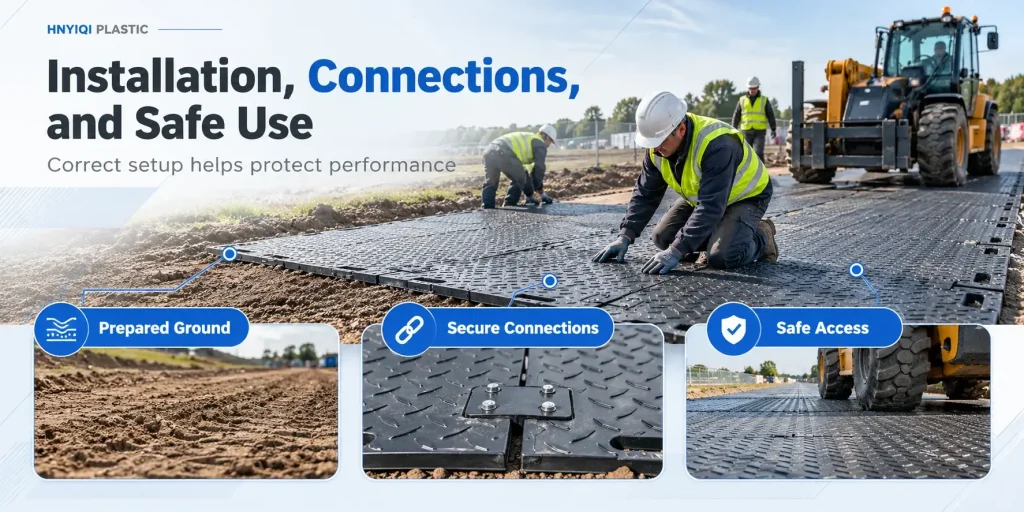
Choosing the right ground protection mat is only part of creating a reliable temporary access route.
Once the panels arrive on site, ground preparation, panel alignment, connections, and daily operating conditions all influence how the system performs.
A properly specified mat can still shift, bend excessively, or create a trip hazard if it is installed over unsupported ground or exposed to traffic conditions that were not considered during planning.
The installation process does not need to be complicated, but several details deserve attention before vehicles or pedestrians begin using the route.
Prepare the Ground Before Laying the Mats
Start by walking the proposed route and identifying areas with standing water, deep ruts, loose material, or significant changes in ground level.
Remove sharp stones, construction debris, and other objects that could create concentrated pressure beneath the panels. Where the ground is uneven, suitable grading or filling may be needed to establish more consistent support.
Do not use ground protection mats to conceal holes, unsupported voids, or unstable sections of soil. A panel may bridge a small surface irregularity, but a large unsupported area can cause excessive bending when a wheel passes over it.
On wet or soft ground, consider whether additional preparation is necessary.
Depending on the project, this could include drainage improvements, a suitable geotextile separation layer, or a properly designed granular support layer.
A geotextile can help separate soil from imported aggregate, but it does not automatically provide sufficient load-bearing capacity.
Before installation, check that the prepared route can support the intended traffic and that drainage will not direct water into weak sections beneath the mats.
Arrange Panels to Match the Traffic Route
Panel orientation affects coverage, the number of joints, and how vehicles encounter the mat edges.
For a straight temporary road, lay out the panels so the route provides adequate width for the vehicle body, tires or tracks, and any required operating clearance. Remember that turning vehicles may need more space than their nominal width.
For example, placing three 1300 mm-wide panels side by side creates a nominal route width of 3.9 m before accounting for installation gaps and edge details.
A 3.9 m nominal route is not automatically wide enough for every heavy vehicle. Vehicle dimensions, steering behavior, lateral clearance, and site restrictions still need to be checked.
Pay particular attention to panel joints. Unsupported edges and poorly aligned connections may become movement points when wheels repeatedly pass over them.
Where the surface changes from the mat system to exposed ground, examine whether the transition could create abrupt steps, wheel impacts, or trip hazards.
The layout should also allow for the material’s thermal movement. HDPE expands and contracts as temperature changes, so panels should not be forced into a completely rigid arrangement without considering the manufacturer’s installation requirements.
Connect Mats Without Restricting Necessary Movement
Connection systems help adjacent mats remain aligned and reduce relative movement during use.
Some HDPE ground protection mats are manufactured with two-hole or four-hole connection arrangements, while other products use integrated interlocking edges or dedicated joining hardware.
The appropriate connection method depends on the panel design, traffic direction, and expected forces.
In a project with a Polish customer, we optimized the mat connection areas and pin design to simplify installation and reduce manual adjustments. See our customized HDPE ground protection mats case study for details.
In projects where vehicles will travel along long temporary routes, connection planning matters because braking, acceleration, and turning can create forces that tend to shift individual panels.
However, connectors are not structural substitutes for stable ground support. They cannot prevent the underlying soil from settling, and the presence of additional connectors does not automatically increase the panel’s verified load capacity.
Before traffic begins, confirm that each connection is installed as specified, does not protrude into the travel surface, and allows any thermal movement required by the system.
For temporary pedestrian areas, exposed connectors, raised joints, and uneven panel edges also need to be checked for trip hazards.
Case Study: Customized HDPE Ground Protection Mats Improved Installation Efficiency for Outdoor Applications
Case Study: Customiz
In projects where vehicles will travel along long temporary routes, connection planning matters because braking, acceleration, and turning can create forces that tend to shift individual panels.
However, connectors are not structural substitutes for stable ground support. They cannot prevent the underlying soil from settling, and the presence of additional connectors does not automatically increase the panel’s verified load capacity.
Before traffic begins, confirm that each connection is installed as specified, does not protrude into the travel surface, and allows any thermal movement required by the system.
For temporary pedestrian areas, exposed connectors, raised joints, and uneven panel edges also need to be checked for trip hazards.
Control Vehicle Movement and Site Hazards
Once the route is installed, its operating conditions should remain consistent with the assumptions used during selection.
Vehicle speed, wheel loading, turning behavior, and braking forces can all affect mat movement and ground deformation.
Where heavy vehicles are involved, establish a site-specific operating speed based on the route geometry, surface condition, equipment characteristics, and risk assessment. There is no single safe speed applicable to every ground protection mat installation.
Avoid sudden steering or harsh braking where possible, particularly on wet surfaces and at transitions between panels.
You should also restrict access to sections showing excessive settlement, displaced mats, damaged connections, or loss of ground support until the cause has been assessed and corrected.
For pedestrian routes, inspect the surface for mud accumulation, loose panels, exposed fasteners, and uneven edges. A textured surface can still become slippery when contaminated.
Installation should follow the mat manufacturer’s instructions and the site’s relevant safety procedures. For demanding vehicle access projects, engineering review may be necessary before the route is opened.
Inspect, Remove, and Store Mats for Reuse
Ground protection mats are reusable, but their condition should be checked throughout the project rather than only when they are removed.
After installation, establish an inspection routine based on traffic intensity, weather, and ground conditions. Additional checks may be necessary after heavy rain, repeated heavy-vehicle movements, or any visible change in the route.
Focus on panel cracks, permanent deformation, movement at joints, connector damage, and settlement of the supporting ground.
During removal, clear excessive mud and debris before lifting panels. Use appropriate handling equipment or team lifting methods based on the actual panel weight and site conditions.
For reference, a flat 1220 × 2440 × 12.7 mm HDPE panel weighs approximately 36 kg when calculated at a density of 950 kg/m³. Molded surface patterns, handles, and material formulation will affect the finished weight.
Clean and inspect the mats before storage. Stack them on suitable supports in a stable arrangement, following the manufacturer’s storage recommendations, and separate any damaged panels for assessment before their next use.
The goal is not simply to recover the mats after a project, but to preserve their condition for the next installation.
These installation practices help protect the performance of the selected mat system. They also influence the actual cost of reuse, which becomes particularly relevant when comparing ground protection mats with temporary alternatives such as plywood.
Benefits and Limitations Compared with Plywood
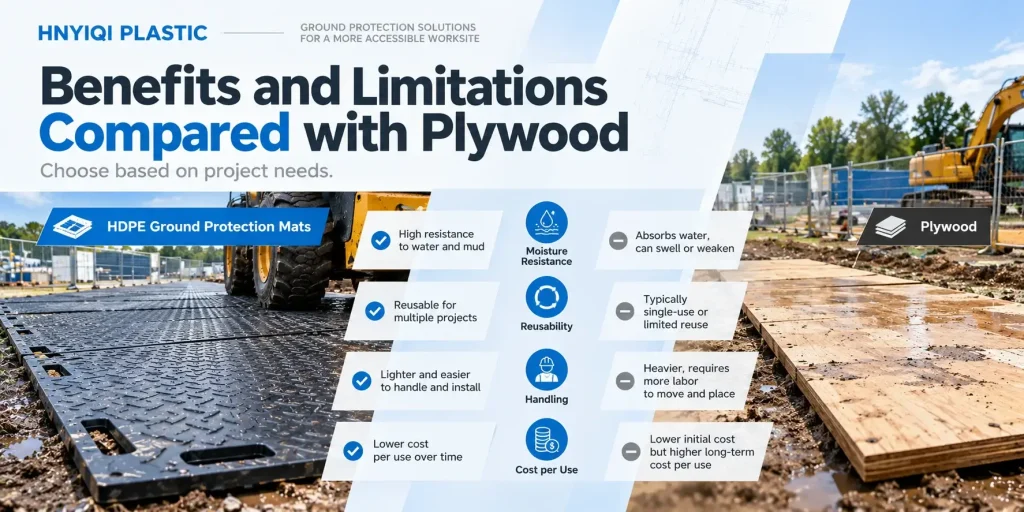
Plywood is still used for temporary ground protection because it is widely available, can be cut on site, and may cost less to purchase initially. HDPE ground protection mats offer a different combination of properties, particularly when the panels need to withstand moisture, repeated handling, and use across multiple projects.
The better option depends on how long the protection is needed, how many times the panels will be reused, and what conditions they will face. Comparing purchase prices alone can overlook costs associated with replacement, handling, cleaning, and disposal.
Moisture Resistance and Repeated Outdoor Use
One of the clearest differences between HDPE mats and plywood is how they respond to water.
HDPE has very low water absorption and does not rot. A ground protection mat made from suitable HDPE can be washed after exposure to mud and returned to service, provided it remains structurally sound.
Plywood behaves differently. Its wood veneers can absorb moisture, especially through exposed edges, drilled holes, or damaged surfaces. Prolonged exposure may cause swelling, warping, or delamination, depending on the plywood grade, adhesive system, and protective treatment.
Exterior-rated or marine-grade plywood can offer better moisture resistance than untreated interior plywood, but it should not be considered waterproof simply because it is sold for outdoor use.
For a short project on reasonably dry ground, plywood may provide adequate temporary protection. Where panels are exposed to repeated wet conditions and frequent relocation, HDPE offers a material advantage because its performance is not dependent on keeping wood veneers dry.
Reusability, Handling, and Surface Protection
HDPE mats designed for temporary access may include molded handles, textured surfaces, and connection points. These features can make it easier to create a consistent layout, lift individual panels, and reuse the same system on another site.
Plywood sheets can also be reused, but their condition after each project matters. Damaged corners, protruding fasteners, splintering edges, and moisture-related deformation may limit further use.
Weight is worth comparing with actual specifications rather than assumptions.
For example, a solid HDPE panel measuring 1220 × 2440 × 12.7 mm has a theoretical weight of approximately 35.9 kg, based on a density of 950 kg/m³.
A plywood sheet of the same length and width at 18 mm thickness would weigh approximately 32.2–40.2 kg if its density were between 600 and 750 kg/m³.
These are calculated examples, not measured product weights. They also compare different thicknesses and do not establish equivalent load-bearing performance.
HDPE mats are not automatically lighter than plywood. The result depends on panel thickness, dimensions, material density, and construction.
For finished lawns or sensitive surfaces, the underside of the panel, trapped debris, and installation method are just as important as the material. Neither HDPE nor plywood can guarantee damage-free ground protection if the supporting soil deforms under traffic.
Comparing Purchase Price with Cost per Use
Plywood can be attractive when the requirement is small, the project lasts only a few days, and the panels are unlikely to be needed again.
For contractors or rental businesses working across multiple sites, the calculation changes. A reusable system may cost more initially but reduce the need to purchase replacement panels for each project.
Consider a simplified cost example:
| Cost Factor | HDPE Ground Protection Mat | Plywood |
|---|---|---|
| Assumed Initial Cost per Panel | $120 | $35 |
| Assumed Usable Project Cycles | 20 | 3 |
| Initial Material Cost per Use | $6.00 | $11.67 |
Note: Illustrative assumptions only. These figures are not current market quotations, verified service lives, or guaranteed reuse cycles. Both products must be inspected before reuse. Freight, installation, cleaning, storage, and disposal costs are excluded.
Under these assumptions, HDPE has a lower initial material cost per use despite its higher purchase price.
However, the result is sensitive to actual purchase prices and the number of times each material can be reused.
A lower cost per use only becomes meaningful when the panels remain serviceable and are actually used enough times to recover the higher initial investment.
You should also consider freight, installation labor, cleaning, storage, damaged-panel replacement, and end-of-life handling. These costs can change the comparison significantly, particularly when panels are transported between distant sites.
Where Plywood May Still Be the Practical Choice
HDPE mats are not necessary for every temporary protection job.
Plywood may remain a reasonable choice when you need a small number of panels for a short, relatively dry project, particularly if the required sheet sizes can be sourced locally and reused for another purpose afterward.
It can also be cut and modified using widely available woodworking tools, although cutting or drilling may affect its durability and suitability for repeated outdoor exposure.
HDPE mats have their own limitations. Their higher initial cost may be difficult to justify for a single short-term job. Large molded panels also need storage space, and their flexibility does not eliminate the need for suitable ground support.
On wet slopes or muddy surfaces, neither plywood nor HDPE should be selected solely on the assumption that the material itself will prevent slipping or ground failure. Surface traction, connections, vehicle behavior, and the supporting soil still require attention.
When comparing options, ask whether the priority is an inexpensive temporary covering or a reusable access system intended for repeated deployment.
The answer helps establish the purchase strategy, but it does not settle the final specification. The next section brings together vehicle loading, ground conditions, coverage requirements, and operating priorities to help you choose a suitable ground protection mat for your project.
How to Choose the Right Mat for a Project
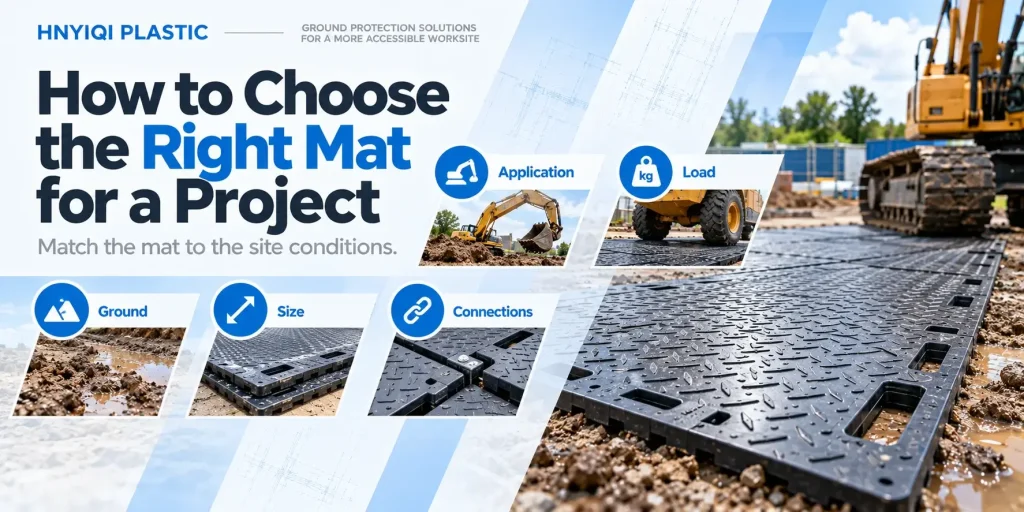
By this stage, you should have a clearer understanding of what ground protection mats can do, how they work, and where their limitations lie.
The final decision is about matching a specific mat system to the conditions of your project.
Start with the job the mats need to perform, not the thickness or advertised load capacity. A temporary walkway, a landscaped access route, and a road carrying loaded construction vehicles may require very different specifications, even when the panels look similar.
The following five steps will help you narrow down the options and prepare the information needed for a meaningful technical recommendation.
Step 1: Define the Main Purpose and Duration
First, identify what you need to protect or accomplish.
Are you trying to prevent damage to a finished lawn, create a temporary route for construction equipment, or maintain vehicle access during wet weather?
The answer determines which performance requirements deserve priority.
For pedestrian areas, surface comfort, slip resistance, and edge transitions may be more important than heavy-vehicle loading. For repeated machinery access, ground support, panel movement, and resistance to repeated loading become more significant.
Also establish the installation period and whether the mats will be reused.
A ten-day installation used once has different cost and handling priorities from a mat system deployed across several construction projects each year.
This distinction helps you avoid paying for performance or structural features your project does not require.
Step 2: Identify the Maximum Loads and Ground Conditions
Before selecting a thickness, gather information about the equipment that will use the route and the ground beneath it.
For vehicles, provide the model, maximum operating weight, axle configuration, and tire or track dimensions whenever available.
If a route will carry several types of equipment, identify the vehicle or loading arrangement that creates the most demanding conditions. This may not be the vehicle with the highest total weight.
Next, describe the supporting surface. Is it compacted gravel, grass, clay, loose sand, or ground that becomes saturated after rainfall?
If geotechnical data such as CBR measurements are available, include them along with the test conditions. Photographs showing existing ruts, soft areas, or drainage problems can also help identify potential risks.
In project discussions involving heavy vehicles, a vehicle model and photographs of the proposed route can be more useful for initial screening than an unsupported request for a “100-tonne mat.”
They do not replace engineering data, but they help identify what still needs to be verified.
Where ground conditions are uncertain or failure could create significant safety risks, obtain an appropriate site assessment before selecting the system.
Step 3: Match Panel Dimensions and Surface Design to the Route
Once the loading and support conditions are understood, consider the physical layout.
Panel length and width influence the number of mats, route width, connections, and installation effort. Thickness affects panel weight and bending behavior, but it should not be selected from a fixed vehicle-weight chart without considering the complete mat system.
For example, if you need to cover a straight route measuring 100 m long and 4 m wide, the nominal coverage area is:
100 m × 4 m = 400 m²
With 1220 × 2440 mm panels, dividing the area by approximately 2.98 m² per panel gives a theoretical minimum of about 135 panels.
However, this is an area-based estimate, not a finished installation plan. Actual quantities depend on panel orientation, the required route width, connections, cutting, and edge arrangements.
Surface design should also reflect how the route will be used. Vehicle traffic may benefit from a pronounced traction pattern, while pedestrian areas may require a lower-profile, more comfortable walking surface.
Choose the panel arrangement and texture around the movement expected on site, rather than selecting a product based on appearance alone.
Step 4: Review Connections, Handling, and Site Constraints
A suitable mat must also be practical to transport, install, maintain, and remove.
Consider how the panels will arrive, whether machinery is available for unloading, and how they will be moved around the site.
Check the proposed connection system against the route layout, especially at turning points, sloped sections, and transitions.
For large temporary access projects, connection quantities and installation labor can become meaningful cost factors.
If the mats will be used in areas with substantial temperature changes, confirm the manufacturer’s guidance on thermal movement, storage, and installation.
You should also establish how the route will be inspected and who will be responsible for responding to settlement, displaced panels, or damaged connections.
The most economical panel on paper may not be the most practical option if it requires excessive handling or creates avoidable installation difficulties.
Step 5: Verify the Specification Before Ordering
Before placing an order, request a specification that clearly identifies the proposed product and its intended use.
You should be able to confirm:
| Selection Factor | Information to Confirm | Why It Matters |
|---|---|---|
| Project Application | Vehicle access, pedestrian traffic, lawn protection, or temporary flooring | Identifies the main performance requirements |
| Vehicle and Load | Maximum operating weight, axle loads, tire or track dimensions | Helps assess loading conditions beyond gross vehicle weight |
| Ground Conditions | Soil type, moisture, drainage, and available CBR data | Helps determine whether the underlying ground can support the proposed system |
| Mat Dimensions | Length, width, thickness, and dimensional tolerances | Affects coverage, handling, layout, and panel bending behavior |
| Surface and Connections | Traction pattern, connection holes, compatible hardware, and route layout | Influences traction, alignment, and installation practicality |
| Project Duration | Installation period, expected traffic, and planned reuse | Supports durability, maintenance, and cost-per-use assessment |
| Performance Verification | Relevant test reports, rating conditions, and site trial requirements | Helps verify suitability before full-scale installation |
Note: This checklist supports preliminary product selection. Final suitability should be confirmed against actual ground conditions, loading requirements, and applicable project safety criteria.
For projects involving demanding vehicle loads or difficult ground conditions, a sample inspection or controlled site trial may be necessary before committing to full-scale installation.
A small sample can help assess material, dimensions, and surface finish. It cannot, by itself, verify the performance of a complete temporary roadway under heavy traffic.
The extent of testing should match the risk, scale, and operating requirements of the project.
Turn Your Site Requirements into a Practical Mat Specification
You do not need to determine every technical parameter before contacting a manufacturer.
Start with the information you already have: what will use the mats, the ground conditions, the coverage area, and the expected installation period. Add vehicle data, drawings, photographs, or test results where available.
At HNYIQI PLASTIC, these details help us review whether a standard HDPE ground protection mat is a reasonable starting option, what dimensions and surface design may suit the application, and which conditions require further verification.
A useful quotation should do more than list a panel size and unit price. It should make clear what is being supplied, why the proposed specification fits the stated requirements, and what still needs to be confirmed.
If you are planning a temporary access route, construction project, or outdoor flooring installation, you can share your project requirements with our team through HNYIQI PLASTIC to discuss available ground protection mat options.
The right choice is not necessarily the thickest or most expensive mat. It is the system that offers an appropriate balance of ground protection, safe operation, installation practicality, and total project cost under the conditions you have identified.
FAQs
What are ground protection mats made of?
Ground protection mats are primarily made from high-density polyethylene (HDPE), reinforced polymers, and composite materials. HDPE is a widely used option for solid ground protection mats because it offers impact resistance, low water absorption, flexibility, and durability during repeated outdoor use.
HDPE mats can be manufactured from virgin resin, recycled polyethylene, or controlled material blends, depending on the required performance. Some heavy-duty systems use reinforced composite structures to achieve different stiffness and load-distribution characteristics. UHMWPE is another polyethylene grade that may be considered for specialized applications where high abrasion resistance is required.
The material alone does not determine load capacity; panel thickness, construction, and ground conditions also matter.
Do ground protection mats work on grass?
Yes. Ground protection mats can help protect grass from direct tire damage, rutting, and repeated equipment movement, making them suitable for temporary construction access, landscaping work, and outdoor events.
However, the level of protection depends on soil moisture, vehicle loads, and how long the mats remain in place. Heavy equipment can still compact the soil beneath the panels, while extended coverage can restrict sunlight and air circulation, potentially damaging the grass.
For sensitive lawns, remove the mats as soon as the work is completed, avoid trapping stones or debris underneath, and inspect the ground during extended installations.
How much weight can ground protection mats hold?
Ground protection mat load capacities vary significantly by material, thickness, panel construction, and supporting ground conditions. Some heavy-duty products are advertised for vehicles weighing 30–100 tonnes or more, but these figures should not be interpreted as universal safe working loads.
A mat supporting a truck on compacted gravel may perform differently on saturated clay, even with the same vehicle weight.
To assess suitability, confirm the maximum vehicle weight, axle or wheel loads, soil conditions, and the manufacturer’s rating or test basis. For demanding applications, site-specific engineering evaluation may be required.
Are ground protection mats reusable?
Ground protection mat load capacity varies with material, thickness, panel construction, and ground support. There is no single weight limit that applies to all ground protection mats.
A mat used beneath a truck on compacted gravel may perform differently on saturated clay, even at the same vehicle weight.
To assess suitability, confirm the vehicle’s maximum operating weight, axle or wheel loads, soil conditions, and the manufacturer’s load-rating conditions. For heavy-duty applications, request performance evidence relevant to your actual site conditions.
Can ground protection mats be used in mud?
Yes. Ground protection mats can be used on muddy ground to reduce rutting and create temporary access for vehicles or equipment. Textured HDPE mats can also help provide a more consistent tire contact surface than exposed mud.
However, effectiveness depends on mud depth, soil strength, drainage, and vehicle loading. On saturated or deeply rutted ground, additional preparation, such as grading or a suitable support layer, may be necessary.
Mats cannot make severely unstable ground safe for heavy traffic without adequate underlying support.
Do ground protection mats need connectors?
Not every installation requires connectors. Connectors are particularly useful for temporary roads, repeated vehicle traffic, sloped routes, and larger connected surfaces, where individual panels may shift during use.
Some HDPE mats accommodate two-hole or four-hole connection systems, while others use integrated interlocking edges. The appropriate arrangement depends on the panel design and traffic conditions.
For a short, low-traffic installation on stable ground, separate panels may be acceptable if permitted by the manufacturer’s instructions and site assessment. Connectors improve alignment but do not replace adequate ground support.
How long can protection mats stay on turf?
There is no fixed number of days that guarantees turf will remain undamaged beneath ground protection mats. The acceptable coverage period depends on grass type, temperature, moisture, sunlight, mat design, and traffic intensity.
Even without heavy vehicles, prolonged coverage can restrict light and air circulation, while trapped moisture and heat may stress the grass.
For sensitive or high-value lawns, keep the installation period as short as practical, inspect the turf during use, and remove or relocate panels when conditions require it. Do not assume that a mat advertised as grass-friendly can remain in place indefinitely.
Should ground protection mats be rented or bought?
Renting may be more economical for a one-time project, while buying can offer better value when mats are needed repeatedly. The decision depends on project duration, required quantity, transport distance, storage capacity, and expected reuse.
For example, if a project requires 100 mats, compare the complete rental cost—including delivery, collection, and potential damage charges—with the purchase cost plus transport, handling, storage, and maintenance.
If you expect to use the mats across several projects, calculate the cost per deployment. Buying becomes financially attractive when the total cost of ownership is lower than the cumulative rental cost.
Partner with a Professional Engineering Plastics Manufacturer
We provide stable and reliable engineering plastic sheets and custom processing solutions for your projects
Explore More Blogs


Hey There, I'm Balance!
I am the Supply Chain Manager of YIQI Plastic. With 9 years of experience, including 4 years in engineering plastics, I specialize in material sourcing, quality control, and supply chain management.Feel free to contact us.