
Home » Do Ground Protection Mats Harm Grass?
Do Ground Protection Mats Harm Grass?
- Author: Balance Lee
- 9+ Years of Manufacturing
Ground protection mats can protect your lawn from direct vehicle traffic, but they cannot completely eliminate the risk of damage. Heat buildup, blocked sunlight, trapped moisture, and repeated weight bearing can all affect the grass beneath the mats. If you plan to lay protection mats on your lawn, understanding these risks will help you choose the right mats, schedule their installation appropriately, and protect your lawn during both use and removal.
Table of Contents
When Ground Protection Mats Help Protect Grass
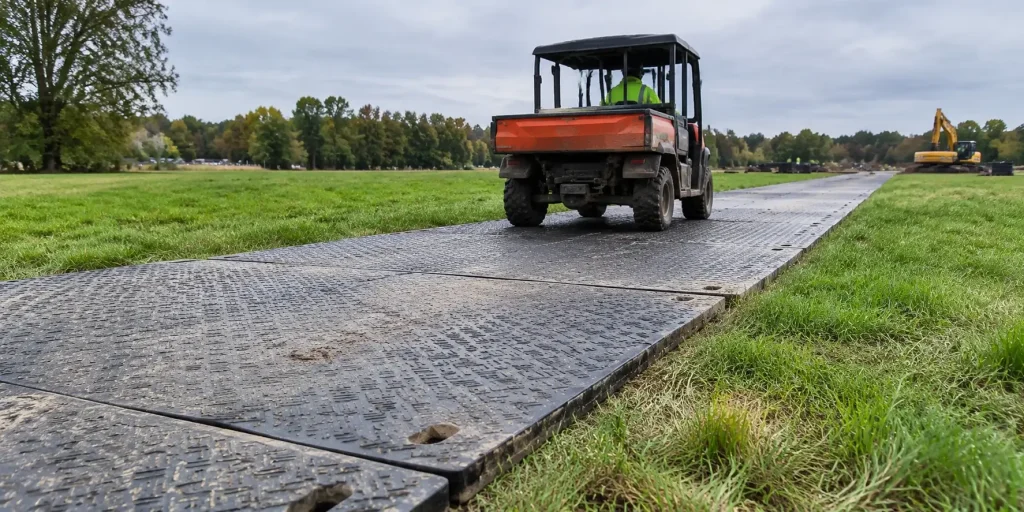
Ground protection mats can help reduce turf damage when grass needs temporary protection from vehicle traffi, heavy machinery or repeated foot traffic, provided the mats and ground conditions are suitable for the intended use.
By creating a physical barrier between the load and the lawn, they reduce direct contact with the grass blades and help limit the formation of ruts and surface disturbance. For more practical applications, explore our guide to the reasons to use ground protection mats.
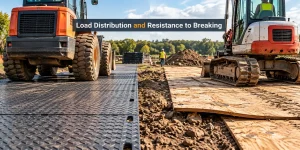
For construction access roads, outdoor activities, and landscaping projects, HDPE mats distribute wheel loads over a wider contact area compared to tires that come into direct contact with the ground. This helps reduce concentrated pressure on the ground, especially when the mats are laid on relatively firm, level soil. However, the actual protective effect depends on the stiffness of the mats, the load distribution, and the condition of the underlying soil.
This difference is even more pronounced on frequently traveled sections of road. Without a mat, repeated vehicle traffic can tear up the turf, create ruts, and cause the topsoil to shift. A properly installed mat system provides a smoother driving surface and reduces these direct mechanical impacts.
A key limitation is that protecting grass from physical damage does not guarantee its health beneath the mats. Even if the lawn appears undamaged during use, prolonged coverage may still pose other risks. The next step is to understand how reduced sunlight, heat buildup, and changes in humidity affect the grass.
How Heat, Light Loss, and Moisture Stress Turf
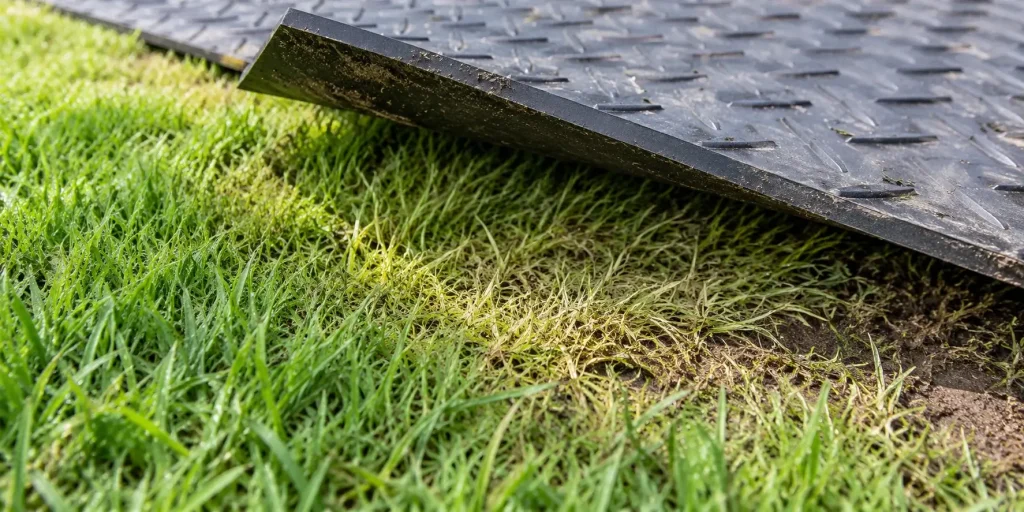
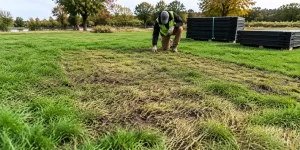
Although ground protection mats can prevent visible damage to the ground surface, the grass beneath them may still be affected by changes in sunlight, temperature, and humidity. As the duration of coverage increases, these effects become more pronounced, especially during hot weather or periods of vigorous grass growth.
Light loss: Grass needs sunlight for photosynthesis. Opaque HDPE mats block direct sunlight, thereby limiting the energy the grass can produce and gradually depleting its stored carbohydrates. Depending on the grass species, the season, and the duration of coverage, early symptoms may include white or yellowing leaves and reduced growth vigor. While transparent mats that allow light to pass through may help somewhat, they do not eliminate other environmental stresses.
Heat Build-Up: Dark-colored mats exposed to direct sunlight absorb a significant amount of solar heat. On hot days, the temperature at the junction between the mats and the turf may exceed the surrounding air temperature, especially in areas with poor air circulation. This can place additional stress on the lawn, which may already be struggling due to insufficient sunlight or lack of moisture. The temperature on the surface of the mats may not be the same as the temperature beneath it; therefore, appearance or color alone is not a reliable indicator of whether conditions are safe.
Moisture Imbalance: A solid mat restrict direct rainfall and irrigation from reaching covered grass,while also reducing evaporation from the soil surface. Wet ground may remain saturated for extended periods, increasing the risk of poor aeration in the root zone. Conversely, lawns growing in naturally dry soil may not receive sufficient moisture during prolonged periods of mulching.
These factors are also interact. In temporary access projects, a lawn that appears intact immediately after mat removal may gradually show signs of discoloration as the effects of prolonged shading or water stress become apparent.
The key in practice is to assess the condition of the turf rather than relying on a fixed “safe coverage period.” Weather, grass species, soil drainage, and duration of coverage are all contributing factors. In addition to these environmental stressors, repeated vehicle traffic poses another problem: soil compaction and root damage.
How Traffic Loads and Soil Compaction Affect Roots
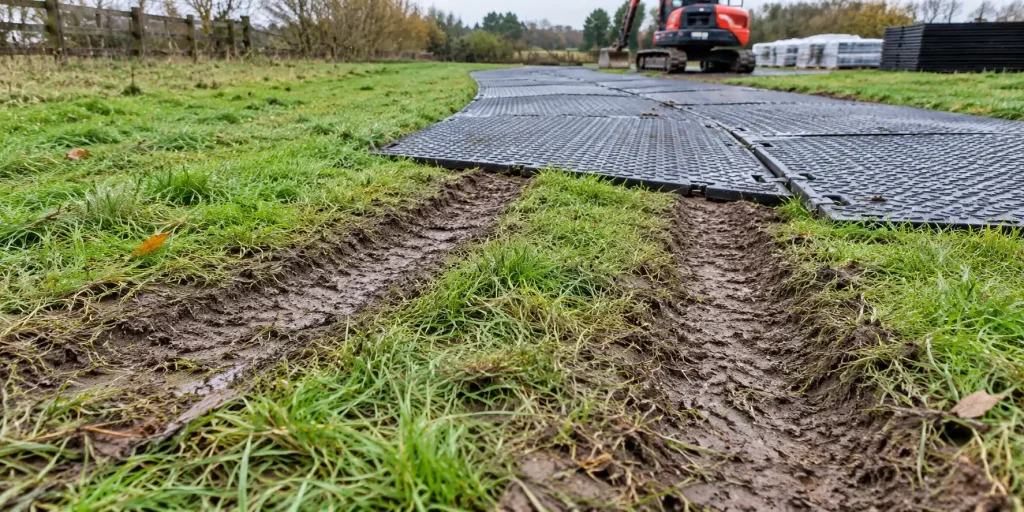
Although heat loss and reduced light exposure can affect the growth of the grass’s aboveground parts, repeated traffic can damage the soil structure that supports the grass roots. Ground protection mats help distribute the load, but the pressure does not disappear—it is simply transferred to the soil beneath the mat.
Vehicle Weight and Repeated Compaction: A single pass over firm, well-drained ground may cause almost no visible disturbance. However, repeated passes by trucks or equipment along the same route gradually compact the soil, especially when the soil is moist. As soil particles are pressed together more tightly, pore space decreases, thereby limiting the flow of air and water necessary for healthy root growth.
Soil conditions are just as important as vehicle weight. Moist clay is particularly prone to compaction, while firm, well-drained ground may provide more stable support. For example, a 5-metric-ton vehicle traveling on a saturated lawn may cause more severe localized damage than a heavier vehicle traveling on properly prepared, load-bearing ground. Vehicle weight alone is not a reliable measure of ground pressure; factors such as axle load, tire contact area, subgrade stiffness, and soil bearing capacity must also be considered.
On temporary construction access roads, ruts caused by repeated vehicle traffic, turf seams, and areas where vehicles turn or brake require particular attention. These locations may experience concentrated loads, turf displacement, and shear forces, thereby increasing the risk of rutting and root-zone disturbance, even when the turf blades are not in direct contact with vehicle tires.
Once the soil becomes compacted, grass roots may have difficulty extending into deeper layers, making it hard for them to access oxygen and moisture. As a result, soil recovery may take longer than the visible grass surface suggests.
The goal is not merely to select a mat with a load-bearing capacity that matches the vehicle’s weight, but to ensure that the entire mat system is suited to the ground conditions and the expected traffic volume. This leads to the next consideration: Which mat materials and designs provide adequate protection for natural turf?
Choosing Grass-Friendly Mat Materials and Designs
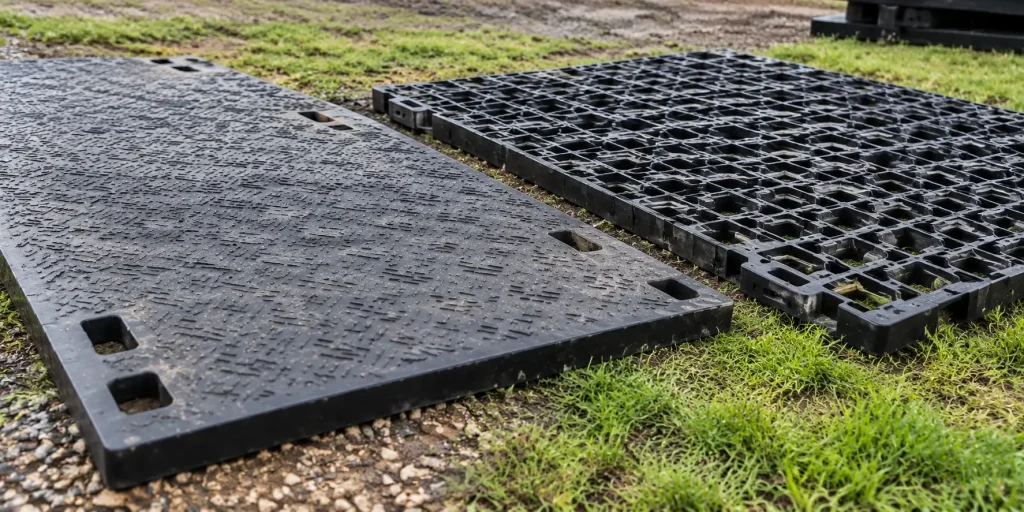
Once you understand how traffic loads and ground conditions affect grass, the next step is choosing a ground protection mat that can effectively distribute the load without placing unnecessary stress on the turf. The mat’s stiffness, surface design, drainage performance, and installation method all influence its performance.
Materials and Stiffness: HDPE ground protection mats strike an ideal balance between impact resistance, flexibility, and durability, making them suitable for temporary access routes. However, thickness alone does not determine their load-bearing capacity. A 20-millimeter-thick HDPE mat has greater bending stiffness than a 10-millimeter-thick mat made of the same material and with a similar structure. However, actual load-bearing performance also depends on the material grade, mat dimensions, subgrade support, and vehicle loads. On soft soil, a thicker mat cannot compensate for insufficient load-bearing capacity.
Light Transmission and Drainage: Solid, opaque HDPE mats are suitable for short-term traffic scenarios where load distribution is the primary consideration, but they block sunlight from reaching the grass beneath. Perforated or open-mesh designs allow for greater light, moisture, and air circulation, making them worth considering for pedestrian areas and light-load applications. Their suitability for vehicular traffic must be verified separately, as the reduced open area and contact surface may affect load distribution.
Surface Texture and Underside Design: Raised, non-slip tread patterns help tires and footwear maintain traction, especially on wet and slippery surfaces. To protect grass, outsole design is equally important. A wide and relatively smooth contact surface helps prevent pressure concentration, while overly prominent protrusions or sharp edges may dig into soft turf. The surface texture should provide sufficient traction while avoiding unnecessary damage to the ground beneath.
Connection and Installation Stability: When vehicles pass over the surface, any displacement, overlapping, or separation of the mats may cause the turf to come into direct contact with the tires. In situations involving repeated vehicle traffic, the use of compatible 2-way or 4-way connectors helps maintain alignment and reduces unnecessary displacement at the mat seams. Additionally, factors such as connection strength, ground conditions, and cornering loads must still be taken into account.
In product selection, we distinguish between routes used by heavy-duty vehicles and temporary pedestrian protection measures, rather than recommending the same mat design for every lawn. On surfaces with sufficient load-bearing capacity, rigid HDPE mats may be suitable for equipment traffic; whereas in light-traffic scenarios where lawn protection is a priority, open-cell grid systems are more appropriate. If you are comparing ground protection mats with plywood, our guide to ground protection mats vs plywood explains the practical differences in different aspects.
The best choice should balance mechanical protection with the grass’s needs for light, moisture, and air. Once the mat type has been selected, proper site preparation becomes the next key factor in preventing avoidable damage.
Preparing Turf Before Mats Are Installed
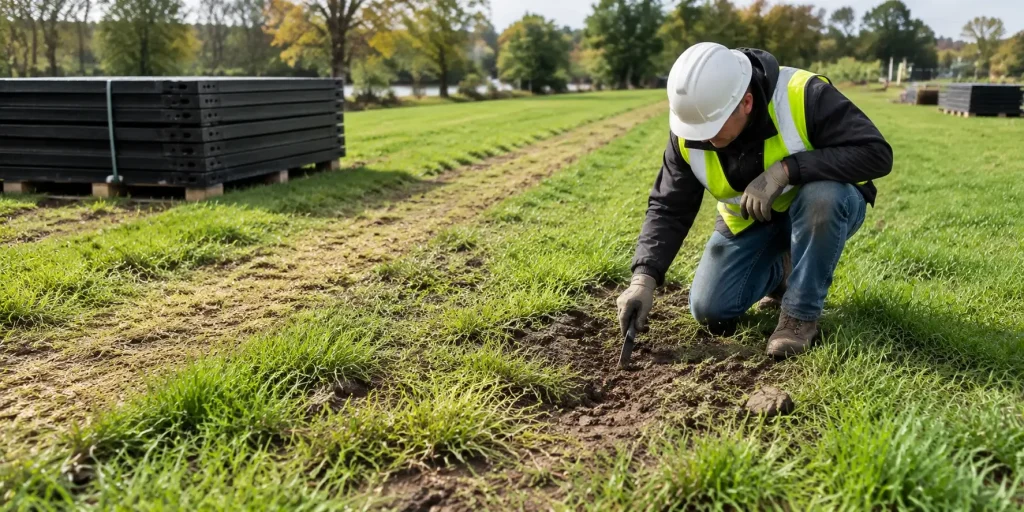
Choosing the right ground protection mat is only part of the process. The condition of the lawn prior to installation determines how well the protection mat will perform and how much pressure the grass can withstand. Conducting a few practical checks can help avoid problems that are difficult to correct after the equipment begins operating.
Check soil’s firmness and moisture. Walk along the planned route to check for areas with standing water or where the ground feels soft underfoot. If your footprints sink noticeably, or if water seeps out of the ground when pressure is applied, the soil may not provide sufficient bearing capacity for vehicle traffic. In this case, postpone installation until ground conditions improve, or assess whether additional ground reinforcement is needed. Laying mats on saturated soil will not restore its bearing capacity.
Inspect and prepare the grass surface. Remove stones, branches, debris, and any other items that could create pressure points beneath the ground protection mats. If the lawn needs mowing, cut it to the height recommended for that grass variety—never cut it too short. Avoid laying the ground protection mat immediately after watering heavily; make sure the soil is moist enough to support grass growth but not waterlogged, and ensure there is no standing water on the surface.
Before laying the first mat, plan your route. For temporary construction access roads, we recommend identifying vehicle entry points, turning areas, and frequently used sections in advance. Direct traffic flow along clearly marked routes to avoid unnecessary crossings of the lawn. Whenever possible, locate frequently used turning areas or equipment parking zones on existing paved surfaces.
Record the initial condition of the lawn. Take photos of representative areas, especially shaded areas, damp areas, and areas where the grass has turned yellow or is sparse. These records will help distinguish between pre-existing problems and changes that occur during the installation of the mats.
For large-scale projects, the soil’s load-bearing capacity should be tested in areas expected to bear the heaviest loads, rather than assuming that the load-bearing capacity is uniform across the entire lawn. Conducting a small-scale trial installation can also help identify issues such as uneven load distribution or turf pad displacement before the entire route is officially opened to traffic.
Once the turf is ready, the focus shifts from installation conditions to the duration of mats installation and the factors that should be monitored during its service life.
Safe Installation Duration and Inspection Frequency
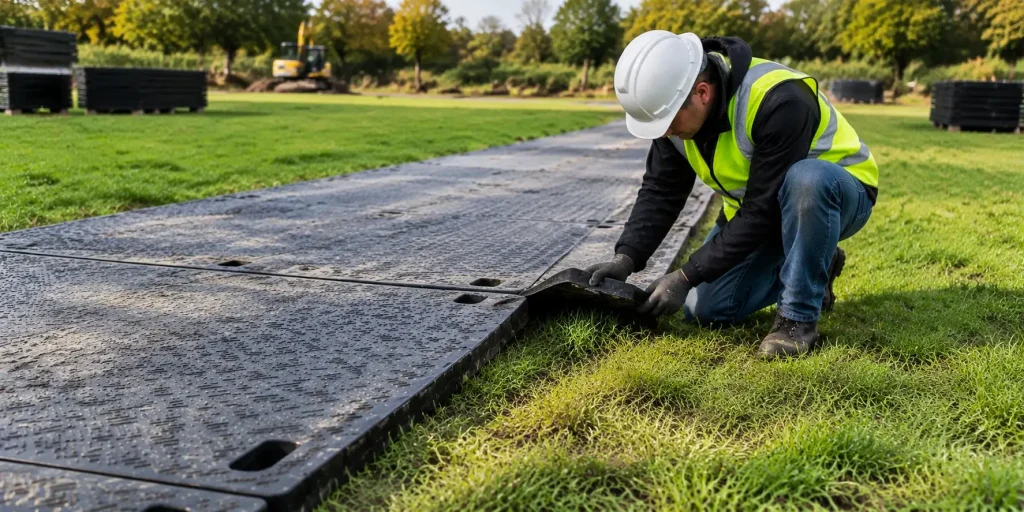
Once the ground protection mat is in place, coverage duration and regular inspections are key to keeping the grass healthy. A protection mat system that performs well for short-term events may cause damage to the grass if left in place for several days, especially in direct sunlight or on poorly drained ground.
How long can mats be safely left on grass? There is no universal safe time limit. For reference only, the U.S. National Park Service’s November 2024 turfgrass guidelines limit approved pedestrian protective decking on ddesignated level 1 turf to 3 days from May 15 to September 14 and 5 days during the specified spring and autumn periods, including installation time. These are site-specific management restrictions and do not constitute a guaranteed safe usage period for solid HDPE mats. Depending on the grass species, weather, and ground conditions, the coverage period for opaque mats may need to be shortened.
For temporary access projects, we recommend removing mats as soon as vehicle access is no longer required, rather than leaving them installed between separate work stages. If the project extends over several days, consider whether sections can be reopened to sunlight without disrupting safe access.
Inspect frequency should reflect site conditions:
• Before opening to traffic: Check that the mats are aligned, the connectors are secure, and that the edges are not curled up or sunk into the ground.
• At least one daily during use: Check the condition of the grass visible at the edges, look for standing water, check for displacement of the mats, and look for signs of ruts. In hot or humid conditions, increase the frequency of inspections, especially during periods of heavy traffic or after rainfall.
• During long-term coverage: When safe and feasible, temporarily lift sections of the mats during periods when no vehicles are passing to inspect the condition of the underlying turf. Look for signs of yellowing, flattened blades of grass, unusual odors, or waterlogged soil.
These inspection intervals are practical on-site management recommendations, not scientifically validated guarantees against turf damage.
If the grass shows noticeable discoloration, inspect the affected area and reassess the installation. If the ground becomes unstable, mats begin to sink, or panel joints shift significantly, immediately stop vehicles, equipment, and pedestrians from entering the area. The route should remain closed until the surface condition, mat alignment, and connections have been assessed and all necessary corrective measures have been completed. Continued use of an unstable route may exacerbate surface damage and increase safety risks.
Monitoring helps detect issues before they worsen, but it cannot completely prevent all effects caused by temporary coverings. The next step is to understand how to remove the mats and help the grass recover afterward.
Removing Mats and Helping Grass Recover
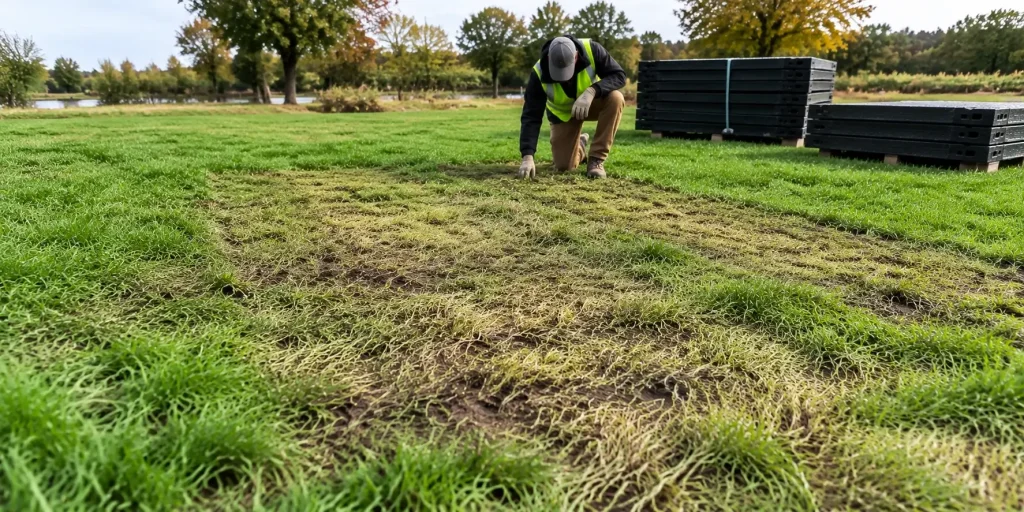
Removing the ground protection mat does not mean that turf care is over. The way you remove the mat, your assessment of the soil, and how you address any visible damage will all affect how quickly the grass recovers. Even if the grass appears flattened or discolored, it’s worth checking whether the crowns and roots remain viable before deciding whether to replace the lawn.
1.Remove mats without dragging them across the grass
Whenever possible, lift the mats vertically or use appropriate handling equipment to move them. Dragging heavy mats across the lawn can tear grass blades, disturb the soil surface, and damage the turf, which has already been weakened by the covering. If a mat becomes stuck in soft ground, carefully loosen it rather than pulling it out while applying tension. Remove any loose debris and check the seams and underside for trapped soil or debris to prevent issues during future use.
2. Inspect the grass and soil before starting repairs
After removal, check for yellowing grass blades, flattened grass blades, bare patches of turf, standing water, and visible ruts. Gently press the soil or use an appropriate hand tool to check whether the surface has become compacted or is still saturated. Flattened grass is not necessarily dead; some turf can recover once it regains access to light, air, and adequate moisture.
If the soil is waterlogged, allow it to drain first before permitting vehicle traffic or performing high-intensity lawn maintenance. Working on wet soil will exacerbate compaction and cause further damage.
3. Restore soil conditions where needed
In areas with mild surface compaction, proper aeration can help improve air and water flow within the root zone. On established lawns, core aeration can alleviate surface compaction by removing small clumps of soil. However, the method used should be tailored to the severity of the problem, soil type, and grass species. For severely compacted soil, a professional assessment may be necessary rather than repeated surface treatments. Schedule core aeration when the grass is actively growing and the soil is workable, and check for shallow irrigation lines or buried utilities before using aeration equipment.
Recovery time depends on the grass species, the growing season, the duration of coverage, and the extent of soil damage. Grass that remains alive may regain its color and resume growth once conditions return to normal, while areas requiring overseeding or new turf will need additional time to recover. Visible greening does not necessarily mean that the underlying soil has fully recovered, paticularly where vehicle traffic has caused compaction.
4. support regrowth instead of applying unnecessary treatments
The goal is to restore the conditions necessary for grass growth, not merely to make the lawn’s surface green again. After assessing the lawn and undertaking the necessary restoration work, the remaining challenge is how to plan future projects to minimize the likelihood of further damage.
When Temporary Flooring Needs Professional Planning
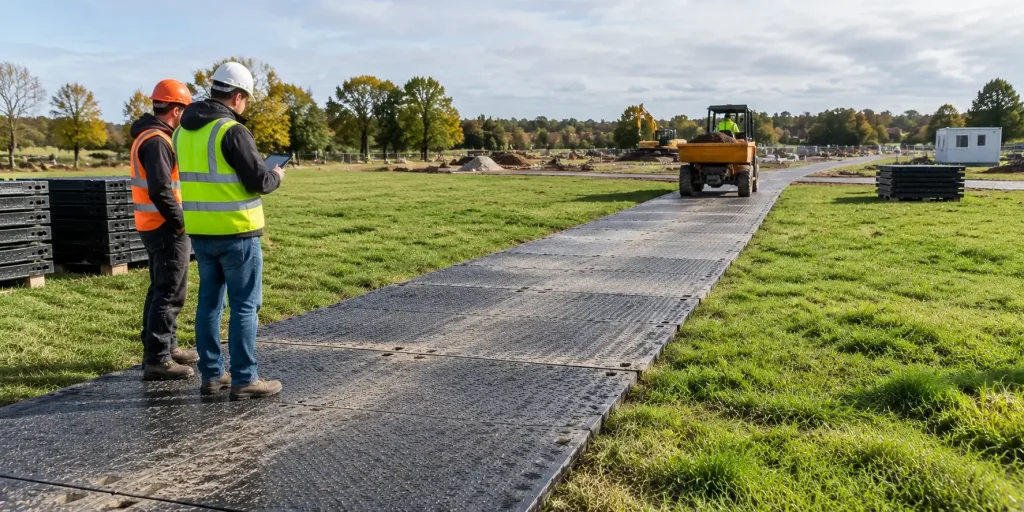
Ground protection mats can reduce damage to the lawn, but the mat itslef is only one part of a successful ground protection system. When a project involves heavy equipment, repeated vehicle traffic, soft soil, or large areas requiring coverage, professional planning helps determine whether the proposed system can withstand the expected loads while preventing unacceptable ground damage.
Heavy-duty vehicles and frequent traffic activity require load-based planning. The requirements for routes used by pedestrians or light maintenance equipment differ from those for routes carrying fully loaded trucks, excavators, or forklifts. The assessment should take into account vehicle weight, axle loads, tire or track contact with the ground, turning maneuvers, route width, and the condition of the load-bearing soil layer. Guidelines based on the BS 5837 standard also distinguish between pedestrian traffic and heavier construction traffic, and recommend the use of engineered protection systems for more severe loads.
Soft, saturated, or sloping ground may need more mats alone. If the site has standing water, deep mud, soft subsoil, or a significant slope, additional subgrade treatment or the installation of a load-distributing base may be required. Simply selecting a thicker HDPE base mat does not guarantee adequate support. The system must be evaluated based on actual subgrade conditions and the intended use.
Long coverage periods and sensitive lawns need a turf-management plan. For landscaped green spaces, public parks, event venues, and other high-value turf areas, this plan should cover the duration of coverage, access routes, inspection intervals, drainage measures, and removal procedures. The U.S. National Park Service’s turf protection guidelines also emphasize that while temporary ground cover materials can reduce physical wear and tear, they cannot eliminate soil compaction or stress issues caused by restricted sunlight, air circulation, and water flow.
At YIQI, when selecting products, we first assess the objects that will be passing over the surface, their frequency of use, and the condition of the subgrade beneath the mat. These details help determine the appropriate dimensions, thickness options, surface texture, and connection system for the HDPE mat. If there are uncertainties regarding subgrade stability or structural safety, the project should also be reviewed by a qualified engineer or on-site expert.
If you plan to set up a temporary access route, event area, or equipment work zone on a grassy area, please have the vehicle specifications, approximate dimensions of the route, photos of the site, and the expected duration of use ready before seeking advice. This information will help you and your suppliers determine whether standard ground protection mats are suitable or if additional ground preparation is required.
This information will help you and your suppliers determine whether standard ground protection mats are suitable or whether YIQI’s OEM ground protection mat solutions may be a better fit for your project.
FAQs
How long can ground protection mats stay on grass?
There is no fixed safe duration for leaving ground protection mats on grass. The appropriate duration depends on the grass species, weather, soil moisture, and the design of the protection mat. Solid, opaque HDPE protection mats block sunlight, so prolonged use may increase stress on the lawn. For temporary projects, the mats should be removed immediately once access is no longer necessary, and the condition of the grass should be checked regularly during use.
Can grass grow through ground protection mats?
Grass cannot grow through solid HDPE ground protection mats because these mats have no holes. Mats with perforations or an open-grid design allow grass blades to grow through thier gaps, provided there is sufficient light, moisture, and growing space. However, repeated trampling will still crush exposed grass, so an open-mesh design does not guarantee that the grass will remain undamaged.
Do clear mats reduce grass damage?
Transparent or translucent mats may help alleviate the problem of insufficient sunlight by allowing some sunlight to reach the grass. However, light transmission depends on the material’s transparency, thickness, degree of surface contamination, and degree of weathering. Transparent mats may also trap heat and restrict moisture exchange. Their effectiveness should be evaluated based on actual site conditions, rather than assuming they are suitable for long-term coverage simply because they are transparent.
Should grass be watered before mats are installed?
Water only when the soil is excessively dry. The goal is to keep the soil moderately moist, not saturated. If the lawn is already sufficiently moist, additional watering may soften the soil, increasing the risk of ruts forming when vehicles drive over it. Check the soil moisture before installation, avoid heavy watering immediately before installation, and allow any damp areas to drain thoroughly before laying the mats.
Can mats scorch grass in hot weather?
Yes, that is indeed the case in some situations. Dark-colored ground protection mats exposed to direct sunlight absorb heat, and restricted airflow can cause temperatures beneath them to rise. However, yellowing grass is not necessarily caused by heat damage, as shade and water stress can also produce similar symptoms. During hot weather, check your lawn more frequently, minimize unnecessary coverings, and remove the mats when they are no longer needed to ensure safe passage.
How can yellow grass recover after mat removal?
First, check whether the grass is still alive and whether the soil is compacted or waterlogged. Allow the lawn to be exposed to sunlight and air again, and water it based on soil moisture rather than following a fixed schedule. If the soil is compacted, proper aeration may help. Wait for the grass to regrow before reseeding, unless bare patches clearly indicate that the turf has died. Recovery depends on the type of grass, the season, and the severity of the damage.
Do ground mats prevent soil compaction under turf?
No. While ground protection mats can distribute wheel loads over a wider area and reduce localized pressure, they cannot completely eliminate soil compaction. Heavy vehicles, repeated traffic, saturated soil, and insufficient mat stiffness can still cause damage to the soil beneath the mats. For high-traffic routes, it is important to comprehensively consider axle loads, soil bearing capacity, mat dimensions, and ground conditions, rather than relying solely on the thickness of the mats.
Which mat type is best for natural grass?
The best choice depends on the expected load, the duration of installation, and whether grass growth needs to be maintained. When the ground provides sufficient support, rigid HDPE mats are suitable for many temporary access applications; however, for areas with low traffic where sunlight and drainage are priorities, open-mesh mats may be a better choice. No design can guarantee no-damage coverage. Mats should be selected based on site conditions and removed promptly once their protective function is no longer needed.
Partner with a Professional Engineering Plastics Manufacturer
We provide stable and reliable engineering plastic sheets and custom processing solutions for your projects
Explore More Blogs


Hey There, I'm Balance!
I am the Supply Chain Manager of YIQI Plastic. With 9 years of experience, including 4 years in engineering plastics, I specialize in material sourcing, quality control, and supply chain management.Feel free to contact us.