
Home » How Ground Protection Mats Work Under Load
How Ground Protection Mats Work Under Load
- Author: Balance Lee
- 9+ Years of Manufacturing
When heavy vehicles, equipment, or repeated traffic move across soft ground, the challenge is not only the weight itself but how that load is transferred to the surface below. Ground protection mats work by spreading forces over a wider area, improving traction, and creating a more stable temporary working surface.
If you need access roads for construction sites, outdoor events, utility projects, or heavy equipment operations, understanding how ground protection mats perform under load helps you choose the right thickness, surface design, and installation method for your conditions. This article explains the engineering principles behind load distribution, ground pressure reduction, and real-world factors that affect mat performance.
Table of Contents
The Load-Distribution Principle Behind Ground Protection Mats
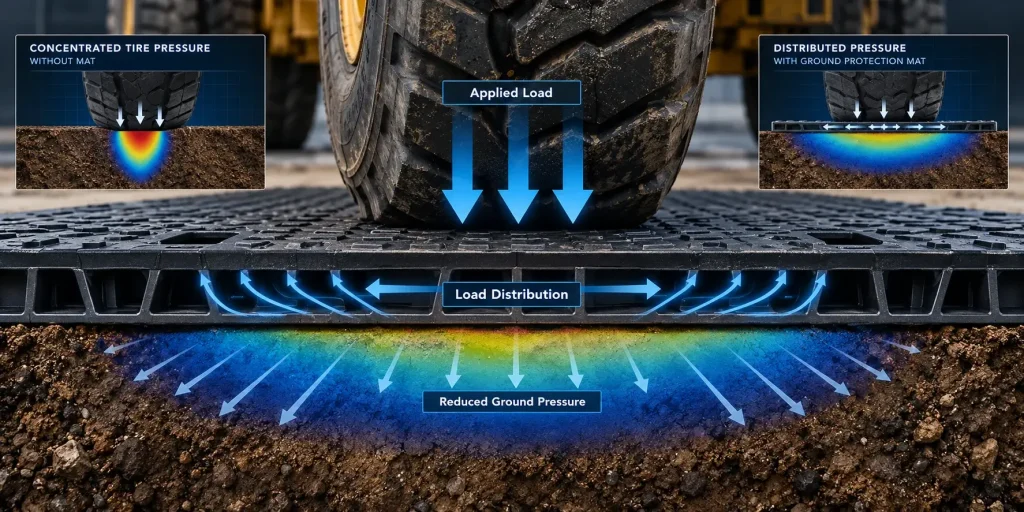
A ground protection mat does not reduce the actual weight of heavy equipment. Its primary function is to change the way the load is transferred to the ground.
When a vehicle tire, track, or outrigger applies force to the mat surface, the load is distributed through the mat structure and transferred over a wider area. This reduces the concentration of pressure on a small section of soil compared with direct contact between the equipment and the ground.
The basic relationship can be described as:
Ground Pressure = Applied Load ÷ Contact Area
A concentrated load creates higher pressure at the surface, which can contribute to rutting, soil deformation, or surface damage. By increasing the effective contact area, a rigid HDPE ground protection mat helps spread the applied force and reduce localized stress on the ground.
For example, a 1220 × 2440 mm ground protection mat provides approximately 2.98 m² of surface coverage. When a vehicle moves across the mat, the load is no longer transferred only through the tire footprint. Instead, the mat works as a structural layer that distributes part of the force across its larger surface area.
However, load distribution is not determined by mat dimensions alone. The actual performance depends on the relationship between the mat, the equipment, and the supporting ground. Key factors include:
| Factor | How it affects load distribution |
|---|---|
| Mat thickness and stiffness | A thicker and more rigid mat can better resist bending when exposed to higher loads. |
| Ground bearing capacity | Compact soil, gravel, and moisture-softened soil respond differently under the same equipment load. |
| Load type and movement | Moving wheel loads, tracked vehicles, and stationary outrigger loads create different stress patterns. |
The same mat specification can produce different results under different site conditions. A vehicle traveling repeatedly over compacted gravel transfers load into a relatively stable base, while the same equipment operating on moisture-softened soil may create deeper deformation because the supporting ground cannot distribute stress effectively.
This is why selecting a ground protection mat requires evaluating the interaction between the mat and the surface below it. Soil condition, traffic frequency, turning movements, and equipment type can influence performance as much as the rated vehicle weight.
How Mats Reduce Rutting, Compaction, and Surface Stress
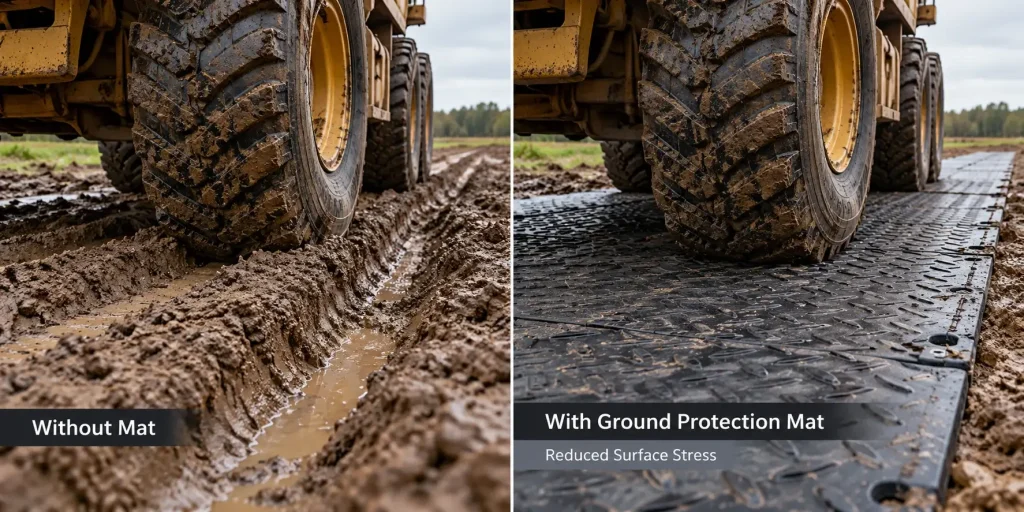
After understanding how ground protection mats distribute loads, the next question is how this load transfer affects the ground itself. The main purpose of a mat is not to eliminate pressure completely, but to reduce concentrated stress that causes surface damage.
When heavy equipment travels directly on soil, the tire or track applies repeated pressure to a limited area. If the soil strength is lower than the applied stress, the surface begins to deform. This process can create visible problems such as:
- Rutting — permanent grooves formed by repeated wheel or track passes.
- Soil compaction — compression of soil particles, reducing air gaps and changing surface conditions.
- Surface shear damage — disturbance caused by traction forces during braking, turning, or acceleration.
A rigid HDPE ground protection mat works as a load-spreading layer between the equipment and the ground. The mat distributes vertical loads across a larger area and helps reduce direct contact stress on the soil surface.
For example, a construction vehicle with a concentrated wheel load may create deep impressions when operating directly on wet soil. When the same vehicle travels over a properly selected mat system, the load is transferred through the mat structure before reaching the ground, which can reduce the depth and severity of surface deformation.
The effectiveness depends on the relationship between the equipment, mat structure, and soil condition. A mat placed on firm ground may mainly protect the surface from abrasion and traffic damage, while a mat installed over soft ground needs enough stiffness and coverage area to prevent excessive deflection.
A simplified comparison:
| Direct Ground Contact | With Ground Protection Mats |
|---|---|
| Load acts on a smaller soil area | Load can spread across a larger effective contact area |
| Higher localized ground pressure | Reduced pressure concentration when the mat is adequately supported |
| Greater risk of wheel ruts and surface damage on weak soil | Lower risk of rutting and localized surface deformation under suitable conditions |
| Repeated traffic can increase soil compaction and surface disturbance | A properly selected mat system can help limit surface disturbance during repeated access |
In temporary access projects, protecting the ground is not only about supporting the equipment weight. The repeated movement of vehicles, especially turning and braking actions, can create additional stress on the surface. Selecting the right mat design helps maintain a more stable working area while reducing unnecessary ground disturbance.
How Tread Patterns Improve Traction and Control
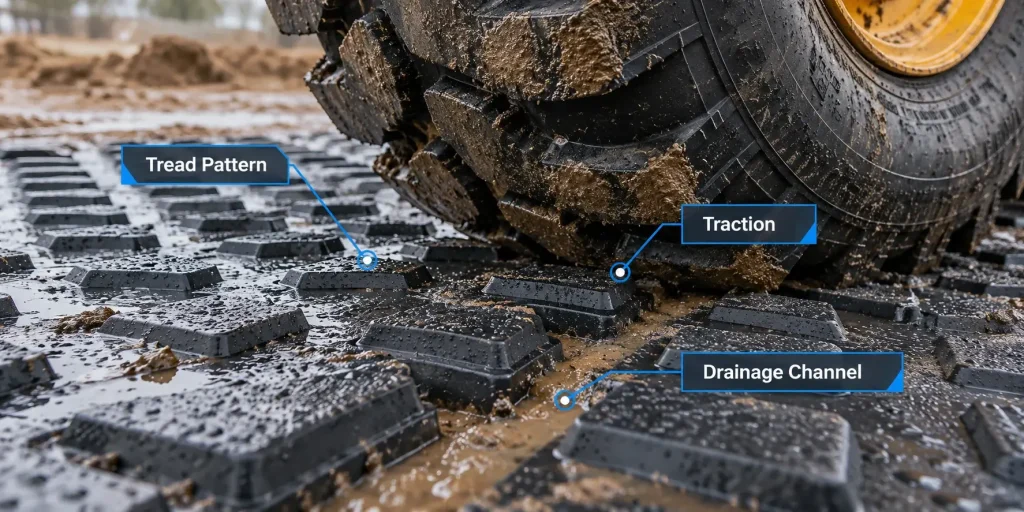
Load distribution is only one part of ground protection performance. When vehicles move, turn, brake, or operate on uneven surfaces, traction and directional control become equally important. This is where the tread pattern on a ground protection mat plays a critical role.
A smooth plastic surface may provide load support, but it offers limited mechanical interaction with tires or tracks, especially when the surface is wet, muddy, or contaminated. Engineered tread patterns create additional contact points and channels that help tires maintain grip while allowing water, mud, and debris to move away from the contact area.
The tread design influences several aspects of vehicle movement:
- Traction during acceleration — Raised patterns can increase mechanical engagement between the tire and mat surface, helping reduce unnecessary wheel spin.
- Braking and turning stability — Surface texture provides additional resistance against sliding forces generated during direction changes.
- Mud and water management — Grooves and raised sections create pathways for water or loose material to move away from the tire contact area.
Different applications require different surface structures. For example, equipment operating on a muddy construction site may require a more aggressive tread pattern for grip, while temporary walkways or areas with frequent pedestrian movement may prioritize a flatter, more comfortable surface.
In ground protection projects involving repeated vehicle traffic, the tread pattern also affects how the surface performs over time. A suitable texture can help maintain traction after multiple passes, while an unsuitable surface design may allow mud buildup or reduce vehicle control in changing weather conditions.
It is important to evaluate the complete working environment rather than selecting a mat based only on load capacity. A mat that supports the equipment weight but provides insufficient traction may not perform well in areas involving slopes, frequent turning, or wet ground conditions.
How Connected Mats Form a Stable Temporary Route
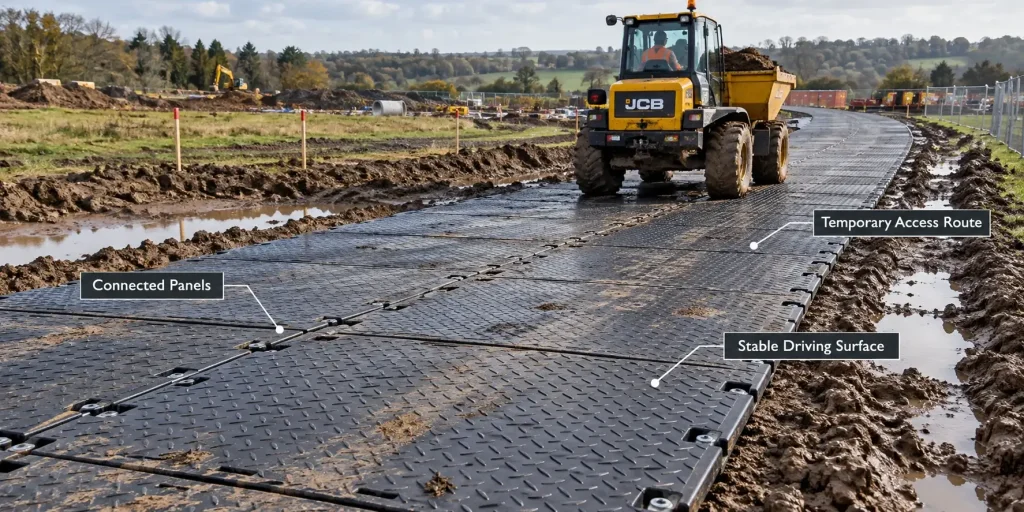
A single ground protection mat can spread load over a wider area, but large-scale access projects require multiple mats to work together as a continuous surface. The connection system transforms individual mats into a temporary route that can better handle repeated traffic and changing ground conditions.
When mats are connected, the load from passing vehicles is not only supported by one panel. Adjacent mats can work together to create a larger structural surface, helping reduce movement between individual sections and maintaining a more consistent driving path.
The connection method affects the overall performance of the temporary route. A properly designed system should help with:
- Lateral stability — reducing unwanted shifting when vehicles turn, brake, or travel across uneven ground.
- Surface continuity — keeping connected mats aligned so wheels or tracks can pass more smoothly between sections.
- Load sharing between panels — allowing neighboring mats to participate in supporting moving loads.
For example, on a construction access road where trucks pass through the same area many times each day, individual mats without effective connections may gradually move apart due to braking forces, steering movements, or uneven ground settlement. A connected mat system helps maintain route alignment and reduces the need for frequent repositioning.
For a practical reference, this ground protection mat project example shows how mat specifications and customization requirements can be considered for a specific site application.
The installation method also influences how well the connected surface performs. The ground underneath should be assessed before installation, because connectors can maintain panel alignment but cannot replace proper ground preparation. On very soft or unstable soil, additional measures such as leveling, drainage improvement, or a supporting base layer may be required.
In temporary road applications, the goal is not simply to place more mats on the ground. A well-designed mat system combines panel strength, connection performance, and suitable installation conditions to create a safer and more reliable working route.
Performance on Grass, Mud, Sand, Pavement, and Slopes
Ground protection mats do not perform in the same way on every surface. The interaction between the mat and the ground beneath it determines how effectively loads are transferred, how much the surface is protected, and how stable vehicle movement will be.
Choosing the right mat system requires considering ground condition, equipment type, traffic frequency, and the type of movement involved. A solution that works well on compact grass may require a different approach when used on saturated mud or loose sand.
Grass: Protecting Surface and Reducing Damage
On grass surfaces, the primary purpose of a ground protection mat is often to protect vegetation and maintain access without creating excessive surface disturbance.
When vehicles repeatedly travel directly on grass, tire pressure and turning forces can damage the root zone, create visible tracks, and remove the protective surface layer. A properly installed mat system helps spread vehicle loads and provides a defined traffic path.
For landscaping projects, outdoor events, golf courses, and temporary access routes, factors such as mat color, surface pattern, and weight distribution may influence the final result.
Mud: Improving Stability on Soft Ground
Mud presents a different challenge because the supporting soil has limited strength and may deform under repeated loading.
In these conditions, ground protection mats help by creating a more stable upper surface and reducing direct contact between tires and soft soil. However, performance depends heavily on soil depth, moisture level, and the severity of the load.
For example, a light service vehicle traveling occasionally across shallow mud creates a different requirement compared with heavy equipment making repeated passes through saturated ground. In deeper soft soil conditions, additional ground preparation may still be required.
Sand: Managing Settlement and Surface Movement
Loose sand can allow tires and equipment to sink because the particles move easily under pressure.
Ground protection mats provide a firmer surface layer that distributes loads over a wider area, helping reduce localized sinking. However, sand conditions vary significantly. Compact coastal sand, dry loose sand, and deep dune-type sand can respond differently under the same equipment weight.
When using mats on sandy ground, installation quality and connection strength become more important, especially where vehicles repeatedly accelerate, brake, or turn.
Pavement: Protecting Finished Surfaces
On asphalt, concrete, or other finished surfaces, the purpose of ground protection mats can be different. Instead of preventing sinking, they are used to protect the existing surface from abrasion, impact, and concentrated loads.
Heavy equipment, cranes, and tracked machinery can create surface marks or damage finished areas, particularly during turning movements. A suitable mat system creates a protective layer between the equipment and the pavement.
The required mat specification depends on the equipment load and whether the surface needs temporary protection or long-term repeated access.
For projects involving protective panels, temporary work surfaces, or other fabricated plastic components, selecting HDPE for construction applications also requires attention to material grade, thickness, and expected loading conditions.
Slopes: Balancing Load and Vehicle Control
Sloped terrain introduces additional challenges because vehicles generate not only vertical loads but also horizontal forces.
During uphill movement, braking, or turning on slopes, traction and mat stability become critical. Tread design, connection method, and installation direction can influence how well the system maintains position.
On steeper slopes or unstable terrain, ground protection mats should be evaluated together with site safety measures rather than used as a standalone solution.
Why Load, Soil Moisture, and Mat Stiffness Matter
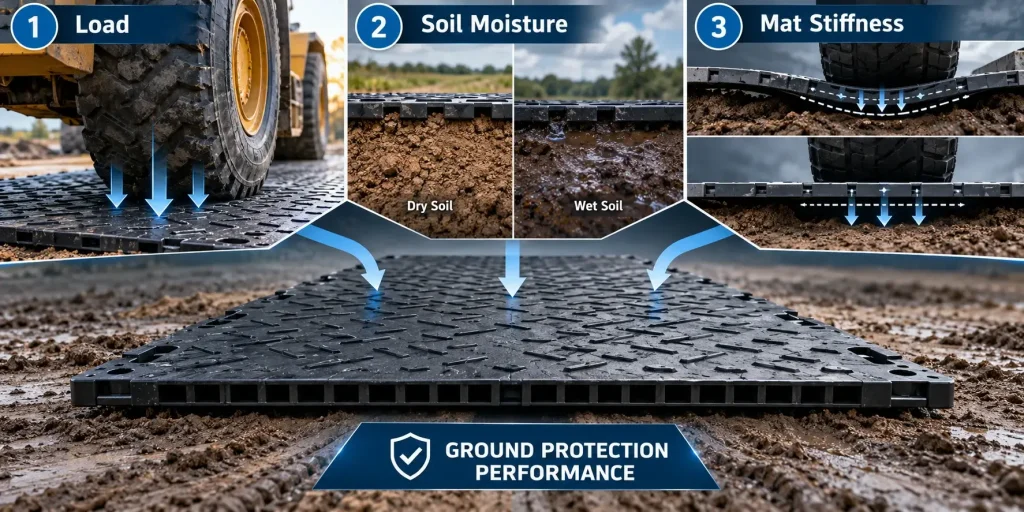
Ground protection mat performance is not determined by the mat alone. The final result depends on the relationship between equipment load, ground condition, and mat structural properties. Understanding these three factors helps explain why the same mat can perform differently from one project site to another.
One mistake is to evaluate a ground protection mat only by the maximum equipment weight. In practice, the way that weight is applied to the ground can be just as important as the total load itself.
Equipment Load: Understanding How Force Reaches the Mat
The total weight of equipment is only the starting point. What affects the mat system is the actual load transferred through tires, tracks, or outriggers.
Different equipment creates different stress patterns:
- Wheeled vehicles apply repeated moving loads through relatively small contact areas.
- Tracked equipment distributes weight over a larger footprint but can generate significant shear forces during turning.
- Outriggers and support legs create concentrated static loads over small areas.
For example, a crane outrigger pad and a truck access route may involve similar equipment weights, but the loading conditions are completely different. A stationary outrigger applies concentrated vertical pressure, while a moving truck creates repeated dynamic loading across the route.
This is why mat selection should consider where the force is applied, how frequently it occurs, and whether the load is moving or stationary.
Soil Moisture: Why Ground Conditions Change Performance
The condition of the soil underneath the mat has a direct impact on how the system performs.
Dry, compacted soil can provide stronger support because the particles are more tightly packed. When soil becomes saturated, water reduces the friction between particles and lowers the ground’s ability to resist deformation.
A simple comparison:
| Soil Condition | Expected Ground Response |
|---|---|
| Compact and relatively dry soil | Provides stronger support with lower risk of surface deformation under suitable loading conditions. |
| Moist soil with reduced strength | May experience greater settlement when exposed to repeated equipment loads. |
| Saturated soft soil | Higher possibility of rutting, ground deformation, and increased mat deflection. |
In field applications, weather changes can significantly affect ground conditions. A temporary route that performs well on firm ground may require additional consideration after heavy rainfall, because the supporting layer beneath the mat may no longer provide the same level of resistance.
Mat Stiffness: Balancing Strength and Flexibility
Mat stiffness determines how the product reacts when loads are applied.
A mat that is too flexible may bend excessively under concentrated loads, reducing its ability to distribute pressure effectively. A sufficiently rigid structure helps transfer loads across a wider area while maintaining a more stable driving surface.
However, higher stiffness is not the only consideration. The appropriate balance depends on the application:
- Heavy equipment access may require greater structural support.
- Pedestrian pathways may prioritize lighter handling and easier installation.
- Uneven terrain may require enough flexibility to maintain surface contact.
In practical applications, selecting the right mat thickness is not simply about choosing the thickest option available. The better approach is to match mat stiffness with equipment loading and ground conditions.
Mat thickness affects bending resistance, but material properties and support conditions also need to be considered. For a closer look at how thickness influences stiffness and load response, see our HDPE sheet thickness selection guide.
Putting the Three Factors Together
Load, soil moisture, and mat stiffness work together as a system. A high-capacity mat placed on extremely weak saturated soil may not perform as expected if the ground beneath cannot provide sufficient support.
Likewise, a suitable mat on stable ground may deliver better results because the supporting surface allows the mat structure to distribute loads more effectively.
Before choosing a ground protection mat, evaluate:
- Maximum wheel, track, or support load
- Ground condition and moisture level
- Traffic frequency
- Turning and braking requirements
- Required connection system
This evaluation approach helps ensure that the selected mat system matches the actual working environment rather than relying on equipment weight alone.
This evaluation approach helps ensure that the selected mat system matches the actual working environment rather than relying on equipment weight alone.
Different projects may require different combinations of HDPE ground protection mat options, including thickness, surface pattern, dimensions, and connection design.
Conditions Where Ground Protection Mats May Not Be Enough
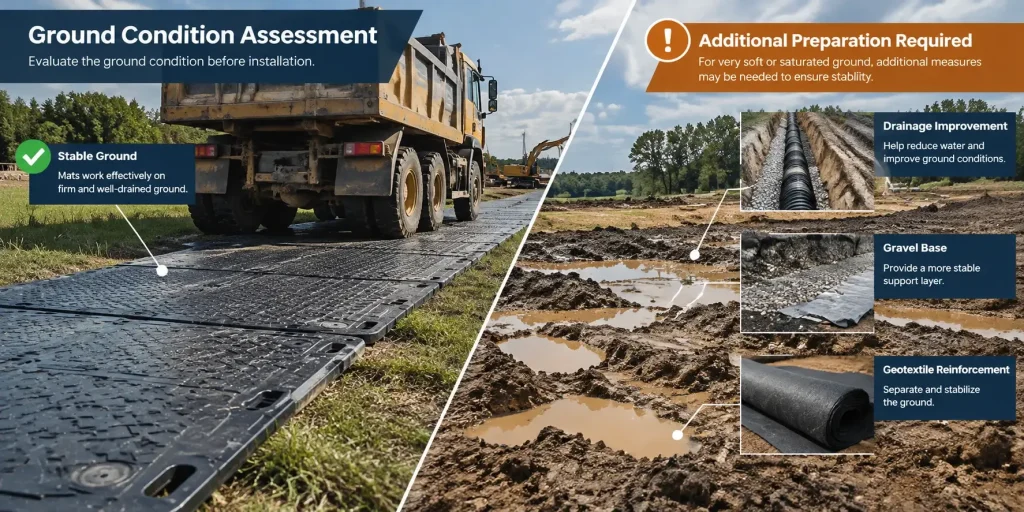
Ground protection mats are designed to create temporary access, reduce surface disturbance, and improve working conditions for vehicles and equipment. However, they are not a replacement for engineered ground improvement in every situation.
Understanding the limitations of a mat system is just as important as understanding its advantages. In some environments, the ground below the mat remains the controlling factor, and additional preparation or engineering measures may be required.
Extremely Soft or Unstable Ground
When the supporting soil has very low bearing capacity, the ground beneath the mat may continue to deform even if the mat itself has sufficient strength.
For example, saturated clay, deep mud, or recently disturbed soil may not provide enough support for repeated heavy equipment traffic. In these conditions, the mat can distribute loads across a wider area, but it cannot create a stronger foundation underneath.
Possible additional measures may include:
- Soil stabilization
- Geotextile reinforcement
- Gravel or aggregate base layers
- Drainage improvement
The key consideration is whether the ground can provide enough support for the mat system to work effectively.
Permanent Roads or Long-Term Heavy Traffic
Ground protection mats are primarily intended for temporary access and surface protection applications.
For projects requiring permanent vehicle routes, continuous heavy traffic, or infrastructure-level durability, a designed road structure may be more appropriate. Permanent roads often require engineered layers such as compacted aggregate, asphalt, or concrete based on traffic requirements.
A temporary mat route may support repeated access for a project period, but it should be evaluated differently from a permanent transportation surface.
Loads Beyond the Mat System Design
Every ground protection mat has practical limits based on:
- Material properties
- Thickness
- Support conditions
- Load type
- Installation method
A mat designed for light vehicles and pedestrian access should not be expected to perform the same way under heavy cranes, mining equipment, or concentrated support loads.
For example, an outrigger load from a large crane creates a very different stress pattern compared with a truck tire load. Such applications require careful evaluation of contact pressure and support conditions before selecting a mat solution.
Severe Slopes or High-Risk Terrain
On steep slopes, the challenge is not only vertical load but also horizontal movement.
Vehicles generate additional forces during:
- Braking
- Acceleration
- Turning
- Uneven surface transitions
In these conditions, traction, connection systems, and site safety planning become critical. Ground protection mats can improve surface stability, but they should be considered as part of a wider site management approach rather than the only control measure.
Making the Right Decision
The most effective ground protection system starts with understanding the actual working environment.
Before selecting a mat, consider:
- What equipment will travel across the surface?
- How often will the route be used?
- Is the ground firm, soft, wet, or unstable?
- Are there concentrated loads such as outriggers?
- Is the requirement temporary access or a permanent structure?
A professional approach is not about choosing the strongest mat in every case. It is about matching the mat design to the actual conditions and recognizing when additional ground preparation is necessary.
FAQs
Do ground protection mats stop all soil compaction?
No. Ground protection mats can reduce concentrated pressure and limit surface disturbance, but they cannot completely eliminate soil compaction.
The final result depends on factors such as equipment weight, traffic frequency, soil type, and moisture level. On soft or saturated ground, repeated heavy loads may still compress the soil beneath the mat. The main purpose of a mat system is to spread loads and reduce the severity of surface damage, not to remove all ground stress.
How do mats prevent vehicles from sinking?
Ground protection mats help prevent sinking by increasing the load-bearing area and reducing pressure concentration on the soil.
Without a mat, tire or track loads act directly on a smaller area, which can exceed the soil’s ability to support the equipment. A rigid mat creates a wider support surface and helps transfer loads more evenly.
However, performance still depends on ground conditions. On extremely soft soil, additional measures such as drainage improvement or ground reinforcement may be required.
Do thicker ground mats distribute weight better?
A thicker mat can provide higher stiffness and better resistance to bending, but thickness alone does not determine performance.
Load distribution also depends on mat material, surface design, support conditions, and the type of equipment using the mat. A thicker mat may be beneficial for heavy loads or uneven ground, while a thinner mat may be suitable for lighter access applications.
The right choice is based on matching mat thickness with actual load conditions, rather than simply selecting the thickest option.
Why do ground protection mats have different tread patterns?
Different tread patterns are designed to balance traction, drainage, and surface stability for different working conditions.
Aggressive tread designs can provide stronger grip in muddy or uneven areas, while flatter patterns may be preferred for pedestrian access or applications requiring smoother movement.
The tread pattern should match the environment, vehicle type, and expected movement. A suitable surface design helps improve control during acceleration, braking, and turning.
Do connectors increase mat performance?
Yes, connectors can improve the stability of a mat system, but they do not increase the load capacity of the material itself.
The main function of connectors is to keep individual mats aligned and reduce movement between panels during repeated vehicle traffic, turning, and braking. This helps create a more continuous temporary route.
However, connectors cannot replace proper mat thickness, suitable ground conditions, or correct installation. The overall performance depends on the complete system, including the mats, connectors, and supporting ground.
Can ground mats bridge holes or trenches?
Ground protection mats may span small gaps under suitable conditions, but they should not be treated as a replacement for structural bridging systems.
The ability to cross a gap depends on factors such as mat thickness, span length, load type, and support at both ends. Heavy concentrated loads, such as crane outriggers, require careful evaluation because unsupported sections can experience higher bending stress.
For larger holes, trenches, or unstable areas, additional engineering solutions may be necessary.
How does wet soil change mat performance?
Wet soil can reduce the supporting ability beneath the mat and increase the risk of deformation.
When soil contains more water, the particles may move more easily and the ground may become less resistant to repeated loading. In these conditions, the mat may still distribute loads effectively, but the supporting layer underneath becomes a more important factor.
Before installation, evaluating drainage, soil condition, and expected traffic helps determine whether additional preparation is required.
Can ground protection mats fail under heavy loads?
Yes, a ground protection mat system can fail if the applied conditions exceed its design limits or if installation conditions are unsuitable.
Failure does not only mean the mat material breaks. It can also include excessive bending, connector separation, sinking into weak soil, or loss of surface stability.
The risk can be reduced by selecting the correct mat specification based on load type, support conditions, and traffic requirements. For example, a moving truck load and a concentrated crane outrigger load require different evaluations.
A reliable mat system is not defined by handling the highest possible load, but by being correctly matched to the actual application.
Partner with a Professional Engineering Plastics Manufacturer
We provide stable and reliable engineering plastic sheets and custom processing solutions for your projects
Explore More Blogs


Hey There, I'm Balance!
I am the Supply Chain Manager of YIQI Plastic. With 9 years of experience, including 4 years in engineering plastics, I specialize in material sourcing, quality control, and supply chain management.Feel free to contact us.