
Home » Ground Protection Mats vs Plywood: Key Differences
Ground Protection Mats vs Plywood: Key Differences
- Author: Balance Lee
- 9+ Years of Manufacturing
When you need temporary access for vehicles or heavy equipment, both plywood and ground protection mats may seem like practical options. But how do you know which one is better suited to your project? The differences go beyond purchase price. Load distribution, traction, wet-weather performance, ground protection, and repeated use can all affect your decision. This guide compares ground protection mats vs plywood to help you understand where each material works, what limitations to consider, and how to choose based on your ground conditions, equipment, and project requirements.
Table of Contents
Ground Protection Mats vs Plywood at a Glance
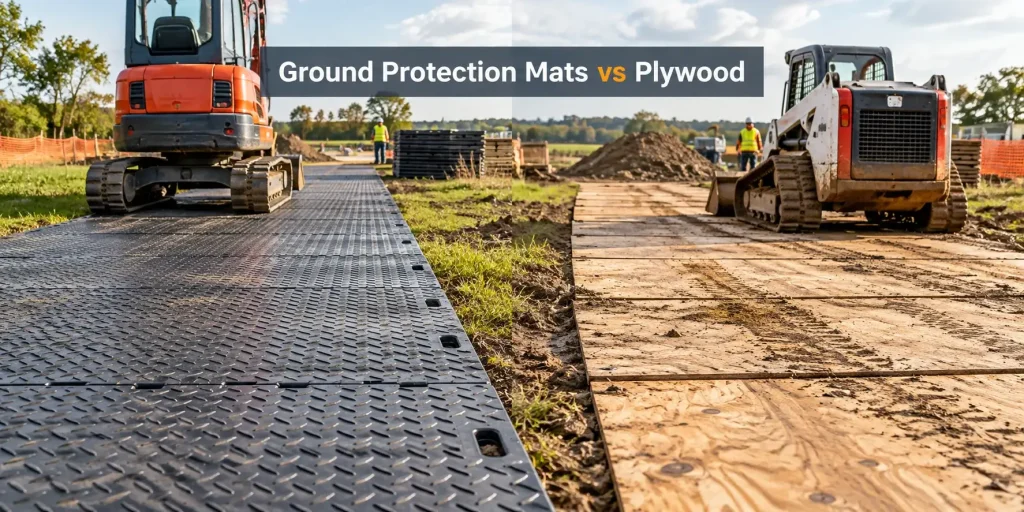
Ground protection mats and plywood can both provide a temporary surface for equipment access, but they differ in material structure, load distribution, moisture resistance, handling, and long-term cost.
Plywood consists of bonded wood veneers, while purpose-built ground protection mats are made from engineered materials such as HDPE (high-density polyethylene). Both can help separate vehicle traffic from the ground, but neither material can compensate for soil that lacks sufficient bearing capacity.
If you are comparing these options, the first decision should not be based on sheet price alone. Mat thickness, equipment weight, ground conditions, installation requirements, and the number of planned uses all influence whether a product represents good value.
Ground Protection Mats vs Plywood: Quick Comparison
| Comparison Factor | HDPE Ground Protection Mats | Plywood |
|---|---|---|
| Material | Solid HDPE, with virgin or recycled material options | Cross-laminated wood veneers bonded with adhesive |
| Load Support | Designed to distribute loads across the contact area; performance depends on thickness, mat design, and ground support | Can spread loads over a wider area, but bending and damage depend on panel grade, thickness, and support |
| Wet Conditions | HDPE has low water absorption; textured surfaces can improve traction, subject to contamination and site conditions | Moisture can cause swelling, edge damage, or delamination, depending on panel grade and exposure |
| Surface Traction | Raised traction patterns are available for vehicle and pedestrian movement | Traction depends on surface treatment, wear, and moisture |
| Ground Protection | Provides a separation layer to help limit rutting and surface disturbance when properly selected and installed | Can reduce direct contact with the ground, but bending, movement, and deterioration may reduce effectiveness |
| Handling & Installation | Integrated handles and connection systems are available; individual mat weight depends on size and thickness | Can be cut on-site and moved without specialized connectors; larger or thicker panels may require team handling |
| Reuse & Lifespan | Suitable for repeated projects when loading, handling, storage, and environmental exposure remain within product limits | Reuse depends on panel grade, moisture exposure, edge condition, and damage between projects |
| Purchase Cost | Higher initial material cost in many like-for-like purchasing scenarios | Lower initial cost may be available, depending on local plywood grade and pricing |
| Total Project Cost | Repeated use may reduce cost per deployment, but transport, cleaning, storage, and replacement must be included | May be economical for short-term applications; replacement, disposal, and installation labor can increase cumulative cost |
What Should You Compare Before Ordering?
One purchasing mistake is to compare only the price of one plywood sheet with one HDPE mat, even when the two products have different dimensions, thicknesses, and intended applications.
For example, a 1220 × 2440 × 12.7 mm solid HDPE mat has a calculated material weight of approximately 35–36kg, assuming an HDPE density of 0.93–0.96 g/cm³. Actual weight varies with handle cutouts, surface profiles, and manufacturing tolerances.
That weight matters when planning manual handling, pallet quantities, container loading, and installation labor. A comparable-size plywood panel may be lighter, but its actual weight and suitability depend on its grade, thickness, and moisture content.
Before requesting quotations, you should compare usable coverage area, technical specifications, shipping costs, expected reuse, and replacement requirements rather than focusing only on price per sheet.
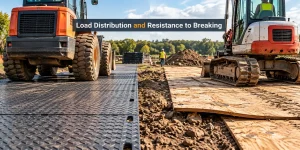
Load Distribution and Resistance to Breaking
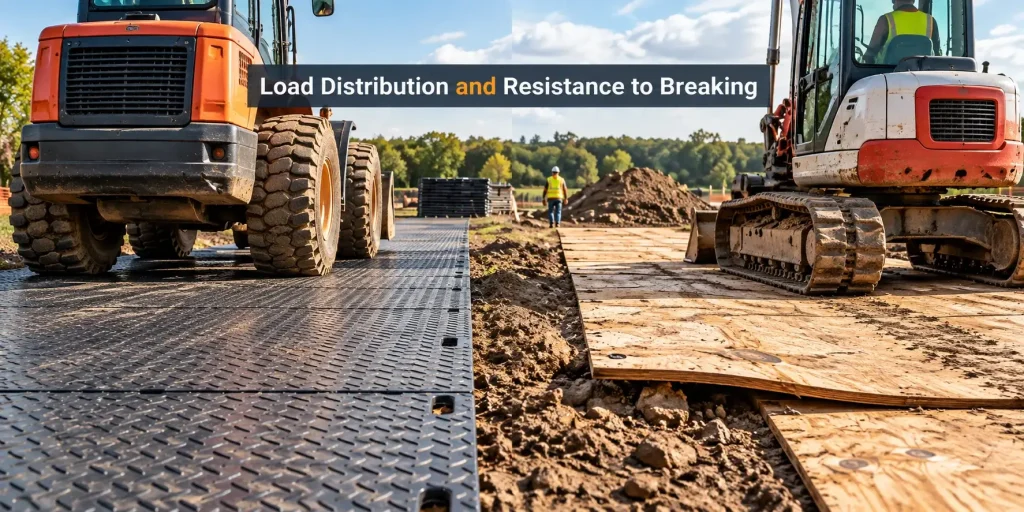
When heavy equipment travels over temporary access surfaces, the main concern is not just whether the panel can support the vehicle’s weight, but how that weight is transferred to the ground beneath it. Ground protection mats and plywood respond differently to concentrated loads, bending, and repeated traffic.
How Do HDPE Mats and Plywood Respond to Heavy Loads?
HDPE ground protection mats combine material toughness with controlled flexibility. Under wheel or track loads, the mat can bend to follow moderate ground irregularities while helping spread pressure beyond the equipment’s immediate contact area. This flexibility also allows HDPE to deform without cracking under certain loading conditions.
Plywood behaves differently. Its cross-laminated wood layers provide bending stiffness, which can be useful when the panel is adequately supported. However, if a wheel passes over an unsupported gap or a soft patch of soil, bending stress can increase, potentially causing cracks, veneer separation, or permanent damage. Moisture exposure and previous loading damage can further affect its performance.
The distinction is important: HDPE’s flexibility does not automatically mean it can carry more weight than plywood. Panel thickness, material grade, unsupported span, and underlying soil strength determine how either product performs.
Why Ground Support Matters More Than a Load Rating Alone
Consider a wheeled machine applying a static vertical load of 10,000 kg to one tire. Using gravitational acceleration of 9.81 m/s², the corresponding force is approximately 98.1 kN.
The simplified average ground pressure depends on the effective load distribution area:
| Effective Support Area | Calculated Average Pressure |
|---|---|
| 0.25 m² | 392 kPa |
| 0.50 m² | 196 kPa |
| 1.00 m² | 98 kPa |
These values illustrate the relationship between load and support area; they are not measured pressure distributions or guaranteed performance figures for either material. The calculation assumes the stated load is distributed uniformly over each area and excludes dynamic impact, bending effects, and uneven soil support.
Doubling the effective support area reduces the calculated average pressure by half. However, placing a large mat on soft ground does not mean its full surface will carry the load equally. Localized deflection can concentrate pressure beneath the wheel, particularly where soil support is inconsistent.
What Should You Check Before Selecting Mat Thickness?
For temporary access projects, equipment weight alone is insufficient for choosing a mat. A 20-tonne tracked excavator and a 20-tonne wheeled machine can apply different contact pressures because their load distribution and operating movements differ.
When reviewing a ground protection mat specification, check:
- Maximum wheel, axle, or track load: Identify the load applied to the mat rather than relying only on the equipment’s total weight.
- Ground condition: Evaluate whether the underlying surface is firm, uneven, saturated, or susceptible to rutting.
- Mat thickness and construction: Confirm the material grade, dimensions, and applicable loading conditions.
- Traffic pattern: Account for repeated passes, turning, braking, and dynamic loading.
- Ground preparation: Determine whether leveling, drainage, geotextiles, or a suitable aggregate base is needed.
For example, HNYIQI PLASTIC supplies HDPE ground protection mats in thicknesses such as 12.7 mm, 15 mm, and 20 mm. These options allow you to consider different handling requirements and ground conditions, but thickness alone cannot establish a safe load capacity. A heavier mat is not a substitute for assessing weak soil or concentrated equipment loads.
If you need to protect a temporary route from repeated heavy traffic, the practical starting point is to provide equipment load details, ground conditions, and expected traffic frequency. These specifications make it possible to assess suitable mat options and identify where additional ground preparation or engineering verification may be necessary.
Load support is only one part of site safety. Once a panel can accommodate the expected loading conditions, the next concern is how securely vehicles and workers can move across its surface, especially during turning and braking.
Before placing an order, please verify the actual product specifications for the selected model, including substrate thickness, applicable total profile thickness, actual unit weight, grip design, and connector type. These details should be obtained from the latest product specifications rather than inferred based on general shim thickness ranges.
Traction, Stability, and Worksite Safety
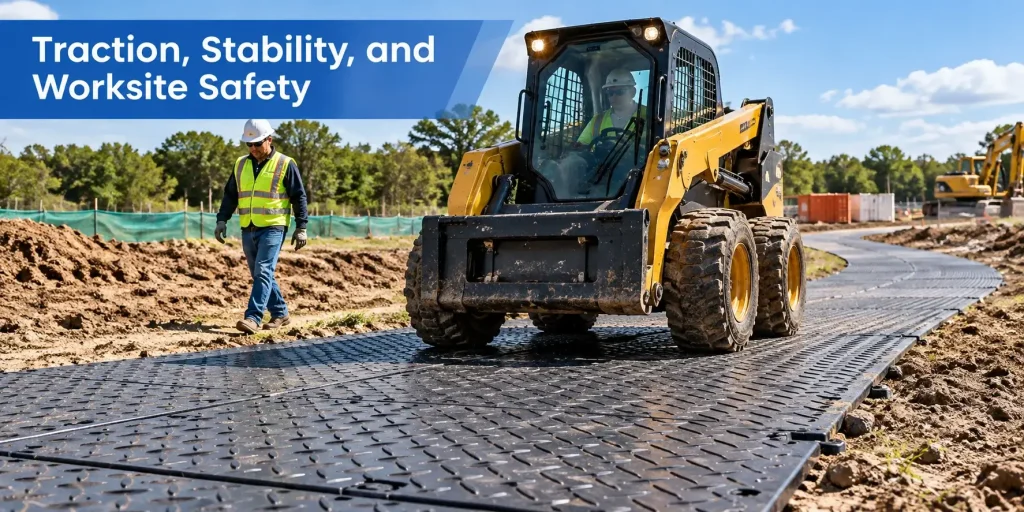
After confirming that a temporary access surface can handle the expected loads, the next consideration is how safely vehicles and workers can move across it. A panel may provide adequate support under a stationary vehicle but behave differently when tires accelerate, brake, or turn.
Ground protection mats and plywood offer different levels of surface grip and installation stability. These differences become particularly important on sloped routes, during frequent equipment movements, and when the surface is exposed to dirt or moisture. The placement, connection, and securing of the mats also affect how stable the finished track will be. For practical guidance on ground preparation and the safe installation of ground protection mats, please refer to our installation guide.
How Does Surface Texture Affect Traction?
HDPE ground protection mats can be manufactured with raised diamond, grid, or other traction patterns. These profiles create additional surface texture for tire contact and can improve grip compared with a smooth HDPE sheet under comparable conditions.
Plywood has a different surface structure. Untreated wood veneers provide some natural texture, but traction can change as the surface becomes polished, worn, or contaminated. Anti-slip coated plywood is also available, so not all plywood panels should be treated as having the same traction performance.
When comparing surface options, consider how the equipment will move:
- Straight-line travel: A suitable textured surface can help maintain tire grip along temporary access routes.
- Turning and braking: Lateral and braking forces increase the demand on both surface traction and panel stability.
- Pedestrian access: Raised patterns may improve footing, but excessive protrusions can also create difficulties for wheeled carts or small equipment.
At HNYIQI PLASTIC, ground protection mat options include double-sided traction patterns. This is particularly useful when you need a textured upper surface for vehicle movement and a profiled underside that can contribute to contact with the ground. However, the actual resistance to sliding depends on surface conditions, applied loads, and the ground beneath the mat.
Why Mat Movement Matters During Turning and Braking
Surface traction and panel stability are related, but they are not the same. Even when tires grip the upper surface, the panel itself may shift if the connection to adjacent panels or the contact with the underlying ground is insufficient.
Consider a temporary access route where loaded vehicles must make a tight turn. As the vehicle changes direction, the tires apply lateral forces to the surface. If individual panels are free to move, gaps or uneven edges may develop along the route.
HDPE mats with compatible connection systems can help maintain alignment and reduce relative movement between adjacent panels. However, connectors do not eliminate the need for suitable ground support, correct installation, and inspection.
Plywood panels can also be secured or supported using appropriate site-specific methods, but placing loose sheets edge to edge does not create an interconnected route.
For projects involving repeated turning or braking, panel alignment, connector suitability, edge transitions, and ground anchorage where required deserve as much attention as surface texture.
What Should You Check Before Opening a Temporary Route?
Before allowing vehicle or pedestrian traffic, inspect the installed surface rather than relying only on the material specification.
| Safety Check | What to Look For |
|---|---|
| Surface Condition | Mud, oil, loose soil, standing water, or other materials that could reduce traction |
| Panel Stability | Rocking, sliding, lifting edges, or movement under initial loading |
| Connections | Correct connector installation, secure engagement, and visible damage |
| Route Geometry | Sharp turns, slopes, sudden level changes, and unsupported edges |
| Traffic Requirements | Vehicle type, tire condition, travel direction, speed, and separation from pedestrians |
A useful installation check is to observe the first controlled vehicle pass at low speed, where site procedures permit. Look for panel displacement, excessive deflection, or connector movement before allowing repeated traffic. This observation does not replace an engineering assessment or establish a safe load rating.
No surface pattern can guarantee slip resistance under every condition. If the route includes significant slopes, sharp turns, or contaminated surfaces, assess the need for additional controls before use.
These considerations become even more important when weather changes. Rainfall can affect both surface friction and the ground supporting the panels, which leads to the next comparison: how HDPE mats and plywood perform in rain, mud, and changing weather conditions.
Performance in Rain, Mud, and Changing Weather
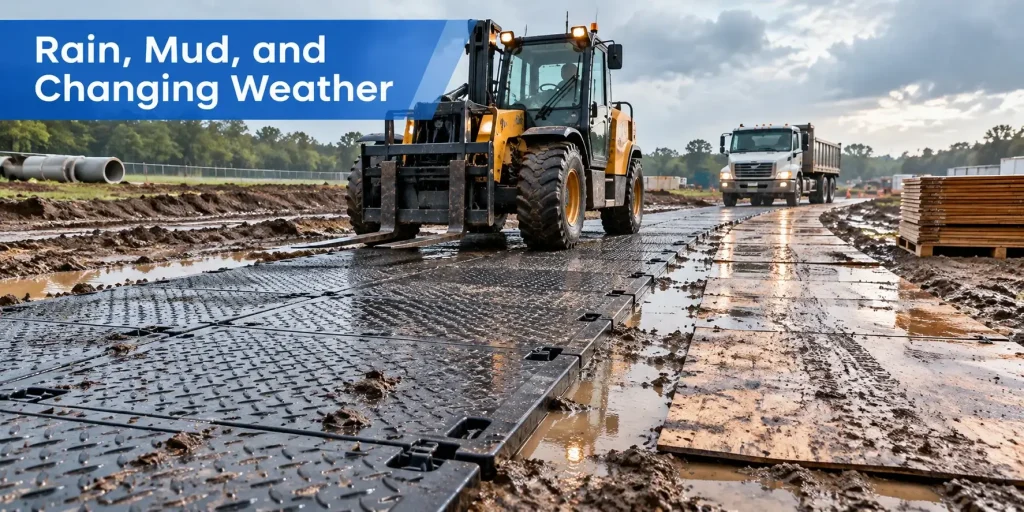
Rain can change more than the condition of a temporary access surface. It can also reduce the strength of the soil underneath, making it harder for vehicles to maintain a stable route. The key difference between HDPE ground protection mats and plywood is how each material responds to prolonged moisture exposure and changing ground conditions.
HDPE does not absorb water in the way wood-based panels do, while plywood performance depends on its adhesive bond, panel grade, edge protection, and exposure duration. However, water resistance alone does not guarantee reliable access over saturated soil.
How Does Prolonged Moisture Affect Each Material?
HDPE ground protection mats have low water absorption and do not contain bonded wood veneers. Exposure to rain therefore does not cause the same moisture-related swelling or veneer delamination associated with plywood. This makes HDPE a practical choice for outdoor projects where the access surface may remain wet between equipment movements.
Plywood requires a closer look at its construction. Interior-grade panels are unsuitable for prolonged outdoor moisture exposure, while exterior-grade plywood uses more moisture-resistant adhesive systems. Even with exterior-grade panels, repeated wetting and drying can affect the wood veneers, particularly at unsealed edges or damaged surfaces. When evaluating plywood for outdoor applications, check the panel grade and the adhesive exposure class rather than relying solely on the “for outdoor use” label. In the APA classification system, “Exposure 1” and “Exterior” denote different moisture exposure conditions, but neither classification alone can determine whether the panel is suitable for withstanding concentrated vehicle loads.
For example, a 12.7 mm HDPE mat and a 12 mm exterior-grade plywood panel should not be considered interchangeable simply because their thicknesses are similar. Their moisture behavior, mechanical properties, and condition after repeated exposure can differ substantially.
For temporary routes exposed to rain over multiple days, you should consider whether the surface must remain installed between shifts, how water will drain, and whether the material can be inspected and reused afterward.
What Happens When the Ground Becomes Saturated?
The more serious problem during heavy rain may be beneath the panels rather than within them. As soil becomes saturated, its resistance to deformation can decrease, particularly in soft clay, disturbed fill, or poorly drained ground.
Imagine a temporary construction route that is firm when installation begins. After sustained rainfall, the upper soil layer softens. A loaded vehicle passes over the same section repeatedly, and the panels begin to settle into the ground.
In this situation, neither HDPE mats nor plywood can restore the soil’s lost bearing capacity. Even an undamaged mat can sink, flex excessively, or become difficult to remove if the foundation underneath continues to deform.
For projects involving soft or waterlogged ground, the solution may require additional preparation, such as:
- Surface grading: Remove significant ruts and high spots to provide more continuous support beneath the panels.
- Drainage: Prevent water from collecting along the route or flowing beneath the mats.
- Geotextile separation: Where specified by the site design, help limit mixing between weak soil and an added aggregate layer.
- Aggregate reinforcement: Introduce an appropriately designed granular layer where existing soil cannot provide sufficient support.
These measures should be selected according to the site conditions and expected traffic loads. Increasing mat thickness without assessing the ground is not a reliable solution to saturated soil.
What Should You Check After Heavy Rain?
If your temporary access route remains in place during changing weather, inspect both the panels and the underlying conditions before reopening it to equipment.
| Inspection Area | What to Check After Rain | Why It Matters |
|---|---|---|
| Surface Drainage | Standing water and blocked drainage paths | Water accumulation may soften the supporting soil |
| Ground Settlement | New ruts, sinking sections, or uneven support | Local deformation can increase panel bending |
| Panel Condition | Cracks, excessive bending, swelling, or delamination where applicable | Damage may reduce the panel's suitability for further use |
| Edges and Joints | Gaps, raised edges, and soil washed out beneath connections | Uneven transitions can affect vehicle movement |
| Route Recovery | Whether soft areas require drainage, grading, or reinforcement | Prevents reopening a route before the supporting ground is suitable |
One practical detail during site inspections is to check the sections where vehicles stop, turn, or repeatedly follow the same wheel path. These locations deserve attention because loading is concentrated over a smaller area of the route, and existing ruts can retain rainwater.
The purchasing decision is therefore not simply which material survives rain better, but which complete access solution remains suitable after the ground becomes wet.
Rain and mud can also affect the surface beneath the route after it is removed. The next section examines how ground protection mats and plywood differ in their ability to limit ruts, ground disturbance, and surface contamination.
Ground Damage, Splinters, and Surface Contamination
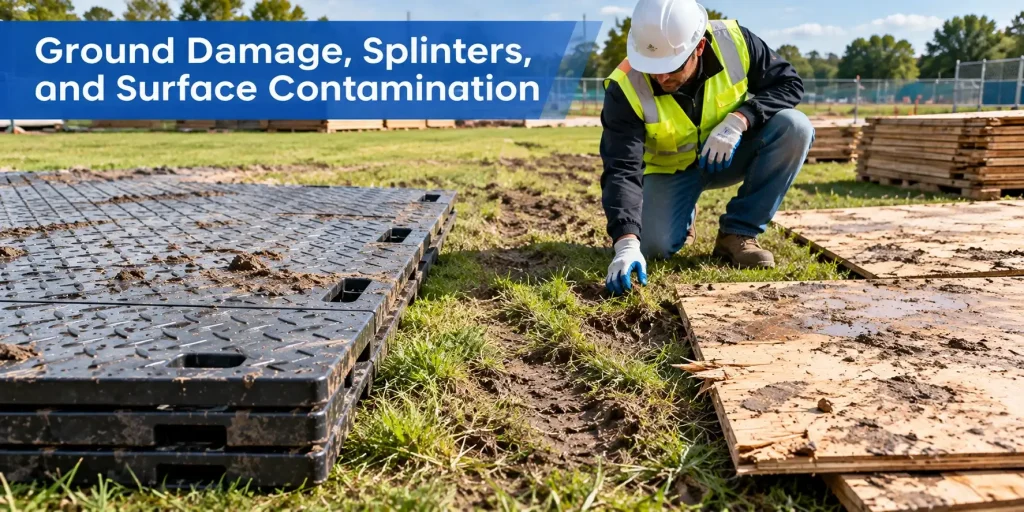
A temporary access route should do more than allow equipment to reach a work area. The condition of the ground after the panels are removed also matters, particularly on lawns, landscaped areas, finished surfaces, and sites where restoration costs are a concern.
Both HDPE ground protection mats and plywood provide a physical barrier between equipment and the ground. However, they differ in how they respond to repeated use, what happens when their surfaces deteriorate, and how much cleanup may be required after removal.
How Do the Two Materials Affect the Ground Beneath Them?
Neither material guarantees damage-free ground protection. Even when the surface remains covered, repeated vehicle movements can compress soil, disturb turf, or leave impressions where ground support is uneven.
HDPE mats provide a continuous protective surface without the wood veneers or exposed grain found in plywood. When properly supported and positioned, they help separate tires and tracks from the underlying ground. Plywood can provide similar separation, but damaged corners, broken edges, or displaced panels may leave sections of the surface exposed.
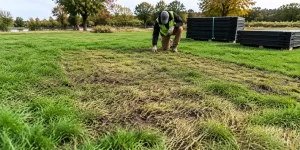
For projects involving lawns or landscaped areas, the duration of coverage deserves attention alongside vehicle weight. Grass covered for an extended period receives less light and may experience restricted air exchange. Under sufficiently prolonged or unfavorable conditions, turf can become discolored or damaged even if the mats remain intact.
If you need to preserve a finished landscape, consider the route layout, equipment movements, ground moisture, and how long the panels will remain in place. Where practical, removing or relocating the temporary surface between work phases may help limit prolonged coverage.
What Happens When Plywood Splinters or Breaks?
Plywood damage is not limited to reduced structural performance. Repeated handling, vehicle traffic, and damaged panel edges can leave wood splinters, loose veneer fragments, or exposed fasteners if mechanical fixings are used.
These materials can create additional hazards for workers and complicate cleanup, particularly on residential properties, event grounds, or landscaped areas where loose debris should not be left behind.
Solid HDPE mats do not contain wooden layers, so they cannot produce wood splinters or veneer fragments. However, HDPE is not immune to surface damage. Severe abrasion, cutting, or impact can create plastic shavings, gouges, or broken sections that also require inspection and removal.
This distinction becomes important when evaluating a panel for reuse. A surface may still appear serviceable from a distance, while damaged edges or loose material make it unsuitable for another deployment without further inspection.
What Should You Check Before Leaving the Site?
The final inspection should cover both the removed panels and the exposed ground. A clean-looking access route is not necessarily a fully restored surface.
| Inspection Area | What to Look For | Recommended Action |
|---|---|---|
| Soil and Turf | Ruts, compressed soil, flattened grass, or damaged roots | Assess whether leveling, aeration, or turf repair is needed |
| Panel Debris | Wood splinters, veneer fragments, plastic shavings, or broken pieces | Collect and dispose of debris according to site requirements |
| Surface Residue | Mud, sand, trapped vegetation, or material transferred from vehicles | Remove residue without damaging the underlying surface |
| Edges and Transitions | Disturbed soil, displaced gravel, or damage around the route boundary | Restore affected areas and check drainage paths |
| Panels for Reuse | Cracks, damaged edges, loose fragments, or contaminated surfaces | Clean, inspect, and separate damaged panels before storage |
For example, when temporary access panels are removed from a landscaped property, the edges of the route and the areas where equipment was parked deserve closer inspection. These locations can show concentrated surface disturbance even when the central travel path appears acceptable.
You should also distinguish between the types of contamination involved. Soil and vegetation trapped beneath a panel are different from oil, fuel, or hydraulic-fluid leakage. Neither HDPE mats nor plywood should be treated as a substitute for spill containment or environmental protection measures. Contaminated materials and affected soil may require separate handling.
If minimizing restoration work is part of your purchasing decision, compare not only the condition of the panels after use but also the amount of debris, cleaning, and ground repair required to return the site to an acceptable condition.
Once the route has been assessed for ground protection and cleanup, the next practical consideration is how efficiently the panels can be transported, positioned, connected, and removed.
Handling, Installation, and Route Connections
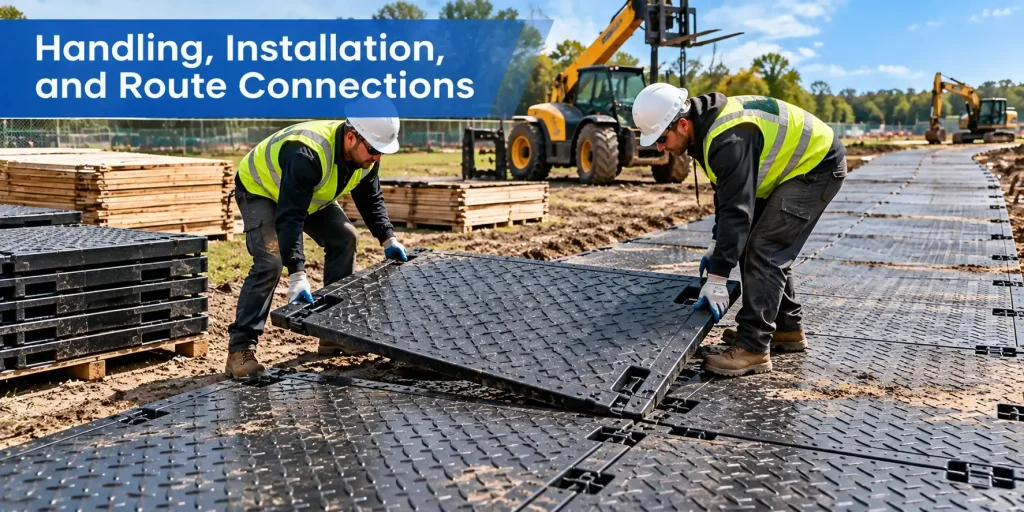
Once you have selected a suitable material, the next challenge is turning individual panels into a practical access route. Handling time, installation methods, and panel connections can influence how efficiently the route is built, adjusted, and removed.
Plywood offers flexibility in terms of on-site cutting and temporary coverage, while HDPE ground protection mats—designed specifically for ground protection—can be equipped with integrated handles and compatible connection systems. The specific choice between these options depends on your route layout, available labor, equipment access conditions, and whether the panels need to be moved between different projects. For routes with specific dimensions, handling requirements, or connection layouts, OEM ground protection mats can be customized to meet the anticipated application needs.
How Do Size and Weight Affect Handling?
Panel dimensions directly affect how many pieces you need and how easily workers can position them.
At 12.7 mm nominal thickness and an assumed HDPE density of 0.93–0.96 g/cm³, a completely solid rectangular panel would weigh approximately 35–36 kg. This is a calculated base-material estimate; the actual weight can differ depending on the panel profile, handhold openings, connector design, and whether the stated thickness refers to the base or overall profiled thickness.
This is a calculated material weight, not a measured product specification. Actual weight should be confirmed for the mat design being purchased.
Plywood sheets are available in comparable dimensions, but their weight varies with thickness, wood species, panel construction, and moisture content. A lighter panel may be easier to reposition, while larger or heavier sheets can still require two-person handling or mechanical assistance.
Some HDPE mat designs include four or six integrated handholds, allowing workers to grip the panel from different positions. This can make positioning and retrieval more convenient, but handles do not eliminate lifting risks.
Before ordering, confirm the individual panel weight, handle layout, packaging dimensions, and the equipment available for unloading. These details become especially important when a project requires hundreds of panels rather than a short access strip.
How Are Temporary Access Routes Connected?
An important installation difference is how individual panels are kept together along the route.
Plywood can be laid edge to edge or secured using an appropriate site-specific fixing method. It is also straightforward to cut when the route must fit around obstacles. However, loose sheets do not provide a built-in connection system, and site modifications may create additional labor or damaged edges.
HDPE ground protection mats can be supplied with two-way or four-way connectors, depending on the mat design and layout requirements.
- Two-way connectors join two adjacent mats, making them suitable for straight connections along a temporary access route.
- Four-way connectors can connect four mat corners at a shared junction, supporting wider layouts with multiple rows.
- Connector-hole arrangements should be checked before ordering because hole spacing and connector compatibility can differ between mat designs.
For a long, narrow access road, the number and position of connections matter more than simply choosing the largest available mat. A wider working platform may require a different arrangement, particularly where several rows meet or the layout changes direction.
Connection hardware should be included in the initial quotation and installation plan, rather than treated as an accessory to consider after the mats arrive.
How Much Installation Work Does the Route Require?
Consider a temporary access route measuring 100 m long and 4 m wide, with a total nominal area of 400 m².
Using 1220 × 2440 mm panels as an illustrative layout, you could place four mats across the route, with their 1220 mm sides aligned along its length. This provides a nominal width of 9.76 m, so it would not be an efficient arrangement for a 4 m road.
A more practical starting layout is to orient the 2440 mm side across the route and place two mats side by side, giving a nominal route width of 4.88 m. With each row extending 1.22 m along the road, approximately 82 rows, or 164 mats, would cover slightly more than 100 m in length.
This is a geometric planning example, not a final installation drawing. It excludes joint spacing, connector clearances, route transitions, irregular boundaries, and site-specific adjustments.
For procurement, the calculation illustrates why mat orientation and connection layout should be determined before finalizing quantities. Ordering from the required road area alone can lead to unnecessary cutting, excess coverage, or shortages at the installation stage.
What Makes Removal and Relocation Easier?
For short projects, cutting plywood to fit an irregular area may be convenient. Once the project is finished, however, damaged sheets may be harder to recover intact or prepare for another installation.
HDPE mats with integrated handles and removable connectors can be lifted, separated, cleaned, and stacked for relocation, provided they remain in suitable condition. Before storage, remove trapped soil from handle openings and connection points, and inspect the panels for excessive deformation or damage.
When comparing your options, consider the complete handling cycle: unloading, positioning, connecting, repositioning, removal, and return transport. A panel that is convenient to install but costly to recover may not provide the best value for repeated projects.
These operational differences also affect your budget. The next section looks beyond initial material prices to compare reuse, replacement, and total project cost.
Reuse, Lifespan, Waste, and Total Cost
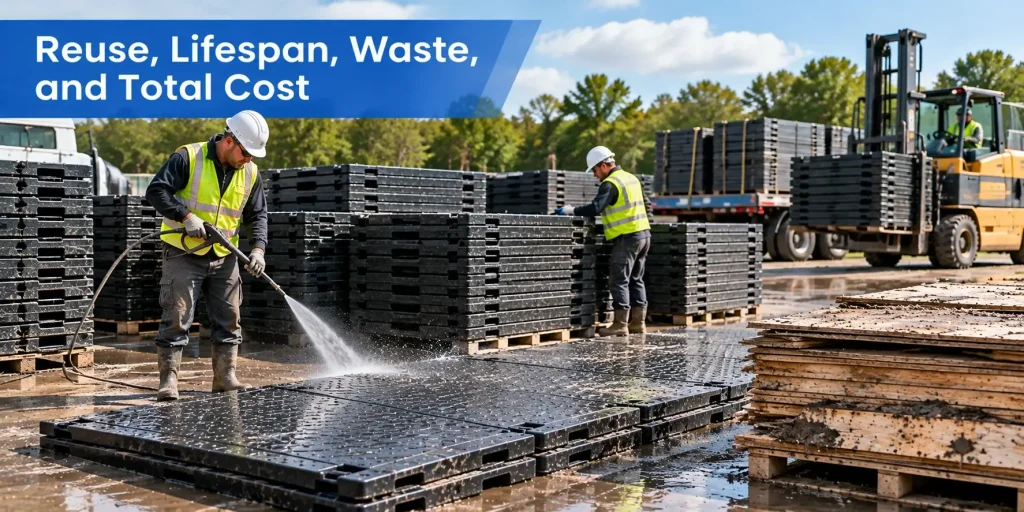
The difference between the purchase price of plywood and HDPE ground protection mats becomes more meaningful when you consider how many projects the materials will serve. A lower upfront price does not always mean a lower cost over multiple installations.
Plywood can be economical for a short-term project, while reusable HDPE mats may offer better value when the same panels are deployed across several sites. The decision depends on actual reuse, damage rates, transportation, storage, and the work required between projects.
How Many Times Can You Reuse Each Material?
HDPE ground protection mats are designed for repeated handling and outdoor deployment. Their solid plastic construction avoids moisture-related wood swelling and veneer separation, making them suitable for recovery and reuse when the panels remain within their operating limits.
However, there is no fixed number of uses that applies to every HDPE mat. Service life depends on material formulation, thickness, applied loads, surface abrasion, UV exposure, and handling damage. A panel that has experienced severe deformation or cracking should not be returned to service simply because it is made from HDPE.
Plywood can also be reused, particularly when you select a suitable grade and protect it from excessive damage. Its remaining serviceability depends on panel stiffness, edge condition, moisture exposure, and the integrity of its bonded layers.
When planning repeated projects, ask a more useful question than “How many years will this product last?”: How many complete deployments can you reasonably expect before replacement becomes necessary?
This is especially relevant if your company manages recurring construction projects, equipment rentals, or temporary event installations.
How Does Reuse Change the Total Cost?
To compare the two materials fairly, calculate the cost over a defined number of deployments rather than comparing only the purchase price.
Consider the following illustrative five-project scenario, using one panel position per deployment. The prices and costs are hypothetical assumptions for calculation, not supplier quotations or verified market averages.
| Cost Factor | HDPE Ground Protection Mat | Plywood |
|---|---|---|
| Initial Panel Price | $90 per mat | $25 per sheet |
| Deployments Evaluated | 5 | 5 |
| Panels Purchased | 1 mat, reused 5 times | 5 sheets, assuming replacement after each project |
| Material Cost | $90 | $125 |
| Additional Costs | $8 connector allowance + $30 total cleaning and storage | $15 total disposal allowance |
| Total Modeled Cost | $128 | $140 |
| Cost per Deployment | $25.60 | $28.00 |
In this example, the HDPE mat costs more at the beginning but has a lower calculated cost per deployment after five uses.
The result is highly dependent on the assumptions. If plywood remains serviceable for two or more projects, its purchasing cost decreases. If an HDPE mat is damaged early, lost between jobs, or requires expensive return freight, its cost advantage may disappear.
The example also excludes installation labor and transport costs that apply differently to each project. These figures are illustrative calculations, not market quotations. Actual project cost will vary with plywood grade, mat specification, purchase price, freight, cleaning, storage, replacement rate, and the number of deployments.
What About Waste and End-of-Life Disposal?
Repeated use can also reduce the number of panels that need to be purchased and discarded. If one HDPE mat remains serviceable across five projects, it can replace several single-use panels in that particular scenario.
However, reusability and recyclability are not the same thing.
HDPE is a thermoplastic material that can be mechanically recycled through appropriate processes. Actual recycling depends on local collection facilities, material composition, contamination, and whether a recycler accepts the product.
Plywood contains wood veneers bonded with adhesive. Disposal or recovery options depend on its coatings, treatments, contamination, and local waste-management requirements. Clean plywood may be suitable for certain reuse or recovery routes, while treated or contaminated panels may require separate handling.
You should also consider transportation and cleaning. Heavy reusable mats transported over long distances can create additional costs and environmental impacts, so fewer discarded panels do not automatically mean a lower overall environmental footprint.
When Does a Reusable Mat Become the Better Investment?
Before committing to a large order, estimate your expected deployment frequency and the condition in which the panels are likely to return.
A practical purchasing assessment should include the number of planned projects, anticipated replacement rate, connector costs, return transport, storage space, and end-of-life handling. If these figures are uncertain, calculate at least two scenarios: one with successful repeated use and another allowing for panel damage or early replacement.
For a single light-duty project with no plans to recover the surface, plywood may remain the less expensive choice. For recurring access routes where panels can be inspected, recovered, and redeployed, HDPE mats provide an opportunity to spread the initial investment across multiple projects.
The best value is determined by the cost of each usable deployment, not simply the lowest price per panel.
With load performance, installation, weather exposure, surface protection, and ownership costs now considered, the final step is to identify which material fits your particular project requirements.
When Plywood Works and When Purpose-Built Mats Are Safer
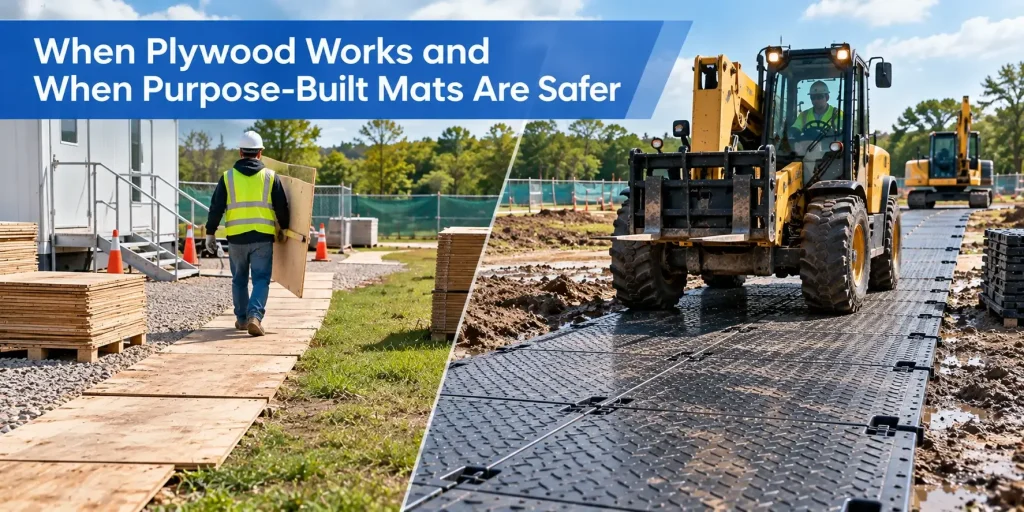
Plywood and HDPE ground protection mats both have a place in temporary ground access. The right choice depends on what will cross the surface, what lies underneath it, and how long the route must remain in service.
Plywood can be a cost-effective solution for limited, light-duty applications on firm ground. Purpose-built HDPE mats become more attractive when you need a connected access route, repeated deployment, improved resistance to moisture-related deterioration, or a surface designed for equipment movement.
When Is Plywood a Reasonable Choice?
Plywood deserves consideration when the project has clearly defined, limited loading requirements and the ground already provides adequate support.
For example, you may find plywood suitable for:
- Short-term pedestrian access or light-duty work areas: Provided the panel grade, thickness, surface condition, and support are appropriate.
- Small areas with irregular dimensions: Where cutting panels on-site is more practical than using full-size mats.
- Firm, level surfaces: Where there are no unsupported gaps or significant concentrated equipment loads.
- One-time projects with limited budgets: Particularly when recovering and storing reusable mats would add unnecessary expense.
The important distinction is that standard construction plywood should not be treated as a rated heavy-equipment access system. If vehicles or machinery will travel over the panels, the selected plywood and installation method must be verified for those loads.
When Should You Consider Purpose-Built HDPE Mats?
HDPE ground protection mats offer practical advantages when a temporary surface must function as a coordinated access system rather than a collection of individual sheets.
They deserve closer consideration in the following situations:
- Repeated vehicle or equipment traffic: When the mat design and loading specifications are suitable for the intended vehicles and ground conditions.
- Temporary roads and wider working platforms: When compatible connectors can help maintain the intended arrangement of adjacent panels.
- Outdoor projects with prolonged moisture exposure: When avoiding wood swelling and veneer delamination is important.
- Recurring projects: When panels can be recovered, inspected, stored, and deployed again.
- Sites requiring controlled installation and removal: When integrated handles, standardized dimensions, and removable connectors simplify project planning.
For example, if you are building a temporary route for an excavator or loaded truck, choosing between a 12.7 mm, 15 mm, or 20 mm HDPE mat requires more than knowing the vehicle’s total weight. You also need wheel or track loading information, ground conditions, turning requirements, and the intended traffic pattern.
A purpose-built mat may offer a better-controlled installation, but it is not automatically safe for every heavy vehicle or weak soil condition. Product load claims should be supported by applicable test information and checked against the actual installation conditions.
How Can You Make the Final Choice?
Before ordering, work through four questions:
- What will use the route? Identify pedestrians, wheeled vehicles, tracked equipment, or stationary machinery, including the relevant concentrated loads.
- What is the ground condition? Confirm whether the surface is firm, uneven, landscaped, saturated, or requires additional ground preparation.
- How long and how many times will it be used? Separate a single short project from an access system intended for repeated deployment.
- What does the complete solution cost? Include the panels, connectors, freight, installation, recovery, storage, replacement, and site restoration.
If your project involves light loads, firm ground, and a single short deployment, correctly specified plywood may meet your needs without the additional investment in dedicated mats.
If you need a repeatable, connected temporary access route for equipment, purpose-built HDPE ground protection mats are worth evaluating against your actual loading and site requirements. As for other construction applications, the choice of HDPE material and thickness depends on the load, operating conditions, and intended use.
The final decision should be based on verified suitability for the application—not the assumption that either material is always stronger, safer, or cheaper.
For a project-specific assessment, you can share your equipment type, maximum wheel or track load, ground conditions, required route dimensions, and expected duration. These details provide a practical starting point for selecting suitable mat specifications, estimating quantities, and determining whether additional ground preparation or engineering verification is needed.
FAQs
Is plywood safe for heavy equipment access?
Standard plywood is not automatically suitable for heavy equipment access. Its safety depends on panel grade, thickness, concentrated wheel or track loads, and the strength of the supporting ground. A plywood sheet may perform adequately over firm, level ground but bend or crack when a heavy wheel passes over an unsupported section.
For repeated truck or machinery traffic, purpose-built HDPE ground protection mats with verified load performance may offer a more suitable solution. However, neither material can compensate for inadequate ground bearing capacity, so loading and site conditions must be assessed before installation.
How many times can plywood be reused outdoors?
There is no fixed number of times plywood can be reused outdoors. Exterior-grade plywood may withstand several installations if it remains structurally sound, but repeated moisture exposure, handling damage, and vehicle loading can reduce its serviceability.
Before each reuse, check for delamination, cracked veneers, swollen edges, permanent bending, and damaged corners. A dry surface does not necessarily mean the internal layers remain intact. If you need panels for recurring outdoor projects, comparing their actual replacement frequency with reusable HDPE mats provides a more reliable cost assessment than relying on an estimated lifespan.
Do plastic ground mats become slippery when wet?
Yes, HDPE ground protection mats can become slippery when wet, particularly if mud, oil, algae, or other contaminants accumulate on the surface. However, mats with raised diamond or grid patterns can provide better tire traction than smooth plastic sheets under comparable conditions.
Surface texture alone cannot guarantee slip resistance. The type of tire, slope, braking forces, and surface contamination also influence traction. For temporary access roads exposed to rain, select a suitable textured mat, keep the surface clear of excessive debris, and inspect the route before allowing equipment to pass.
Which option causes less damage to grass?
Purpose-built HDPE ground protection mats can help reduce direct tire damage, rutting, and surface disturbance when properly installed over suitable ground. Their connected layout can also help maintain coverage along temporary access routes, reducing the risk of exposed sections caused by panel movement.
However, neither HDPE mats nor plywood can completely prevent grass damage. Vehicle weight, soil moisture, repeated passes, and the length of time the grass remains covered all affect the outcome. For sensitive lawns, limit coverage duration, avoid unnecessary turning, and inspect the ground after removing the panels.
Are ground protection mats more expensive than plywood?
The initial purchase price of a purpose-built ground protection mat can be higher than a plywood sheet, but the comparison changes when reuse, handling, replacement, freight, and site restoration are included.
However, the initial price does not reflect the full project cost. HDPE mats can be recovered and reused across multiple installations, while plywood may require earlier replacement due to moisture or mechanical damage. If you plan repeated projects, compare cost per deployment, including connectors, shipping, cleaning, storage, and replacement. For a single short-term application, plywood may remain the more economical option.
Which option is easier to move and install?
Plywood may be easier to cut and adjust on-site, particularly for small or irregular areas. However, large sheets can still require multiple workers, and loose panels may need additional securing.
HDPE ground protection mats can include integrated handles and two-way or four-way connectors, making them practical for assembling and relocating temporary access routes. A 1220 × 2440 × 12.7 mm solid HDPE panel has a theoretical weight of approximately 35–36 kg before handle cutouts and surface profiling. For larger projects, compare panel weight, unloading equipment, connector requirements, and installation labor rather than assuming either material is easier to handle.
Can plywood support tracked equipment?
Plywood can support some tracked equipment under appropriately designed conditions, but standard construction plywood should not be assumed suitable for heavy tracked machinery. Track loads depend on equipment weight, actual contact area, turning forces, and the strength of the ground beneath the panels.
Although tracks distribute weight over a larger contact area than some wheel configurations, turning movements can introduce significant surface stress and panel displacement. For repeated excavator or tracked machinery access, consider purpose-built mats with verified load performance. Confirm the equipment’s operating weight, track dimensions, and ground conditions before selecting a material.
Are composite mats a better alternative to both?
Heavy-duty composite access mats can be a better option for certain demanding applications, but they are not automatically superior to HDPE mats or plywood. Depending on their construction, composite mats may offer greater stiffness and load-spreading capability, making them suitable for selected heavy-equipment routes or soft-ground projects.
However, composite mats differ in reinforcement, thickness, weight, connection systems, and price. Some designs also require mechanical lifting equipment. If your project involves heavy concentrated loads or repeated industrial traffic, compare verified load performance, ground requirements, installation equipment, and total project cost before choosing a composite system.
Partner with a Professional Engineering Plastics Manufacturer
We provide stable and reliable engineering plastic sheets and custom processing solutions for your projects
Explore More Blogs
What Makes Removal and Relocation Easier?


Hey There, I'm Balance!
I am the Supply Chain Manager of YIQI Plastic. With 9 years of experience, including 4 years in engineering plastics, I specialize in material sourcing, quality control, and supply chain management.Feel free to contact us.